4.8/5 on Trustpilot

Most musicians spend months drilling scales, expecting improvisation to follow naturally. It doesn’t always work that way. Scales are the raw material of melody, but knowing them by heart and using them expressively are two very different skills. The gap between running a scale and actually improvising with it is where most players get stuck. This guide breaks down exactly how scales function in improvisation, how to match them to chords, and how to move beyond mechanical patterns into genuinely musical playing.
Key Takeaways
| Point | Details |
|---|---|
| Scales guide note choices | Using appropriate scales helps improvisers quickly find notes that fit the underlying harmony. |
| Chord-scale mapping is essential | Connecting each chord to its corresponding scale is the basis of successful improvisational playing. |
| Advanced scales expand creativity | Exploring scales beyond major and minor unlocks new sonic possibilities and expressive phrasing. |
| Practice builds fluency | Regular scale and improvisation practice, especially with play-alongs and ear training, strengthens improvisational skills. |
| Avoid mechanical solos | Musicians should go beyond mere scale runs by focusing on voice-leading and melodic flow for engaging improvisation. |
Why scales are the foundation of improvisation
Every melody you’ve ever heard is built from a scale. When you improvise, you’re making real-time decisions about which notes to play, and scales define the pool of notes available to you at any given moment. Without that framework, note choices feel random and disconnected from the harmony underneath.
Scales serve as the primary raw material for melodies in jazz improvisation, providing note choices that fit specific chords via chord-scale theory. This is the core idea behind why scales matter so much. They’re not just finger exercises. They’re a map.
Here’s what scales actually give you as an improviser:
- A defined note pool that fits the underlying harmony
- Safe notes you can land on confidently without clashing
- A starting point for building melodic phrases
- A shared language with other musicians in the room
But here’s the catch. Scales are necessary for improvisation, but they’re not sufficient on their own. A musician who only runs scales up and down will sound like they’re practicing, not performing. The goal is to internalize the scale so deeply that you stop thinking about it and start thinking about the music.
“Knowing a scale is like knowing the alphabet. You still have to learn how to write sentences.”
Understanding jazz improvisation basics means recognizing that scales are the starting point, not the destination. Once you accept that, everything else clicks into place.
Matching scales to chords: Chord-scale theory in action
Chord-scale theory is the system that connects specific scales to specific chords. It’s the backbone of modern jazz education and one of the most practical tools you can add to your practice routine.

The classic chord-scale pairings work like this: Dorian for the ii chord, Mixolydian for the V chord, and Ionian (the major scale) for the I chord. These three alone cover the most common progression in jazz, the ii-V-I. Schools like Berklee and the Aebersold method have built entire curricula around this framework.
Here’s a quick reference for the most common chord-scale pairings:
| Chord type | Scale to use | Example in C major |
|---|---|---|
| Major I | Ionian | C major scale |
| Minor ii | Dorian | D Dorian |
| Dominant V | Mixolydian | G Mixolydian |
| Minor seventh | Aeolian | A natural minor |
| Half-diminished | Locrian | B Locrian |
To build real fluency, follow these steps:
- Learn each scale in all 12 keys. Fluency means no hesitation, regardless of the key center.
- Identify the chord type first. Before you play a note, know whether you’re over a major, minor, or dominant chord.
- Map the scale to the chord. Use the table above as your starting reference.
- Practice with backing tracks. Play a ii-V-I in one key, then cycle through all 12.
- Sing the scale before you play it. Your ear needs to know the sound before your fingers do.
Pro Tip: Use play-along tracks from resources like Aebersold or iReal Pro to practice chord-scale connections in real musical contexts. Practicing scales in isolation is useful, but applying them over actual chord progressions is where the real learning happens.
For a deeper look at how this applies to the guitar specifically, check out these music theory tips and this guitar scales guide to build a strong foundation. You can also explore chord chart strategies to see how chords and scales connect visually.
Beyond major and minor: Advanced scale choices and creative strategies
Once you’re comfortable with Dorian, Mixolydian, and Ionian, it’s time to expand your palette. Advanced improvisers use a wider range of scales to add color, tension, and surprise to their solos.
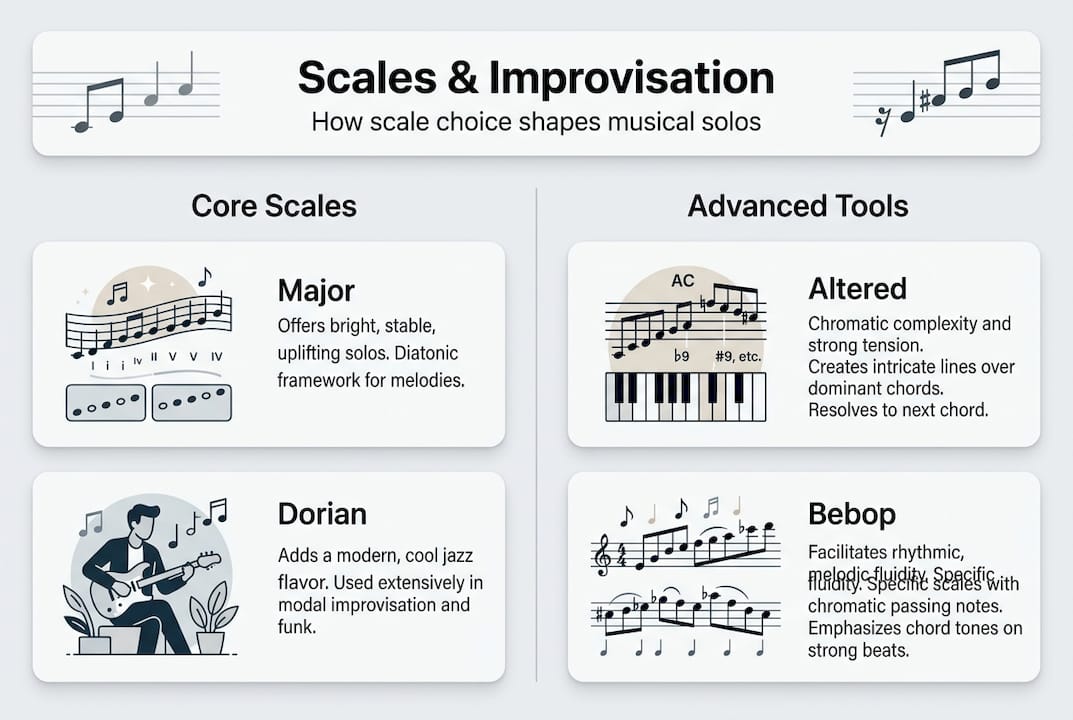
Bebop scales, melodic minor, and variable scales are key tools here. Bebop scales add a chromatic passing tone to standard scales, which keeps your eighth-note phrases landing on chord tones on the strong beats. Melodic minor and its modes offer up to five different options for a single altered dominant chord. Variable scales let you imply harmonic motion even when the chord isn’t changing.
Here’s a breakdown of advanced scale options and their uses:
| Scale | Best used over | Effect |
|---|---|---|
| Bebop dominant | Dominant V7 | Smooth eighth-note lines |
| Melodic minor | Minor I chords | Bright, slightly tense sound |
| Altered scale | Altered dominant V7 | Maximum tension before resolution |
| Whole-half diminished | Dominant chords | Symmetrical, angular phrases |
| Lydian dominant | Dominant with #11 | Floating, unresolved color |
Key strategies for using these scales creatively:
- Use the altered scale on V7 chords to build tension that resolves powerfully into the I chord.
- Switch scales mid-phrase to imply harmonic movement over a static chord.
- Combine bebop scales with arpeggios to keep lines rhythmically strong and harmonically clear.
- Experiment with the Lydian dominant for a more modern, floating sound over dominant chords.
Pro Tip: When you hit a V7 chord, try the melodic minor scale built a half-step above the root. So over G7, play Ab melodic minor. This gives you the altered scale automatically, with all the tension tones your ear craves before the resolution.
For a full breakdown of how these scales work on the fretboard, the guitar scales explained resource is a great next step.
Expert opinions: Navigating nuance and avoiding mechanical improvisation
Here’s the hard truth that most scale-focused practice routines miss. Playing the right scale over the right chord is only the beginning. The difference between a solo that sounds mechanical and one that sounds musical comes down to how you use those notes.
Experts consistently point to voice-leading and horizontal harmony as the keys to moving beyond scale runs. Voice-leading means connecting notes smoothly from one chord to the next, prioritizing melodic logic over harmonic correctness. Horizontal thinking means you’re hearing the melody as a continuous line, not as a series of separate scale choices for each chord.
The traditional chord-scale approach can actually work against you if you apply it too rigidly. When improvisers think vertically, switching scales chord by chord, solos can sound choppy and academic. The more musical approach is to think horizontally, letting melodic lines flow across bar lines and chord changes.
Here’s what expert-level improvisers focus on:
- Voice-leading: Move to the nearest available note when changing chords, not the nearest scale tone.
- Guide tones: Target the 3rd and 7th of each chord. These notes define the harmony most clearly.
- Outside playing: Use altered or whole-half diminished scales on the V chord for tension, then resolve cleanly to inside scales on the I.
- Phrase shape: Think about where your phrase starts, peaks, and lands. A good phrase has a shape, not just correct notes.
- Space: Silence is part of the melody. Leaving space makes your phrases more powerful.
“Voice-leading and horizontal thinking move solos from routine to art.”
The goal is to make the scale invisible. When your improvisation is working, listeners don’t hear scales. They hear melody, emotion, and intention.
Practical guide: Internalizing scales for creative improvisation
Knowing the theory is one thing. Building it into your playing is another. Here’s a step-by-step process for turning scale knowledge into genuine improvisational fluency.
Scales must be internalized and combined with phrasing, patterns, and ear training for effective improvisation. Play-along resources like Aebersold are specifically designed to build this kind of fluency in real musical contexts.
Follow this practice sequence:
- Pattern practice. Don’t just run scales up and down. Practice them in thirds, fourths, and sequences. This builds muscle memory and melodic variety.
- Transcribe solos. Pick a solo you love and learn it note for note. Identify which scales are being used and how the phrases are shaped.
- Ear training. Sing scale tones over chord progressions before you play them. Your ear should lead your fingers, not the other way around.
- Real-time improvisation. Set a timer for five minutes and improvise over a backing track without stopping. Don’t edit yourself. Just play.
- Review and analyze. Record every session. Listen back and identify where you defaulted to scale runs versus where you played actual melodic phrases.
Beyond scales, integrating arpeggios, guide tones, and chromatic approaches is what separates intermediate players from advanced ones. Arpeggios outline the chord directly. Guide tones anchor your phrases harmonically. Chromatic notes add color and surprise.
Pro Tip: Record your improv sessions and listen back specifically for scale-based patterns. When you hear yourself running a scale, ask: could this have been a phrase instead? That question alone will accelerate your development faster than any exercise.
For more structured guidance on building these habits, the music theory learning tips on our blog are a solid resource to bookmark.
Tools and resources to boost your improvisation skills
You’ve got the framework. Now it’s about building the habits and having the right tools to support your practice. Cheat sheets, visual diagrams, and structured guides can cut your learning time significantly when you’re trying to internalize chord-scale relationships and advanced scale options.

At Musiciangoods, we’ve built a library of resources specifically for musicians who want to learn faster and practice smarter. From visual scale maps to music theory books designed for real-world application, everything is created by musicians who’ve been through the same learning curve you’re on. Whether you’re working through your first ii-V-I or exploring altered dominants, our music learning tips and downloadable tools give you a clear path forward. The goal is the same as yours: less mechanical practice, more musical expression.
Frequently asked questions
How do I choose the right scale for improvising over a chord?
Identify the chord type first, then apply chord-scale theory to select the match: Dorian for minor ii, Mixolydian for dominant V, and Ionian for major I chords.
Can practicing scales alone improve my improvisation?
Scales are foundational but must be combined with ear training, phrasing, and real-time experimentation to develop genuine improvisational skill.
What are some advanced scales to use for jazz improvisation?
Melodic minor, altered dominant, bebop scales, and whole-half diminished are the most common advanced choices for modern jazz improvisers.
How can I avoid sounding mechanical when improvising with scales?
Focus on voice-leading and horizontal harmony rather than switching scales chord by chord, and integrate arpeggios and guide tones to keep your lines melodic.