 4.8/5 on Trustpilot

Learning piano chords as a beginner can feel overwhelming when you face a keyboard full of keys and countless chord combinations. Many new players struggle to know where to start, which chords matter most, and how to practice effectively without feeling lost. This guide cuts through the confusion by teaching you the foundational major, minor, and seventh chords that form the backbone of most music. You’ll discover visual methods, step-by-step practice routines, and actionable tips that transform chord learning from frustrating to achievable, helping you build confidence and musicality from your very first practice session.
Table of Contents
- Essential Piano Chords Every Beginner Should Learn
- How To Practice Piano Chords Effectively As A Beginner
- Understanding Chord Progressions And Their Role In Musicality
- Explore Music Theory Tools And Resources
- FAQ
Key takeaways
| Point | Details |
|---|---|
| Start with foundational chords | Major, minor, and seventh chords provide the building blocks for most songs and musical styles |
| Practice progressions consistently | Common patterns like I-IV-V-I create musical flow and help you understand how chords work together |
| Slow, focused practice wins | Consistent 15-30 minute sessions with attention to finger placement beat rushed, long practice marathons |
| Visual aids accelerate learning | Chord charts and keyboard diagrams reduce memorization effort and speed up recognition |
| Theory supports creativity | Understanding chord construction and relationships enables improvisation and musical expression |
Essential piano chords every beginner should learn
Mastering basic chord types gives you immediate access to thousands of songs and builds the foundation for advanced techniques. Beginners should start with major, minor, and seventh chords as the building blocks of most music, providing a solid framework for musical growth.
Major chords create bright, happy sounds and consist of three notes: the root, major third, and perfect fifth. For C major, you play C-E-G simultaneously. Minor chords sound darker or sadder, using the root, minor third, and perfect fifth. C minor uses C-Eb-G. Seventh chords add complexity and jazz flavor by including a fourth note. C7 combines C-E-G-Bb, creating tension that resolves beautifully to other chords.
Visual keyboard diagrams transform abstract theory into concrete finger positions. When learning C major, place your thumb on middle C, middle finger on E, and pinky on G. This 1-3-5 finger pattern works for most basic triads and helps your hands remember positions through muscle memory. For minor chords, simply lower the middle note by one half step, keeping the same finger shape.
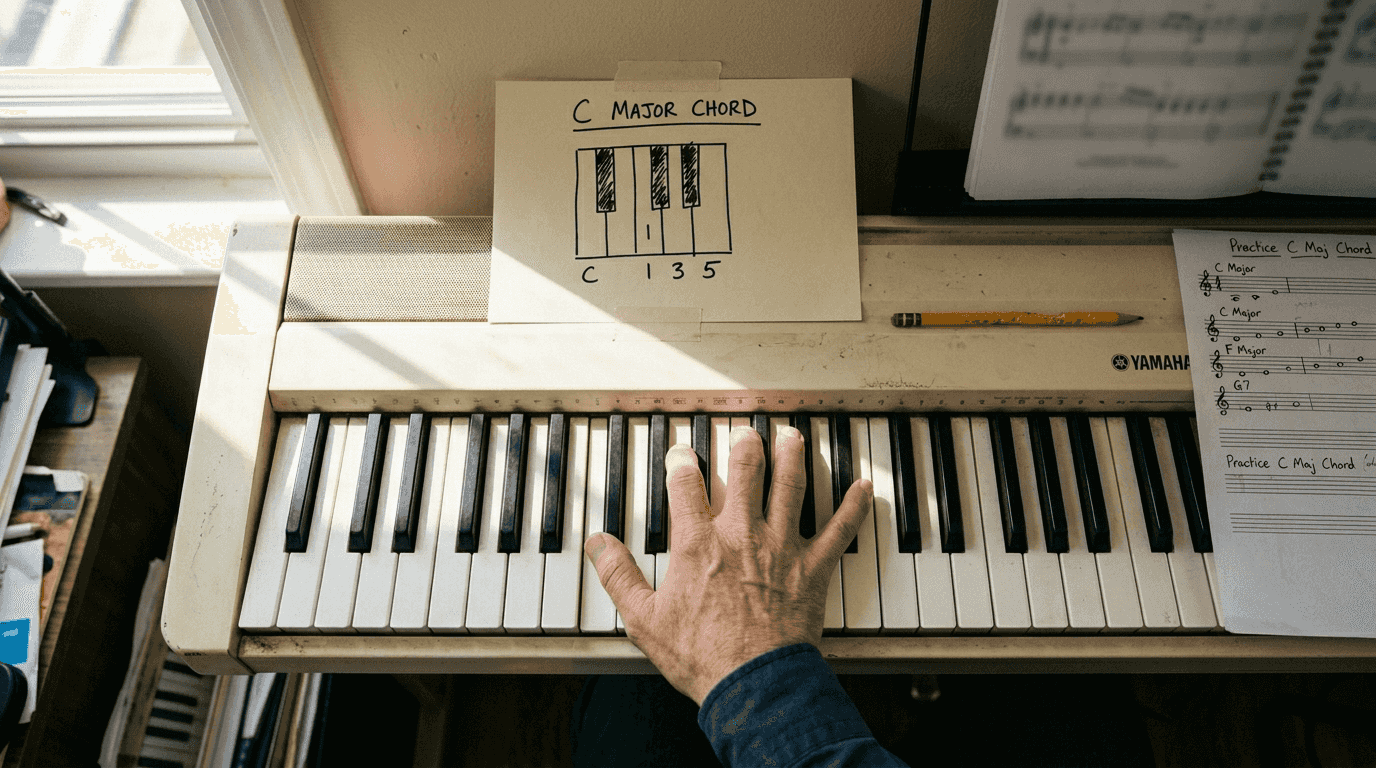
Chord inversions let you play the same chord with notes in different orders, making transitions between chords smoother and less jumpy. Instead of always playing C-E-G, you can play E-G-C or G-C-E. These inversions reduce hand movement and create more flowing, professional-sounding progressions. Start by learning root position first, then gradually explore inversions as your comfort grows.
Pro Tip: Practice each chord slowly, holding it for four full counts while listening carefully to ensure all notes sound clearly and simultaneously. This builds accuracy before speed.
Common beginner mistakes include rushing between chords before fingers are positioned correctly, resulting in sloppy transitions and wrong notes. Poor finger placement, like using awkward fingerings or hovering fingers too far above keys, creates unnecessary tension and slows progress. Take time to establish proper hand position from day one.
Here’s a quick reference for essential beginner chords:
| Chord Type | Example | Notes | Sound Character |
|---|---|---|---|
| Major | C major | C-E-G | Bright, happy, stable |
| Minor | A minor | A-C-E | Dark, sad, introspective |
| Seventh | G7 | G-B-D-F | Jazzy, tense, resolving |
| Major | F major | F-A-C | Warm, full, grounded |
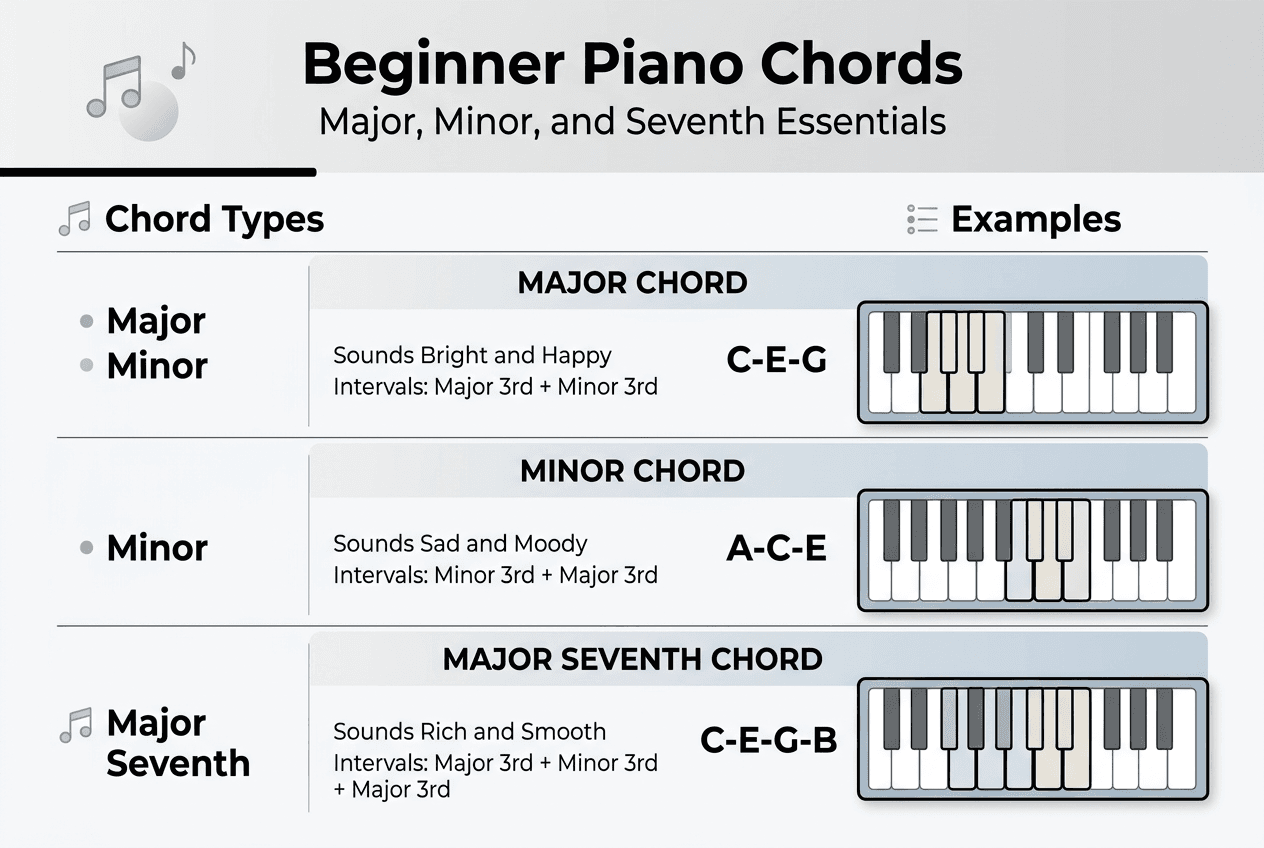
Use a free piano chords chart as a visual reference during practice, keeping it near your keyboard for quick lookups. This external reference reduces frustration and keeps practice sessions moving forward productively.
How to practice piano chords effectively as a beginner
Effective practice strategies accelerate learning far more than simply spending hours at the keyboard without structure or focus. Consistent practice matters more than speed when building chord proficiency, making deliberate, quality sessions your priority.
Follow this daily practice routine for steady progress:
- Warm up for 3 minutes with simple finger exercises and scales to prepare your hands
- Practice individual chords for 10 minutes, playing each chord type slowly and cleanly
- Work on chord transitions for 8 minutes, moving between two chords repeatedly until smooth
- Play simple progressions for 7 minutes, combining multiple chords into musical sequences
- Cool down for 2 minutes by playing chords you already know confidently
A metronome transforms your practice by enforcing consistent tempo and revealing timing problems you might not notice otherwise. Start at a comfortable slow speed like 60 beats per minute, playing one chord per beat. As accuracy improves, gradually increase tempo by 5 BPM increments. This systematic approach builds both accuracy and speed simultaneously, preventing the common mistake of playing fast but sloppy.
Hand coordination develops through alternating practice between right hand, left hand, and both hands together. Spend equal time on each hand individually before combining them. Your non-dominant hand typically needs extra attention, so don’t neglect isolated left hand practice if you’re right-handed. This balanced approach prevents one hand from becoming significantly weaker than the other.
Pro Tip: Record yourself playing chords and progressions, then listen back critically to identify timing inconsistencies, wrong notes, or uneven volume between fingers. Your ears catch mistakes your hands might miss in the moment.
Practice in tiny chunks at a slow tempo, then space and mix what you practice so it sticks. This scientifically-backed method beats marathon sessions that lead to fatigue and diminishing returns. Quality trumps quantity every time.
Safety reminder: Stop immediately if you feel pain, tingling, or excessive tension in your hands, wrists, or forearms. Proper technique should feel comfortable and sustainable. Adjust your posture, take breaks, and never push through discomfort that could lead to injury.
Consistent 15 to 30 minute sessions, five days per week, produce better results than occasional long practice marathons. Your brain consolidates learning during rest periods between sessions, making regular short practices more effective for long-term retention. Use a piano chords chart during practice to reinforce visual learning and reduce memorization pressure.
Understanding chord progressions and their role in musicality
Chord progressions create the harmonic foundation that supports melodies and gives songs their emotional character and forward motion. Learning common progressions helps you understand how music works and enables you to play countless songs quickly.
The I-IV-V-I progression represents the most fundamental pattern in Western music, appearing in folk songs, hymns, classical pieces, and pop hits. In the key of C, this progression uses C-F-G-C chords, creating a satisfying journey from home base, through tension, and back to resolution. This pattern feels complete and stable, which explains its universal popularity across genres and centuries.
The ii-V-I progression dominates jazz and sophisticated pop music, creating smooth, professional-sounding harmonic movement. In C major, this uses Dm-G7-C, with the minor ii chord adding color before the dominant seventh creates tension that resolves beautifully to the tonic. This three-chord sequence forms the backbone of jazz standards and appears in thousands of songs.
Progressions support melodies by providing harmonic context and emotional direction. A melody note gains different meanings depending on the underlying chord. The note E sounds stable over C major, tense over F major, and resolved over Am. Understanding this relationship helps you choose chords that enhance your melodies rather than clash with them.
Here’s a comparison of common progressions:
| Progression | Example in C | Typical Genre | Emotional Quality |
|---|---|---|---|
| I-IV-V-I | C-F-G-C | Folk, rock, hymns | Stable, complete, satisfying |
| ii-V-I | Dm-G7-C | Jazz, sophisticated pop | Smooth, professional, resolved |
| I-V-vi-IV | C-G-Am-F | Modern pop, rock | Emotional, contemporary, catchy |
| I-vi-IV-V | C-Am-F-G | Doo-wop, oldies | Nostalgic, classic, circular |
The circle of fifths provides a visual map showing relationships between keys and helping you understand why certain progressions work. Moving clockwise by fifths (C to G to D) creates strong, natural-sounding progressions. This tool becomes invaluable when transposing songs to different keys or understanding key signatures.
Practice progressions effectively with these tips:
- Start with I-IV-V-I in C major until transitions feel smooth and automatic
- Practice progressions in various keys to enhance musical skills and prevent key-specific limitations
- Use a metronome to maintain steady timing while changing chords
- Play each chord for four beats initially, then experiment with different rhythmic patterns
- Listen to songs using these progressions to hear them in musical context
- Combine progressions with simple right-hand melodies once comfortable
Transposing progressions to different keys challenges your understanding and builds flexibility. If you can play I-IV-V-I in C, try it in G (G-C-D-G) or F (F-Bb-C-F). This practice reveals patterns that work across all keys and prepares you for playing with other musicians who might prefer different keys.
Explore music theory tools and resources
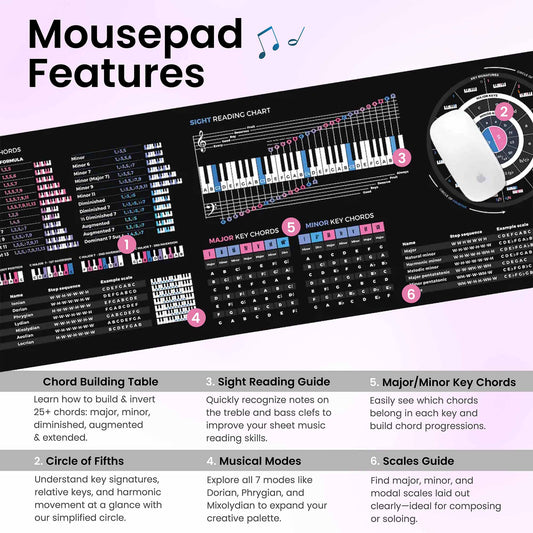
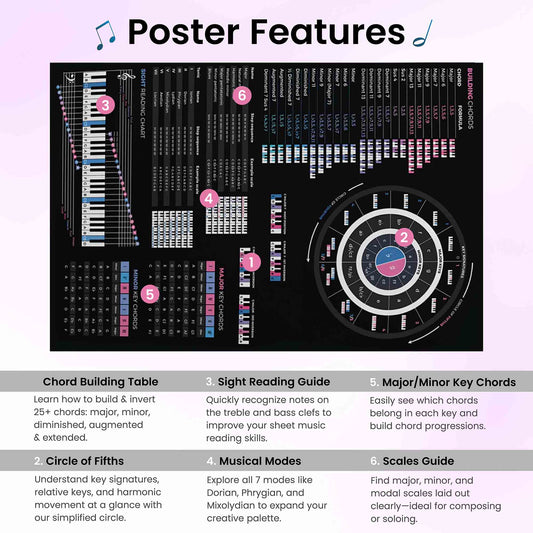
Taking your piano chord knowledge further requires the right educational tools and visual resources designed specifically for developing musicians. Musiciangoods offers comprehensive music theory tools and cheat sheets created by musicians for musicians, helping you learn faster through accessible, visually-rich content.

You’ll find downloadable chord charts, detailed cheat sheets, and beginner-friendly guides that simplify complex theory into practical, actionable steps. These tools complement your practice sessions by providing quick reference materials that reduce memorization burden and keep you focused on playing rather than searching for information. Carefully selected books and accessories deepen your understanding of music theory fundamentals, chord construction, and harmonic relationships. Whether you need visual keyboard diagrams, progression templates, or comprehensive theory guides, these resources support your journey from beginner to confident player with tools designed for real-world musical growth.
FAQ
Which basic chords should beginners learn first?
Major, minor, and seventh chords form the foundation for most beginner practice and songs across all genres. Starting with these three chord types develops harmony understanding effectively while giving you immediate access to thousands of popular songs. Focus on C major, A minor, and G7 as your first three chords, then expand to F major, D minor, and other common keys. This approach builds confidence quickly through recognizable sounds and practical application.
How long should I practice piano chords daily?
Fifteen to thirty minutes most days with focused practice yields steady progress for beginners without causing fatigue or burnout. Consistency beats long but irregular sessions every time. Five days per week allows adequate practice frequency while providing rest days for physical recovery and mental consolidation. Quality matters far more than quantity, so maintain full concentration during shorter sessions rather than mindlessly playing for hours.
What are common mistakes when learning piano chords?
Rushing transitions, poor finger placement, and neglecting proper posture lead to slow progress and physical discomfort that can derail your learning. Avoid racing through chord changes before your fingers are correctly positioned, which creates sloppy playing habits that become harder to fix later. Focus on correct finger placement and relaxed posture to prevent injury and tension. Use a metronome to develop steady rhythm and resist the temptation to speed up before you’re ready.
How do chord inversions help beginners?
Chord inversions reduce hand movement between chords and create smoother, more professional-sounding progressions that flow naturally. Instead of jumping your hand up and down the keyboard, inversions let you keep your hand in one general area while changing chords. This technique becomes essential for playing songs fluently and develops your understanding of how the same chord can serve different musical functions. Start learning inversions after you’re comfortable with root position chords.
Why should I learn chord progressions instead of just individual chords?
Chord progressions teach you how chords function together musically, creating context and meaning that isolated chords cannot provide. Learning progressions like I-IV-V-I helps you understand harmonic movement, tension, and resolution, which are fundamental to all Western music. This knowledge accelerates your ability to learn new songs by ear, improvise accompaniments, and compose your own music. Progressions also make practice more musical and enjoyable than drilling individual chords in isolation.








 Gitarrenakkorde Diagramm Mousepad
 Bassgitarren-Theorie-Spickzettel Mousepad
 Musiktheorie-Spickzettel Mousepad
 Ukulele Theorie Spickzettel Mousepad
 Gitarrentheorie-Spickzettel Mousepad


