 4.8/5 on Trustpilot

Modes remain one of the most misunderstood concepts in music theory, often dismissed as overly complex or reserved for jazz players and advanced theorists. Yet these seven scale patterns hold the key to unlocking new creative possibilities, transforming how you compose, improvise, and understand the emotional language of music. Whether you’re a beginner exploring your first scales or an experienced musician seeking fresh inspiration, grasping the role of modes will fundamentally expand your musical vocabulary and deepen your connection to the sounds you create.
Key Takeaways
| Point | Details |
|---|---|
| Mode basics | Modes are scales derived from a parent scale, each starting on a different degree with a unique interval pattern. |
| Mode moods | Each mode creates a unique tonal personality that shapes the character of a piece. |
| Easy entry point | Dorian offers a practical first mode beyond major and minor for beginners and is common in popular music. |
| Famous modal uses | Dorian appears in Carlos Santana and Miles Davis, Lydian in Joe Satriani and the Simpsons theme, Phrygian in flamenco contexts, and Mixolydian in bluesy rock. |
Understanding modes: what they are and why they matter
Modes are scales derived from a parent scale, each starting on a different degree with a unique pattern. Think of them as seven different perspectives on the same set of notes, each revealing a distinct tonal personality. While the C major scale contains the notes C, D, E, F, G, A, B, starting on D with those same notes creates the Dorian mode, which sounds completely different despite using identical pitches.
The concept originated in ancient Greek music theory, where modes organized pitch relationships and cultural associations. Western music evolved these ideas, eventually standardizing the seven modes we use today. Unlike the major and minor scales that dominate contemporary music, modes offer subtler emotional gradations and tonal colors that can make your playing stand out.
The seven common modes are:
- Ionian (the major scale itself)
- Dorian (minor with a raised sixth)
- Phrygian (minor with a flat second)
- Lydian (major with a raised fourth)
- Mixolydian (major with a flat seventh)
- Aeolian (the natural minor scale)
- Locrian (diminished, rarely used in full compositions)
Each mode creates specific moods and styles. Dorian sounds jazzy and sophisticated, perfect for funk and fusion. Phrygian evokes Spanish flamenco or Middle Eastern music with its exotic, dark quality. Lydian feels dreamy and floating, often heard in film scores. Mixolydian brings a bluesy, rock-oriented vibe that countless guitarists exploit.
Pro Tip: Start by learning just one mode beyond major and minor. Dorian works beautifully over minor chords and appears frequently in popular music, making it an accessible entry point for modal exploration.
Understanding modes transforms how you hear music. Instead of thinking only in major or minor, you recognize the subtle shadings that give songs their distinctive character. This awareness directly impacts your ability to recreate sounds you admire and develop your original voice.
Exploring the characteristics of each mode: scale patterns and emotional impact
Each mode differs in intervals that define its unique sound and emotional quality. The specific arrangement of whole steps and half steps creates the sonic fingerprint that makes Lydian sound bright while Phrygian sounds dark.
| Mode | Interval Pattern | Characteristic Sound | Typical Use |
|---|---|---|---|
| Ionian | W-W-H-W-W-W-H | Bright, happy, stable | Pop, classical, folk |
| Dorian | W-H-W-W-W-H-W | Jazzy, sophisticated, minor but hopeful | Jazz, funk, blues |
| Phrygian | H-W-W-W-H-W-W | Exotic, dark, Spanish flavor | Flamenco, metal, ethnic music |
| Lydian | W-W-W-H-W-W-H | Dreamy, floating, ethereal | Film scores, progressive rock |
| Mixolydian | W-W-H-W-W-H-W | Bluesy, rock-oriented, dominant sound | Rock, blues, Celtic music |
| Aeolian | W-H-W-W-H-W-W | Sad, natural minor, emotional | Classical, pop ballads |
| Locrian | H-W-W-H-W-W-W | Unstable, diminished, tense | Rarely used for full songs |
Dorian mode features a minor third but a major sixth, creating a sound that feels minor yet optimistic. This combination makes it ideal for grooves and vamps. Carlos Santana built much of his signature sound around Dorian, and Miles Davis’s “So What” showcases pure Dorian harmony.

Phrygian’s flat second interval immediately signals its exotic character. The half step between the root and second degree creates tension that resolves downward, a movement central to flamenco music. Metallica and other metal bands exploit Phrygian’s dark intensity for heavy riffs.
Lydian stands out with its raised fourth, creating an augmented fourth interval from the root. This avoids the traditional perfect fourth, giving Lydian an open, spacious quality. Joe Satriani’s “Flying in a Blue Dream” and the main theme from “The Simpsons” both feature Lydian prominently.
Mixolydian functions as a major scale with a flat seventh, making it perfect for dominant seventh chords. This mode dominates rock and blues because it allows major-sounding melodies over dominant chords. The Grateful Dead, Lynyrd Skynyrd, and countless jam bands built entire catalogs around Mixolydian grooves.
Pro Tip: Build simple chord progressions using chords native to each mode, then improvise melodies emphasizing the mode’s characteristic intervals. For Dorian, stress the major sixth. For Lydian, highlight the raised fourth. This approach trains your ear faster than scale exercises alone.
Recognizing these patterns helps you identify modes in songs you hear and intentionally deploy them in your own music. The emotional associations aren’t rigid rules but general tendencies that centuries of music education strategies have reinforced across cultures.
Modes versus traditional scales: similarities, differences, and practical applications
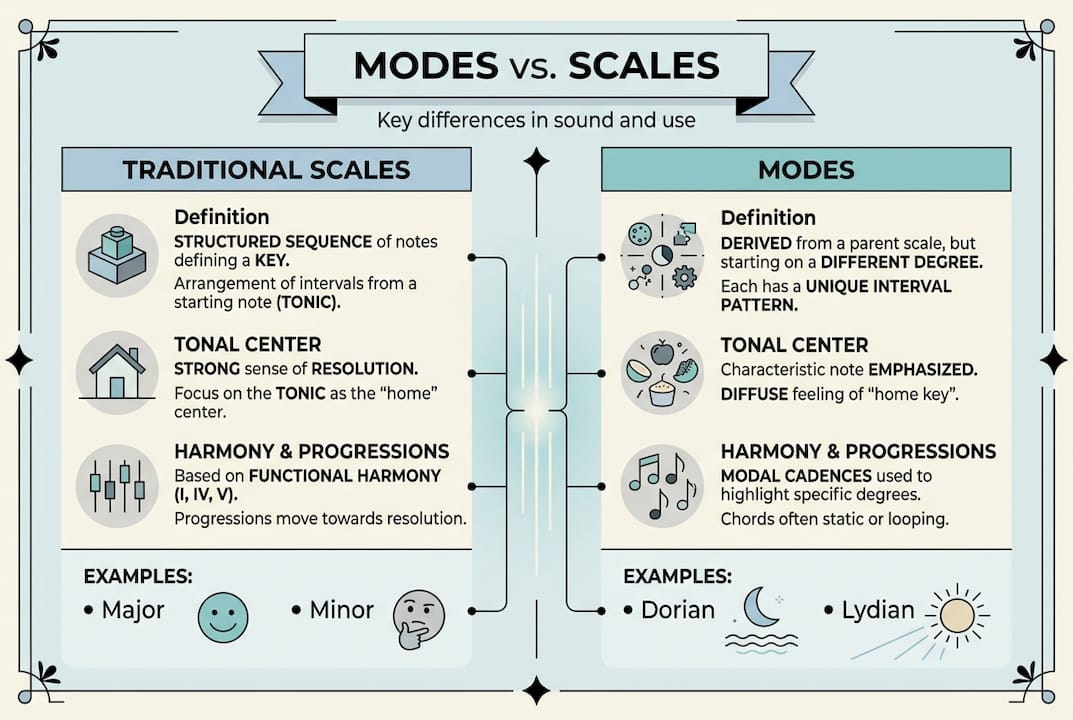
Modes offer tonal alternatives beyond standard major and minor scales for creative expression. While major and minor scales form the foundation of Western music, modes provide seven distinct flavors that expand your harmonic palette without requiring you to learn entirely new note sets.
| Aspect | Major/Minor Scales | Modal Scales |
|---|---|---|
| Number of variations | Two primary (major, natural minor) | Seven modes with unique characters |
| Tonal center | Strong, predictable resolution | Can be ambiguous, floating |
| Harmonic function | Clear tonic-dominant relationships | Often avoids functional harmony |
| Emotional range | Happy or sad dichotomy | Subtle gradations of mood |
| Common usage | Most popular and classical music | Jazz, folk, ethnic, progressive styles |
The fundamental similarity is that modes and traditional scales organize the same twelve chromatic pitches into usable patterns. The C major scale and C Dorian both provide seven notes, but the specific intervals create vastly different sounds. This means transitioning between modal thinking and traditional scale thinking requires minimal technical adjustment but significant conceptual shift.
Practical scenarios for choosing modes over standard scales:
- Creating modal jazz compositions where you want to avoid traditional chord progressions and explore static harmony over a single chord for extended periods
- Writing folk-influenced music that needs an ancient or ethnic quality, particularly using Dorian or Mixolydian modes common in Celtic and Appalachian traditions
- Adding color to guitar solos by switching modes over different chords in a progression rather than staying in one key throughout
- Composing film scores or ambient music where you need specific emotional atmospheres that major and minor scales cannot adequately convey
- Developing improvisational vocabulary in rock and fusion styles where modal playing creates more interesting lines than pentatonic patterns alone
Modes enrich chord progressions through modal interchange, borrowing chords from parallel modes. A song in C major might borrow the flat-VII chord (Bb major) from C Mixolydian, adding unexpected color. The Beatles, Radiohead, and countless progressive rock bands built signature sounds around this technique.
For improvisation, modes let you target specific chord tones and extensions. Over a Dm7 chord, Dorian mode naturally emphasizes the major sixth (B natural), while Aeolian would use the minor sixth (Bb). This single note difference dramatically affects the solo’s character. Jazz musicians think modally to navigate complex changes, treating each chord as its own temporary tonal center rather than relating everything back to a single key.
The shift from scale-based to modal thinking represents a maturation in musical understanding. You stop asking “What key is this in?” and start asking “What mode best expresses the feeling I want?” This question-reframing unlocks creative possibilities that remain hidden when you limit yourself to major and minor.
Applying modes in music: composition, improvisation, and ear training
Ear training and composition exercises focusing on modes improve recognition and versatility. Moving from theoretical knowledge to practical application requires deliberate practice strategies that engage your ears, fingers, and creative instincts simultaneously.
Specific composition exercises with modes:
- Create modal pedal points by sustaining a bass note while harmonizing with chords built from that mode, establishing the tonal center clearly
- Write chord progressions that avoid the tonic chord entirely, using modes to create harmonic interest without traditional resolution
- Compose melodies that emphasize each mode’s characteristic intervals, making the mode’s identity obvious to listeners
- Experiment with modal mixture by shifting between parallel modes within a single composition, creating dramatic contrast
- Build entire pieces around a single mode, forcing yourself to explore its full expressive range rather than defaulting to familiar patterns
For improvisation, focus on modal target notes and characteristic intervals. In Lydian, consistently land on or pass through the raised fourth. In Phrygian, emphasize the flat second. These defining tones signal the mode’s identity to listeners. Start by improvising over simple modal vamps, one-chord grooves that remove harmonic complexity and let you concentrate purely on melodic choices.
Develop your improvisational fluency by practicing modal patterns in all twelve keys. Many musicians learn modes only in C, limiting their practical application. Transpose each mode to every key, drilling the fingerings until they become automatic. This investment pays massive dividends when you encounter modal harmony in real musical situations.
Ear training methods to identify modes by sound and mood:
- Listen to songs known for specific modes and sing the characteristic intervals until you internalize their sound
- Use call-and-response exercises where you hear a modal phrase and sing it back, training your ear to recognize interval patterns
- Practice identifying modes in unfamiliar music by listening for the relationship between melody and bass notes
- Transcribe modal solos note-for-note, analyzing how master musicians navigate modal harmony
- Compare parallel modes (all starting on the same root) to hear how single interval changes affect the overall character
Educators can incorporate modes into lessons by introducing them gradually after students master major and minor scales. Start with Dorian and Mixolydian, which feel familiar yet distinct. Use popular songs as examples rather than abstract exercises. Show students how “Scarborough Fair” uses Dorian, or how “Sweet Child O’ Mine” employs Mixolydian. This music educational benefits approach connects theory to music students already know and love.
Pro Tip: Use backing tracks in different modes to develop your modal playing skills consistently. Spend fifteen minutes daily improvising over a Dorian backing track, then switch to Lydian the next day. This rotation builds comprehensive modal fluency faster than sporadic practice across all modes simultaneously.
The goal is making modal thinking instinctive rather than intellectual. When you hear a chord, you should immediately know which modes work over it and what emotional colors each offers. This fluency transforms you from someone who knows about modes into someone who thinks and creates modally.
Explore tools to master musical modes at MusicianGoods
Ready to transform your modal understanding into practical skill? MusicianGoods offers everything you need to deepen your exploration of modes and music theory. From comprehensive educational books that break down complex concepts into visual, easy-to-understand systems to practical cheat sheets you can reference during practice sessions, the platform provides resources created by musicians for musicians.

Whether you’re looking for detailed theory guides, instrument-specific modal diagrams, or bundled learning packages that accelerate your progress, MusicianGoods equips you with tools designed to make music theory accessible and immediately applicable. The visual approach simplifies modal concepts that traditional texts often overcomplicate, helping you internalize patterns faster and apply them confidently in your playing. Explore the collection today and discover how the right educational resources can unlock your full musical potential.
FAQ
What are the seven modes and how do they differ?
The seven modes are Ionian, Dorian, Phrygian, Lydian, Mixolydian, Aeolian, and Locrian, each derived from the major scale starting on different scale degrees. They differ in their specific interval patterns, which create unique tonal colors and emotional qualities. For example, Lydian features a raised fourth that sounds bright and ethereal, while Phrygian has a flat second that creates an exotic, dark character.
How can I identify modes by ear?
Focus on distinctive intervals such as the raised fourth in Lydian or flat second in Phrygian that define each mode’s character. Practice with modal backing tracks and train with exercises targeting modal sounds, singing characteristic intervals until they become instantly recognizable. Compare parallel modes starting on the same root to hear how single interval changes affect the overall sound and mood.
In what musical genres are modes commonly used?
Modes feature prominently in jazz, folk, rock, and traditional music worldwide, with each genre favoring specific modes for their characteristic sounds. Jazz musicians use Dorian and Mixolydian extensively for improvisation, while folk traditions often employ Dorian and Mixolydian for their timeless, ancient quality. Rock and metal guitarists exploit Phrygian and Aeolian for dark, heavy riffs, and film composers frequently use Lydian for dreamy, floating atmospheres.
Can I use modes over chord progressions or only single chords?
You can apply modes over both single chords and full progressions, though the approach differs for each application. Over a single chord vamp, one mode typically governs the entire section, creating static harmony. In progressions with multiple chords, you can either treat the entire progression as belonging to one parent scale or switch modes over each chord, a technique called chord-scale theory common in jazz.
What is the easiest mode to learn first after major and minor scales?
Dorian mode serves as the most accessible entry point because it sounds like natural minor with one small change, a raised sixth degree. This familiar-yet-different quality makes Dorian easy to hear and remember, plus it appears frequently in popular music from Santana to Daft Punk. Start by playing D Dorian using only white keys on a piano, then transpose the pattern to other roots once you internalize the sound.







 Guitar Chords Chart Mousepad
 Guitar Theory Simplified (Paperback/PDF)
 Bass Guitar Theory Cheat Sheet Mousepad
 Bass Theory Simplified (Paperback/PDF)
 Music Theory Simplified - (Paperback/PDF)
 Music Theory Cheat Sheet Mousepad
 Ukulele Theory Simplified (Paperback/PDF)
 Ukulele Theory Cheat Sheet Mousepad
 Guitar Theory Cheat Sheet Mousepad
 Mixing Mastering Cheat Sheet Mousepad


