 4.8/5 on Trustpilot

Struggling to make your chords sound like an actual song? Random chord changes leave your music feeling disconnected and lifeless. Chord progressions create musical movement and emotion, transforming scattered notes into compelling stories. This guide teaches you practical progression building techniques that turn basic chords into engaging, emotionally resonant music within months.
Key Takeaways
| Point | Details |
|---|---|
| Chord Progression Definition | Sequences of chords that build musical flow and emotional expression in songs |
| Core Functions | Tonic (I), subdominant (IV), and dominant (V) chords control tension and resolution |
| Building Process | Start with I-IV-V, add minor chords, practice transitions, experiment with popular formulas |
| Practice Timeline | Achieve smooth, memorized progressions within 1-3 months through consistent practice |
| Common Mistakes | Rushing transitions, poor finger placement, and ignoring chord functions weaken progressions |
Introduction to Chord Progressions
Chord progressions form the harmonic backbone of virtually every song you love. They’re organized sequences of chords that guide listeners through musical journeys, creating anticipation, release, and emotional depth.
Think of progressions as the foundation beneath a house. Without proper structure, everything collapses. With thoughtful chord arrangement, you build solid frameworks that support melodies, lyrics, and improvisation.
Here’s what chord progressions accomplish:
- Create forward momentum that keeps listeners engaged
- Establish emotional contexts ranging from joyful to melancholic
- Provide predictable patterns that make songs memorable
- Support spontaneous creativity during songwriting and performance
Mastering progressions doesn’t require years of conservatory training. You need basic chord knowledge, pattern recognition skills, and willingness to experiment. The emotional power you’ll unlock makes every practice hour worthwhile.
Prerequisites: What You Need Before Starting
Before building progressions, gather essential tools and knowledge. You don’t need expensive equipment or advanced theory, just foundational understanding and accessible resources.
Start with these basics:
- Know how to play major and minor chords on your instrument
- Understand what musical keys are and how scales work within them
- Have access to guitar, piano, or digital audio workstation (DAW)
- Use chord diagrams and charts as visual references
If you’re completely new to chords, spend a week learning easy guitar chords for beginners before diving into progressions. Piano players should master C major, G major, and A minor chords first.
Theory knowledge accelerates your progress significantly. Reading music theory tips for guitar beginners clarifies how chords relate within keys, making pattern recognition intuitive rather than mysterious.
Visual learners benefit enormously from chord charts. These diagrams show finger positions, note relationships, and progression patterns at a glance. Keep them nearby during practice sessions for quick reference and faster memorization.
Understanding Chord Functions and Roman Numerals
Every chord in a key serves a specific emotional purpose. Understanding these functions transforms you from someone who plays random chords into a musician who crafts intentional musical experiences.
Three primary functions govern most Western music:
- Tonic (I chord): Home base providing stability and resolution
- Subdominant (IV chord): Departure creating gentle movement away from home
- Dominant (V chord): Tension demanding return to tonic for satisfaction
Roman numerals represent chord positions within any key. Uppercase numerals (I, IV, V) indicate major chords, while lowercase (ii, iii, vi) show minor chords. This system lets you apply the same progression formula across all keys, dramatically increasing your versatility.

In C major, I-IV-V translates to C-F-G. Move to G major, and the same progression becomes G-C-D. Same emotional journey, different starting point.
Balancing these functions creates engaging music. Songs that stay on tonic too long sound static and boring. Progressions that overuse dominant chords feel restless and unresolved. Smart songwriters alternate functions strategically, building tension then providing satisfying releases.
Pro Tip: Listen to hit songs and identify their chord functions. You’ll notice most popular music uses variations of the same functional patterns, just in different keys and with creative embellishments.
Step-by-Step Guide to Building Basic Chord Progressions
Now comes the exciting part: constructing your first progressions. Follow these steps methodically, and you’ll build muscle memory alongside musical understanding.
-
Master the I-IV-V foundation: Play C-F-G repeatedly in C major until transitions feel automatic. This three-chord progression appears in thousands of songs from folk to rock.
-
Introduce minor chords for depth: Add the vi chord (A minor in C major) to create I-V-vi-IV (C-G-Am-F). This progression drives countless contemporary hits with its emotional versatility.
-
Practice deliberate transitions: Slow your tempo to half speed. Focus on clean finger placement and smooth chord changes. Speed without accuracy creates sloppy playing habits.
-
Experiment with jazz voicings: Try ii-V-I (Dm-G-C in C major) to add sophisticated color. Seventh chords like Cmaj7 or Dm7 introduce richness beyond basic triads.
-
Build across multiple keys: Practice the same progression in G, D, and A major. This versatility prepares you for playing with other musicians and adapting to different vocal ranges.
Common beginner mistakes include rushing chord transitions, neglecting finger positioning, and ignoring music theory fundamentals. Avoid these pitfalls by prioritizing accuracy over speed initially.
Here’s how popular progressions compare emotionally:
| Progression | Emotional Quality | Example Songs |
|---|---|---|
| I-IV-V | Upbeat, classic | “Twist and Shout,” “La Bamba” |
| I-V-vi-IV | Bittersweet, contemporary | “Let It Be,” “Someone Like You” |
| ii-V-I | Sophisticated, resolving | Jazz standards, “Autumn Leaves” |
| vi-IV-I-V | Melancholic, descending | “Creep,” “Zombie” |
Practice easy chords to practice transitions between these progressions daily. Start with five minutes focused on one progression, then switch to another. This variety prevents boredom while building comprehensive skills.
Pro Tip: Record yourself playing progressions. Playback reveals timing issues and unclear transitions you can’t hear while playing. Adjust based on what you notice, then record again to track improvement.
Common Mistakes and Troubleshooting
Even with solid instructions, beginners encounter predictable obstacles. Recognizing these issues early saves months of frustrated practice.
Rushing transitions destroys musical flow. Your brain knows the next chord before your fingers arrive, creating anxiety that speeds up your hands. The result sounds frantic and mistake-filled. Slow down deliberately. Clean playing at 60 beats per minute beats sloppy playing at 120 every time.
Poor finger placement causes muted strings and buzzing notes. Each finger needs precise positioning just behind frets, applying sufficient pressure without excess tension. Check hand position after every chord change until proper form becomes automatic.
Ignoring theory creates progressions that technically work but emotionally fall flat. Random chord selection rarely produces compelling music. Understanding how balancing tonic, subdominant, and dominant chords creates engaging musical movement transforms your songwriting from accidental to intentional.
Overusing tonic chords makes progressions boring. Songs that return to I too frequently lack forward momentum. Spend more time on IV and V chords, building tension before resolving back home.
Pro Tip: If a progression sounds wrong, check whether you’re staying in key. One note outside the key signature creates dissonance that sounds amateurish rather than creative. Use the circle of fifths to verify your chord choices belong together.
Practice Techniques and Tools for Skill Development
Structured practice accelerates skill development far beyond random noodling. Use these proven techniques to maximize every practice session.
Visual aids simplify complex concepts. Chord charts for practice show finger positions, note relationships, and progression patterns simultaneously. The circle of fifths reveals which chords naturally flow together based on shared notes.
Key versatility separates beginners from intermediate players. Practice the same progression in C, G, D, A, and E major. This exercise builds pattern recognition that lets you transpose songs instantly when playing with singers or other instrumentalists.
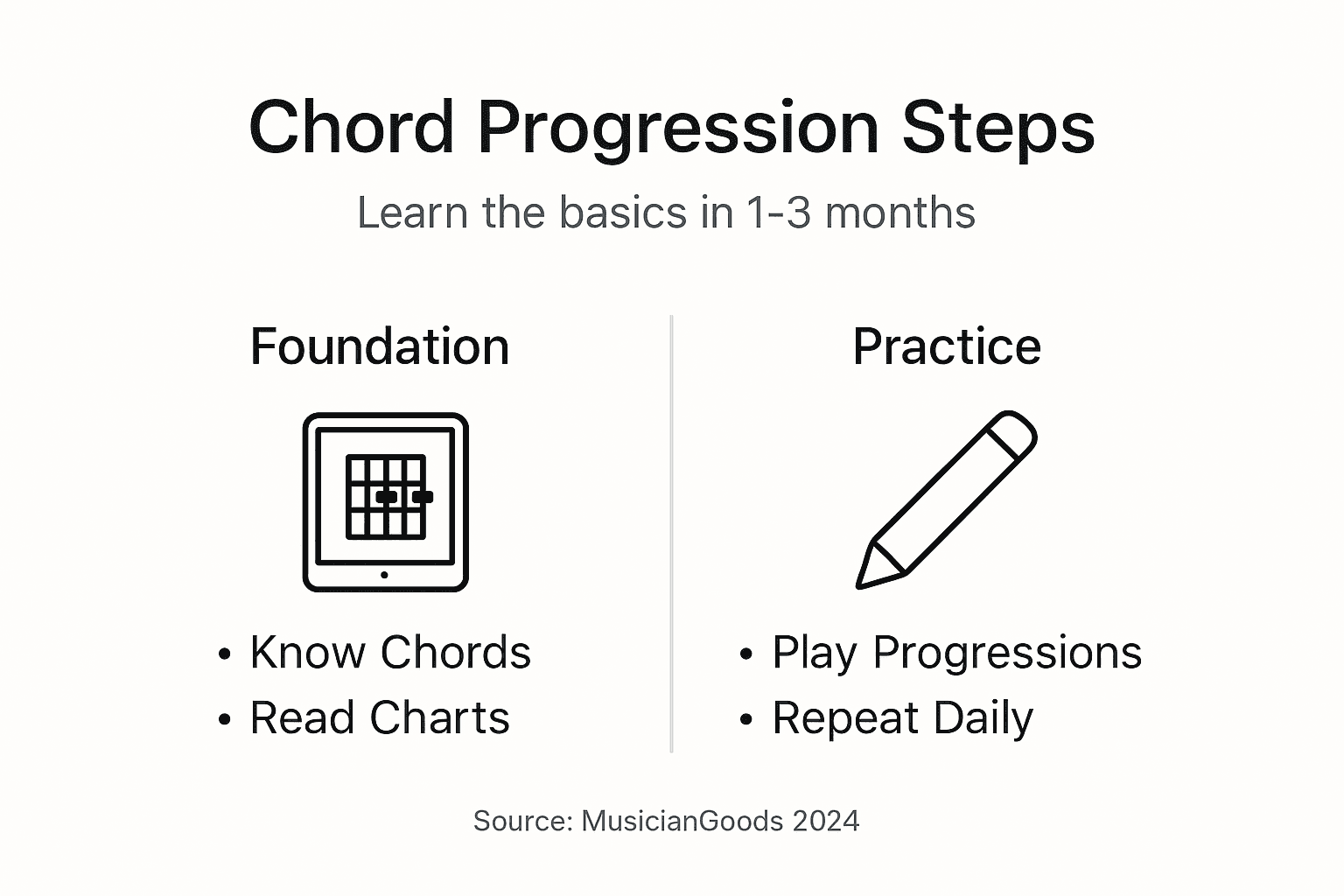
Gradual complexity prevents overwhelm while maintaining progress. Start with basic triads, then add seventh chords once triads feel comfortable. Incorporate sus2 and sus4 chords after mastering sevenths. Each layer adds color without requiring complete relearning.
Tempo progression builds muscle memory effectively:
- Week 1: Practice at 60 bpm until zero mistakes
- Week 2: Increase to 80 bpm, focus on maintaining accuracy
- Week 3: Push to 100 bpm, accept occasional mistakes
- Week 4: Reach 120 bpm with smooth transitions
This methodical approach embeds progressions into motor memory, freeing your conscious mind to focus on creativity and expression rather than mechanical execution.
Expected Outcomes and Measuring Success
Setting realistic expectations prevents discouragement while celebrating genuine progress. Skill development follows predictable patterns when you practice consistently.
Within 1-3 months of regular practice, you’ll achieve smooth, memorized progressions in multiple keys. Your fingers will move between chords without conscious thought, and transitions will sound clean and intentional.
Here’s what progressive improvement looks like:
| Timeline | Skill Milestones | Practice Focus |
|---|---|---|
| Week 1-2 | Play I-IV-V slowly without mistakes | Finger positioning, clean sound |
| Week 3-4 | Add vi chord, maintain smooth transitions | Pattern recognition, tempo |
| Month 2 | Play I-V-vi-IV at performance speed | Musical expression, dynamics |
| Month 3 | Create original progressions confidently | Experimentation, songwriting |
You’ll recognize success when progressions clearly convey intended moods. Happy songs sound genuinely uplifting, while melancholic progressions evoke appropriate emotion. This expressive control marks the difference between playing notes and making music.
Confidence in songwriting experimentation emerges naturally. You’ll hear chord sequences in your head and translate them to your instrument without hesitation. Original songs flow more easily because you understand the structural frameworks supporting them.
Track improvement through speed and fluidity metrics. Record yourself monthly playing the same progression. Compare recordings to hear dramatic differences in timing precision, tone quality, and overall musicality. These tangible measurements prove your dedication is paying off.
Enhance Your Music Theory Knowledge with MusicianGoods
Mastering chord progressions opens doors to deeper musical understanding. Why stop here when comprehensive resources can accelerate your growth further?
MusicianGoods provides clear, actionable guides designed specifically for musicians at your level. Our Music Theory for Beginners guide breaks down complex concepts into digestible steps you can apply immediately.

Looking to expand your chord vocabulary? Our easy guitar chords tutorial introduces new shapes and voicings that add variety to your progressions. Each lesson includes visual diagrams, practice exercises, and real-song applications.
Visual learners particularly benefit from our extensive collection of chord charts visual aids. These tools transform abstract theory into concrete finger positions, making learning faster and more intuitive. Whether you play guitar, bass, or piano, we’ve created resources specifically for your instrument.
Frequently Asked Questions
What is a chord progression in simple terms?
A chord progression is a sequence of chords played in order to create musical expression or mood. They provide the structural backbone for virtually all songs, guiding listeners through emotional journeys from beginning to end.
How long does it usually take to master basic chord progressions?
With regular practice, basic chord progressions can be played smoothly within 1-3 months. Consistent daily practice improves transition speed and accuracy gradually, with noticeable progress every few weeks. Your development speed depends on practice frequency and quality.
Can I create good chord progressions without complex music theory?
Basic chord functions and common progression formulas provide everything needed to start writing effective music. Understanding tonic, subdominant, and dominant roles lets you craft emotionally compelling songs immediately. Advanced theory expands creative options later but isn’t required initially.
What are some common chord progression mistakes to avoid?
Rushing chord changes and improper finger placement cause sloppy, unprofessional sound quality. Ignoring chord functions leads to progressions that sound random and emotionally flat. Balancing tonic, subdominant, and dominant roles creates natural tension and resolution that keeps listeners engaged throughout your songs.







 Guitar Chords Chart Mousepad
 Guitar Theory Simplified (Paperback/PDF)
 Bass Guitar Theory Cheat Sheet Mousepad
 Bass Theory Simplified (Paperback/PDF)
 Music Theory Simplified - (Paperback/PDF)
 Music Theory Cheat Sheet Mousepad
 Ukulele Theory Simplified (Paperback/PDF)
 Ukulele Theory Cheat Sheet Mousepad
 Guitar Theory Cheat Sheet Mousepad
 Mixing Mastering Cheat Sheet Mousepad


