 4.8/5 on Trustpilot


Learning guitar can feel confusing at first when you see so many strings, chords, and tools scattered across your space. For new players, every detail matters, from picking an instrument that fits your style to setting up a practice area that helps you focus. This guide walks you through the basics, making it easier to choose gear, understand the guitar’s physical setup, and build a strong foundation for playing with confidence.
Table of Contents
- Step 1: Set Up Your Guitar And Learning Tools
- Step 2: Identify Notes And Basic Scales
- Step 3: Apply Chords To Common Progressions
- Step 4: Use Cheat Sheets For Quick Practice
- Step 5: Check Progress With Simple Play-Along Songs
Quick Summary
| Essential Insight | Meaningful Explanation |
|---|---|
| 1. Choose the Right Guitar | Select a comfortable guitar that fits your style to enhance learning and encourage practice. |
| 2. Practice Note Identification | Regularly identify notes on the fretboard to build your musical knowledge and muscle memory. |
| 3. Master Common Chord Progressions | Familiarize yourself with popular chord progressions to structure your musical arrangements effectively. |
| 4. Utilize Cheat Sheets | Create quick-reference materials for chords and scales to simplify your practice sessions and reinforce learning. |
| 5. Track Progress with Songs | Use play-along songs that match your skill level to measure growth and maintain motivation in your practice. |
Step 1: Set Up Your Guitar and Learning Tools
Preparing your guitar and creating an effective learning environment are crucial first steps in your musical journey. This section will help you establish the right foundation for learning guitar by understanding essential equipment and setup techniques.
Begin by selecting the right guitar for your needs. Hands-on guitar learning resources recommend choosing an instrument that feels comfortable and matches your musical style - acoustic or electric. For beginners, consider factors like body size, string action, and overall playability.
Here’s a quick comparison of acoustic and electric guitars for beginners:
| Aspect | Acoustic Guitar | Electric Guitar |
|---|---|---|
| Sound | Warm, natural tones | Bright, amplified sounds |
| Playability | Require more finger strength | Easier string pressing |
| Portability | No amp needed, very mobile | Needs amp and cables |
| Maintenance | Fewer parts to care for | Requires electronic upkeep |
Your guitar setup requires several key tools and considerations:
- A reliable guitar tuner
- Guitar picks in various thicknesses
- Comfortable guitar strap
- Music stand or practice area
- Instructional materials or learning guides
Invest in a quality instrument that inspires you to practice regularly. A well-set-up guitar makes learning more enjoyable and helps build proper technique.
Each component plays a critical role in your learning process. The guitar’s physical setup determines how easily you can play and how comfortable you’ll feel while practicing. Pay attention to string height, neck alignment, and overall instrument condition.
Pro tip: Always store your guitar in a stable environment with consistent temperature and humidity to maintain its quality and prevent warping or damage.
Step 2: Identify Notes and Basic Scales
Learning to identify notes and understand basic scales is a fundamental skill that will transform your guitar playing. This step will help you navigate the fretboard with confidence and begin building your musical vocabulary.

Musical notation fundamentals emphasize understanding pitch and note placement as the core of musical comprehension. Start by familiarizing yourself with the standard guitar tuning: E A D G B E from the lowest (thickest) string to the highest (thinnest) string.
To learn the notes on your fretboard, follow these key steps:
- Memorize the open string notes
- Learn the note names on the low E and A strings first
- Practice identifying notes by their fret positions
- Use visual markers like fret dots as reference points
- Repeat the note pattern across different strings
Each fret represents a half-step in musical distance, which means moving up one fret raises the note by a half-step.
Understand that the fretboard follows a repeating pattern. Once you learn the first 12 frets, the pattern continues with the same sequence in higher octaves. Practice note identification systematically by using scale patterns and tracking note relationships.
Pro tip: Practice identifying notes for 10-15 minutes daily using a fretboard diagram, focusing on consistency and muscle memory rather than speed.
Step 3: Apply Chords to Common Progressions
Mastering chord progressions is the key to creating compelling musical arrangements and understanding how different chords work together. In this step, you’ll learn how to seamlessly transition between chords and build foundational musical structures.
Guitar chord progression techniques emphasize developing smooth transitions and understanding the relationships between different chord families. Start by focusing on the most common chord progressions, which typically involve three to four primary chords.
The most fundamental chord progressions include:
- I-IV-V Progression: The backbone of many rock and blues songs
- I-V-vi-IV Progression: Popular in contemporary pop music
- ii-V-I Progression: Fundamental in jazz and more complex musical styles
- 12-Bar Blues Progression: A classic structure used across multiple genres
Chord progressions are like musical sentences - they tell a story through sound and create emotional tension and release.
Practice these progressions by starting slowly and focusing on clean chord transitions. Develop muscle memory by repeating each progression multiple times, paying attention to your finger placement and the smoothness of your movements.
Pro tip: Practice chord progressions with a metronome, starting at a slow tempo and gradually increasing speed as you become more comfortable with the transitions.
Step 4: Use Cheat Sheets for Quick Practice
Cheat sheets are your secret weapon for accelerating guitar learning and keeping complex musical information organized and accessible. In this step, you’ll discover how to leverage these visual tools to dramatically improve your practice efficiency and musical understanding.
Customizable fretboard diagrams provide guitarists with instant reference points for chords, scales, and fingering techniques. These visual guides transform complicated musical concepts into simple, easy-to-understand graphics that can be quickly memorized and applied during practice sessions.
Effective cheat sheet strategies include:
- Create personalized chord reference cards
- Use color-coding to highlight different scale patterns
- Laminate sheets for durability and repeated use
- Digital cheat sheets for mobile learning
- Organize sheets by difficulty and musical style
Guitar learning is about smart practice, not just endless repetition. Cheat sheets help you work smarter, not harder.
Develop a systematic approach to using cheat sheets by integrating them into your regular practice routine. Start by focusing on one musical concept at a time, gradually building a comprehensive library of quick-reference materials.
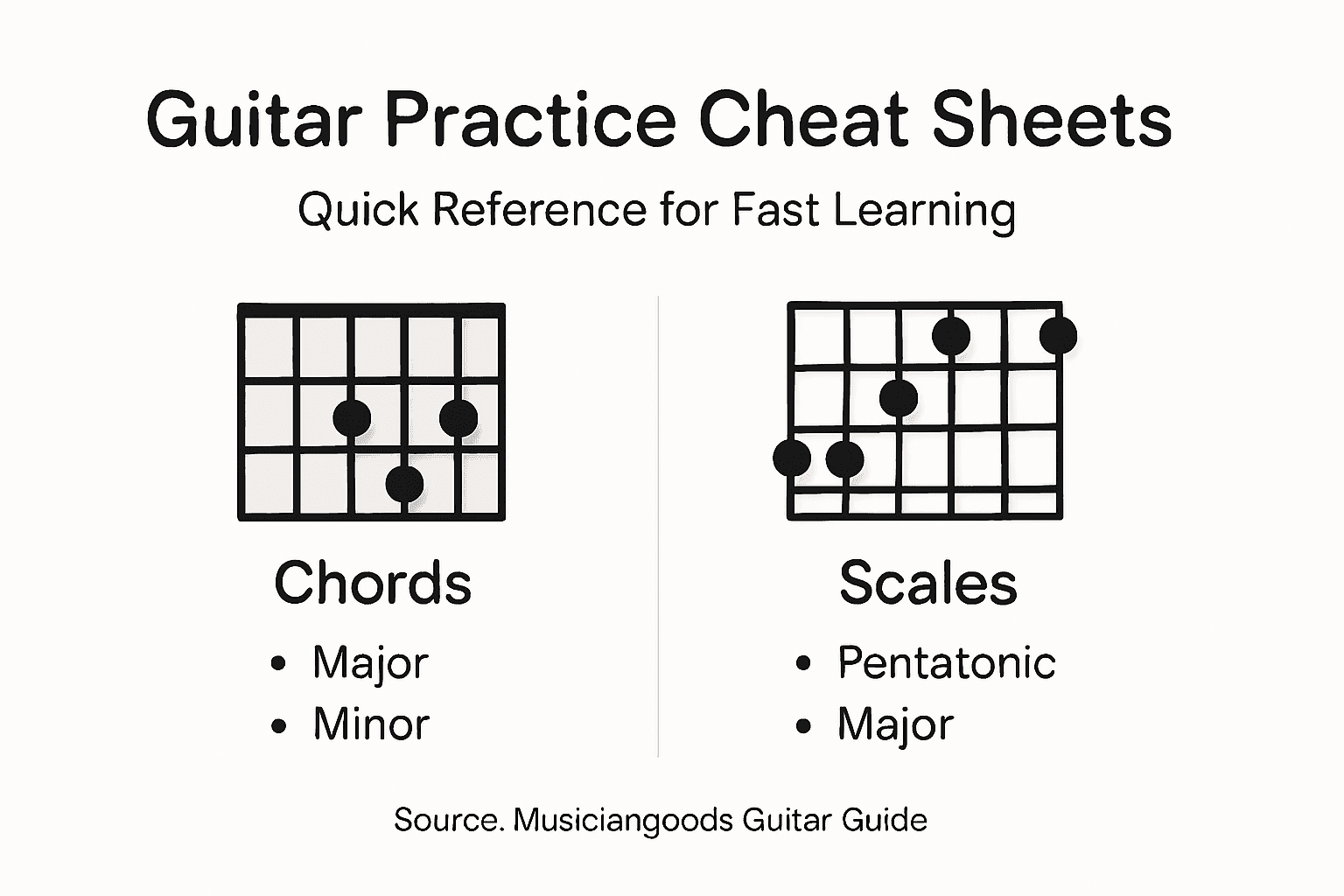
Pro tip: Photograph your cheat sheets and save them on your smartphone for convenient, on-the-go learning and quick review during unexpected practice moments.
Step 5: Check Progress With Simple Play-Along Songs
Tracking your guitar learning progress requires more than just practicing scales and chords - you need practical methods that keep you motivated and show real improvement. Interactive learning modules offer an engaging way to measure and celebrate your musical development through structured play-along experiences.
Choosing the right play-along songs is crucial for maintaining consistent progress. Look for tracks that challenge your current skill level without overwhelming you. These songs should help reinforce the techniques and musical concepts you have been practicing.
Strategies for effective play-along practice:
- Start with songs matching your current skill level
- Select tracks covering different chord progressions
- Use songs that emphasize recent techniques learned
- Record yourself playing to track improvements
- Gradually increase song complexity
Consistent play-along practice transforms abstract musical knowledge into genuine musical expression.
Build a structured practice playlist by selecting songs that progressively challenge your skills. Begin with simpler compositions and gradually introduce more complex arrangements as your confidence grows.
Pro tip: Create a practice journal to log your play-along song performances, noting specific techniques mastered and areas needing improvement.
Use this table to understand how each step in learning guitar builds on the previous one:
| Step | Skill Developed | Foundation for Next Step |
|---|---|---|
| Choose Instruments & Tools | Setup, comfort, readiness | Allows focused, regular practice |
| Learn Notes & Scales | Fretboard knowledge, ear training | Enables smoother chord changes |
| Master Chord Progressions | Rhythm, transitions | Allows playing full songs |
| Use Cheat Sheets | Quick reference, retention | Streamlines learning process |
| Play-Along Songs | Performance, confidence | Real-world application |
Elevate Your Guitar Mastery with Proven Tools and Resources
Learning guitar theory step by step can feel overwhelming when trying to connect notes, scales, chords, and play-along songs smoothly. This article highlights the common challenges of setting up your instrument properly, memorizing fretboard notes, mastering chord progressions, and efficiently using cheat sheets to accelerate learning and build real confidence. If you find yourself stuck or want to deepen your understanding with clear, visual guides and practical tools, there is a more effective way to learn.

Discover how Musiciangoods helps musicians like you conquer these hurdles through expertly crafted educational books, visual cheat sheets, and intuitive practice aids designed for every skill level. Whether you need detailed fretboard diagrams or chord progression references, our resources are made by musicians for musicians to boost your progress faster and make practice more enjoyable. Don’t wait to transform your guitar journey. Visit Musiciangoods and explore tailored solutions that support your growth every step of the way. Start mastering guitar theory the smart way now!
Frequently Asked Questions
How do I choose the right guitar for learning music theory?
Choosing the right guitar involves selecting an instrument that feels comfortable and matches your musical style, whether acoustic or electric. Decide on features like body size and string action, and try playing different guitars to find the best fit.
What are the essential tools I need to set up my guitar for practice?
You need a reliable guitar tuner, various thicknesses of guitar picks, a comfortable strap, and a music stand or practice area. Gather these tools to create an efficient learning environment that promotes better practice habits.
How can I memorize the notes on the guitar fretboard effectively?
To memorize the notes, start by learning the open string notes and focus on the low E and A strings. Practice identifying notes by their fret positions for about 10-15 minutes daily to build muscle memory and increase familiarity with the fretboard.
What are the most basic chord progressions I should practice?
Begin with common chord progressions such as I-IV-V, I-V-vi-IV, and ii-V-I. These progressions form the foundation for many songs; practice transitioning between these chords slowly to develop muscle memory and rhythm.
How can cheat sheets enhance my guitar practice?
Cheat sheets provide quick references for chords and scales, making it easier to memorize and apply complex concepts. Create a personalized set of cheat sheets and integrate them into your regular practice routine, referencing them whenever you encounter challenging material.
What strategies should I use for effective play-along practice?
Start with songs that match your current skill level and gradually increase in complexity. Record yourself playing and track your progress to stay motivated and ensure that you apply the techniques you’ve learned consistently.








 Guitar Chords Chart Mousepad
 Guitar Theory Simplified (Paperback/PDF)
 Bass Guitar Theory Cheat Sheet Mousepad
 Bass Theory Simplified (Paperback/PDF)
 Music Theory Simplified - (Paperback/PDF)
 Music Theory Cheat Sheet Mousepad
 Ukulele Theory Simplified (Paperback/PDF)
 Ukulele Theory Cheat Sheet Mousepad
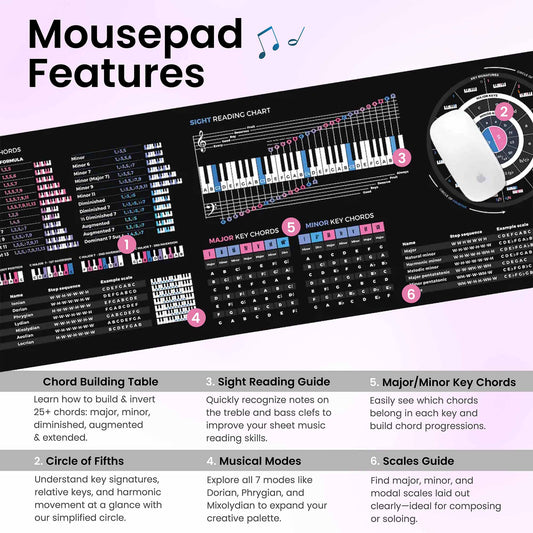
 Guitar Theory Cheat Sheet Mousepad
 Mixing Mastering Cheat Sheet Mousepad


