


You know individual chords, but making them flow together into actual music feels like solving a puzzle without the picture on the box. Many guitarists hit this wall where isolated chord shapes don’t translate into the songs they love. Guitar chord progressions are sequences of chords that create the framework for songs, and understanding them provides a vocabulary for musical expression. This guide breaks down chord progression concepts, shows practical examples across skill levels, and gives you the tools to play and create music with confidence.
Table of Contents
- What Are Guitar Chord Progressions And Why Are They Important?
- Understanding Keys And The Roman Numeral System For Chord Progressions
- Common Beginner And Advanced Guitar Chord Progressions
- Tips For Practicing And Creating Your Own Chord Progressions
- Explore Quality Guitars And Gear To Elevate Your Playing
- Frequently Asked Questions
Key takeaways
| Point | Details |
|---|---|
| Musical foundation | Chord progressions create the harmonic backbone that transforms individual chords into complete songs |
| Roman numeral system | This notation method allows you to transpose any progression across different keys instantly |
| Chord functions matter | Understanding tonic, dominant, and subdominant roles helps you play with musical intention |
| Practice builds fluency | Slow repetition with a metronome and playing along with recordings internalizes progression patterns |
| Substitutions add depth | Replacing chords within progressions enhances your songwriting and playing creativity |
What are guitar chord progressions and why are they important?
Chord progressions provide structure and movement in music, making basic chords sound like a song. Think of progressions as the sentences of music, where individual chords are words. Strumming a C chord sounds pleasant, but moving from C to Am to F to G tells a story your ear recognizes and follows.
Progressions shape the emotional journey of every song through tension and resolution. When you play a G chord after building tension with other chords, your ear feels satisfied because G acts as a musical home base in the key of G. This push and pull creates the feelings that make music compelling, whether you’re playing blues, rock, or folk.
Understanding guitar theory simplified chord progressions starts with recognizing three fundamental chord functions:
- Tonic (I chord): The home base that feels stable and resolved, where musical phrases naturally rest
- Dominant (V chord): Creates tension and urgency, pulling strongly back toward the tonic
- Subdominant (IV chord): Bridges between tonic and dominant, adding movement without extreme tension
These functions work together in every progression you’ll encounter. The I chord establishes where you are, the IV chord suggests movement, and the V chord demands resolution back to I. Recognizing these roles transforms you from someone who plays chord shapes into someone who understands musical conversation.
“Chord progressions are the language that lets guitarists translate musical ideas into reality, whether copying songs or writing original material.”
Mastering progressions unlocks the ability to learn songs faster because you’ll recognize patterns instead of memorizing random chord sequences. You’ll also gain the foundation for improvisation and songwriting, understanding why certain chord combinations work while others clash.
Understanding keys and the Roman numeral system for chord progressions
A key is your musical color palette, the collection of notes and chords that work together harmoniously. When a song is in the key of C major, it draws primarily from the seven chords built on the C major scale. This isn’t a restriction but a framework that gives your playing coherence and direction.
Musicians use Roman numerals to describe chord positions within a key, allowing for the translation of progressions between different keys. Instead of saying “play C, then Am, then F, then G,” you’d say “play I, vi, IV, V.” This system works in any key, making it a universal language for chord progressions.
The diatonic chord scale follows a consistent pattern in major keys:
- I: Major chord (stable, home)
- ii: Minor chord (gentle, transitional)
- iii: Minor chord (subtle, less common)
- IV: Major chord (uplifting, movement)
- V: Major chord (tension, resolution)
- vi: Minor chord (emotional, reflective)
- vii°: Diminished chord (unstable, rarely used in basic progressions)
Capital Roman numerals indicate major chords, while lowercase numerals show minor chords. The degree symbol (°) marks diminished chords. In Western music, each chord in a key has a specific function, with Tonic (I), Dominant (V), and Subdominant (IV) forming the primary building blocks.
Here’s how this pattern translates across different keys:
| Degree | Function | C Major | G Major |
|---|---|---|---|
| I | Tonic | C | G |
| ii | Supertonic | Dm | Am |
| iii | Mediant | Em | Bm |
| IV | Subdominant | F | C |
| V | Dominant | G | D |
| vi | Submediant | Am | Em |
| vii° | Leading tone | Bdim | F#dim |
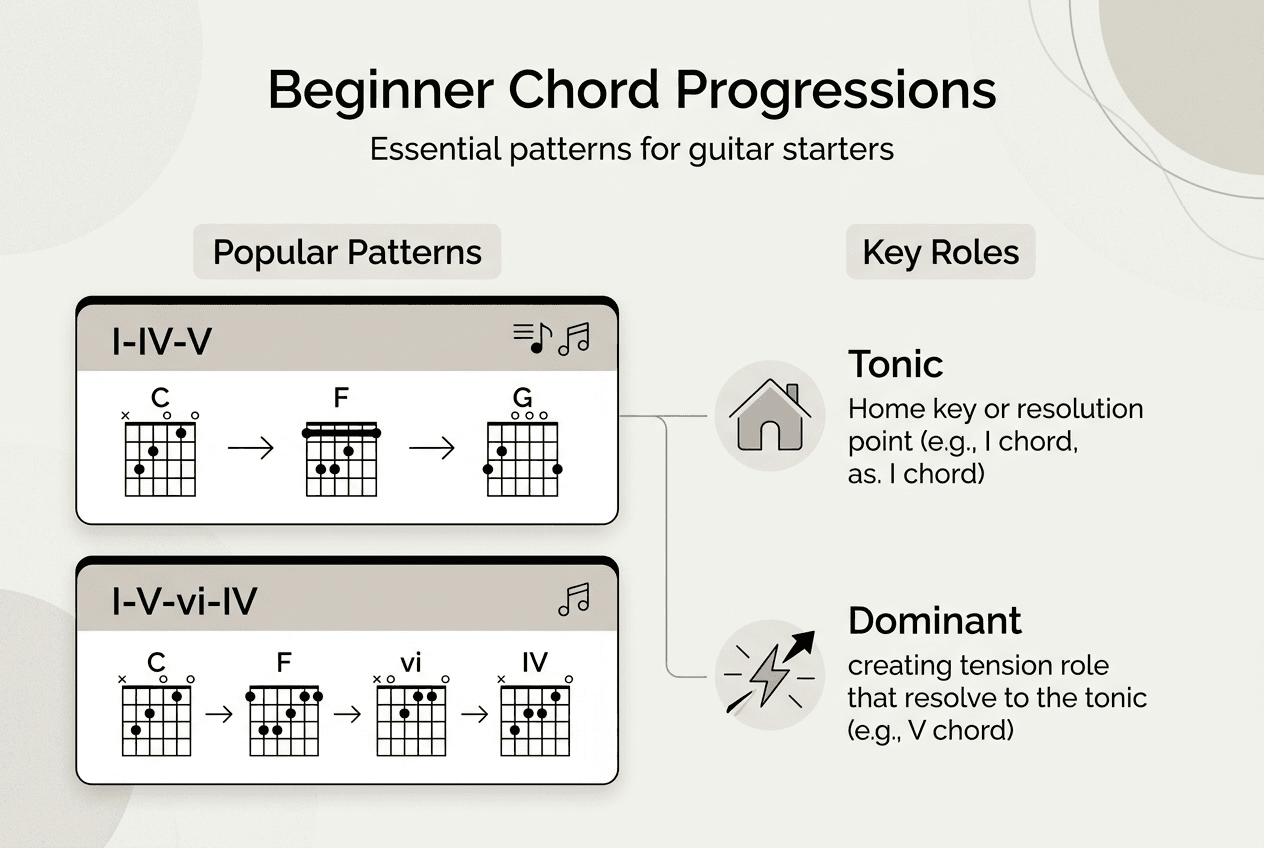
Notice how the pattern stays identical, only the actual chord names change. A I-IV-V progression in C major uses C-F-G, while the same I-IV-V in G major uses G-C-D. The emotional effect remains consistent because the relationships between chords stay the same.
Pro Tip: Memorize that I, IV, and V are always major chords while ii, iii, and vi are always minor in major keys. This pattern recognition helps you quickly identify chord qualities and anticipate the mood of any progression.
Once you internalize this system, you can transpose any song to match your vocal range or play with other musicians in different keys. Understanding practical music theory learning tips accelerates this process, giving you frameworks that stick.
Common beginner and advanced guitar chord progressions
Starting with proven progressions builds your muscle memory and ear training simultaneously. Beginner progressions typically use the I, IV, V, and vi chords because they’re the most stable and pleasant sounding combinations. These four chords appear in thousands of popular songs across every genre.
The I-V-vi-IV progression is extremely common in popular music across various genres. In the key of C, this translates to C-G-Am-F, the backbone of countless hits from the past five decades. Play these four chords in a loop, and you’ll immediately recognize the sound from radio favorites.
Here’s a comparison of beginner versus advanced progressions:
| Level | Progression | Example (C Major) | Characteristics |
|---|---|---|---|
| Beginner | I-IV-V | C-F-G | Classic rock and blues foundation, strong resolution |
| Beginner | I-V-vi-IV | C-G-Am-F | Pop standard, emotional and catchy |
| Beginner | I-vi-IV-V | C-Am-F-G | Doo-wop progression, vintage feel |
| Advanced | I-iii-vi-IV | C-Em-Am-F | Adds minor iii for complexity |
| Advanced | ii-V-I | Dm-G-C | Jazz turnaround, sophisticated resolution |
| Advanced | I-bVII-IV-I | C-Bb-F-C | Modal borrowing, modern rock sound |
Beginner progressions work beautifully for strumming and establishing rhythm guitar skills. Focus on smooth transitions between chords and maintaining steady timing before adding complexity. These simple patterns teach you how chords interact and resolve.
Advanced chord progressions incorporate complex chords like diminished, augmented, and suspended chords, ideal for fingerpicking and soloing. As you progress, you’ll explore:
- Chord substitutions: Replacing a chord with one that shares similar notes, like using iii instead of I for variation
- Diminished chords: Adding tension between major steps, often used as passing chords
- Suspended chords: Creating anticipation by replacing the third with either a second or fourth
- Secondary dominants: Borrowing the V chord from another key to add color and movement
- Modal interchange: Using chords from parallel minor or major keys for unexpected harmonic shifts
Pro Tip: Start experimenting with substitutions by replacing the vi chord with a iii chord in familiar progressions. Both are minor and share two notes, so the substitution sounds natural while adding subtle freshness to overplayed patterns.
Practice these progressions in multiple keys to build fretboard familiarity. The easy guitar chords for beginners you already know become more versatile when you understand how they function within progressions.
Tips for practicing and creating your own chord progressions
Effective practice transforms theoretical knowledge into musical fluency. Understanding chord progressions is fundamental for beginner guitarists, providing the building blocks to create music. Your practice routine should balance repetition with creative exploration.
Follow these steps to master chord progressions systematically:
- Start slow with a metronome: Set your metronome to 60 bpm and play each chord for four beats, focusing on clean transitions without buzzing strings.
- Loop short sections: Practice two-chord changes repeatedly before adding the third and fourth chords, building complexity gradually.
- Increase tempo incrementally: Bump the metronome up by 5 bpm only after you can play the progression perfectly three times in a row.
- Play along with recordings: Choose songs using progressions you’re learning and strum along to internalize timing and feel.
- Practice in multiple keys: Once comfortable in one key, transpose the progression to another key using the Roman numeral system.
- Add rhythmic variations: Experiment with different strumming patterns over the same progression to develop versatility.
Playing along with actual songs bridges the gap between practice and performance. You’ll develop timing, dynamics, and the ability to hear chord changes, essential skills for jamming with other musicians or performing.
Avoid these common mistakes that slow progression:
- Rushing chord changes instead of maintaining steady tempo
- Ignoring rhythm and strumming patterns while focusing only on chord shapes
- Practicing only in one key and struggling when asked to transpose
- Skipping the metronome and developing inconsistent timing
- Never recording yourself, missing opportunities to identify weak spots objectively
Pro Tip: Record yourself playing progressions weekly and compare recordings over time. You’ll hear improvements you might not feel while playing, which builds confidence and reveals specific areas needing attention.
Creating your own progressions starts with understanding the basic guitar chords guide and experimenting within the Roman numeral framework. Begin by choosing a key and writing out the seven diatonic chords. Pick four chords that include at least one from each function group (tonic, subdominant, dominant).
Try starting and ending on the I chord for stability, using IV or ii for movement, and V for tension before resolution. Play your progression in a loop and adjust chords until it feels right. Chord substitutions enhance harmonic progressions, improve songwriting, and overall guitar playing skills.
Trust your ear during this creative process. If a progression sounds good to you, it works, even if it breaks traditional rules. Music theory guides your choices but shouldn’t limit your creativity.
Explore quality guitars and gear to elevate your playing
Now that you understand chord progressions and how to practice them effectively, having the right instrument makes a significant difference in your learning journey. Quality guitars respond better to your touch, stay in tune longer, and inspire you to pick them up and practice daily.
Visit Musiciangoods to explore a wide range of guitars and accessories designed specifically for musicians at every level. Whether you need visual learning tools, chord charts, or comprehensive theory guides, you’ll find resources created by musicians for musicians.

Complement your practice routine with our educational materials that simplify complex concepts through visual diagrams and step-by-step systems. Check out our easy guitar chords resource for additional beginner-friendly guidance that builds on what you’ve learned here. Quality gear paired with structured learning accelerates your progress and keeps you motivated.
Frequently asked questions
What is a guitar chord progression?
A guitar chord progression is a sequence of chords played in a specific order that forms the harmonic foundation of a song. Progressions create movement and emotion in music by establishing patterns of tension and resolution. Understanding progressions helps you learn songs faster, improvise confidently, and write original music.
How can I learn to play chord progressions better?
Practice slowly with a metronome to develop clean transitions and consistent timing. Play along with recordings of songs using progressions you’re learning to internalize their feel and rhythm. Experiment with the same progression in different keys and chord voicings to build fretboard familiarity. Use chord charts and visual tools to reinforce your understanding of how progressions work across the neck.
What are common chord progressions beginners should know?
The I-IV-V progression is the classic beginner pattern appearing in blues, rock, and country music. The I-V-vi-IV progression ranks as the most popular in modern hits across multiple genres. Master these two progressions first, and you’ll have the foundation to play hundreds of songs. These patterns teach you chord relationships and train your ear to recognize common musical movements.