


Struggling to find notes quickly on your guitar? You’re not alone. Many guitarists feel lost navigating the fretboard, relying on memorized shapes rather than understanding where each note lives. This limitation slows your progress and keeps you from improvising freely. Memorizing the fretboard changes everything. It transforms you from someone who plays by rote into a musician who creates intentionally. This guide reveals practical methods to master your fretboard, unlock faster learning, and gain the confidence to play anywhere on the neck without hesitation.
Table of Contents
- Key takeaways
- Why fretboard memorization is crucial for guitarists
- Effective memorization methods for beginners and intermediates
- Visual aids and shortcuts to accelerate fretboard learning
- Applying fretboard knowledge to improve your playing and improvisation
- Explore music theory tools to master fretboard memorization
- FAQ
Key Takeaways
| Point | Details |
|---|---|
| Fretboard mastery speeds learning | Memorizing note locations lets you learn songs faster and improvise with confidence across the neck. |
| Anchor strings method | Begin with the low E and A strings and learn every natural note on them for one week to anchor your fretboard. |
| Fret marker landmarks | Treat the 5th and 12th fret dots as essential anchors that help you locate notes across the neck. |
| Chromatic drill habit | Practice a daily single string chromatic scale naming each note aloud until the sequence becomes automatic. |
| Octave shape mapping | Use octave patterns to connect notes across strings so the same note appears on different strings and you can locate any pitch quickly. |
Why fretboard memorization is crucial for guitarists
Most guitarists start by learning chord shapes and scale patterns. This approach gets you playing quickly but creates a ceiling on your growth. You become a tourist on your own instrument, visiting familiar spots without truly knowing the landscape. Fretboard mastery differentiates tourists from locals, enabling faster learning and confident soloing.
When you memorize the fretboard, several transformations happen simultaneously. First, learning new songs accelerates dramatically because you recognize note relationships rather than hunting for finger positions. Second, improvisation becomes intuitive as you visualize scales and chord tones across the entire neck. Third, music theory stops being abstract and becomes a practical tool you apply in real time.
Consider how beginners struggle with these common scenarios:
- Playing the same lick in different positions feels impossible
- Transposing songs to new keys requires relearning everything
- Soloing stays locked in one fretboard box
- Understanding why certain notes sound good remains mysterious
Confident players navigate these challenges effortlessly because they know their fretboard intimately. They think in notes and intervals, not just shapes. This knowledge creates musical freedom that shape-based playing can never provide.
“Knowing your fretboard transforms playing from mechanical reproduction into intentional music creation.”
The difference becomes obvious when you watch experienced players. They move fluidly between positions, find chord voicings anywhere, and create solos that span the entire neck. This mastery doesn’t require talent, just systematic learning. Our beginner’s guide to frets breaks down the fundamentals that make this possible.
Effective memorization methods for beginners and intermediates
Memorizing the fretboard feels overwhelming until you apply the right system. Breaking the process into manageable steps makes mastery achievable for any player willing to practice consistently.
-
Start with anchor strings. Focus exclusively on the low E and A strings first. These bass strings serve as reference points for finding notes everywhere else. Spend one week learning every natural note on just these two strings before moving forward.
-
Use fret markers strategically. The dots at the 5th and 12th frets aren’t decorative. They mark crucial navigation points. The 12th fret repeats the open string note one octave higher. The 5th fret connects to the next open string. These landmarks help you orient instantly.
-
Practice chromatic scales methodically. Play every note on one string, naming each one aloud. Start on the low E string, playing E, F, F#, G, G#, A, A#, B, C, C#, D, D# as you move up. Repeat this drill daily until automatic.
-
Learn octave shapes. Octaves create visual patterns that connect notes across strings. When you play a note on the E string at the 3rd fret (G), the same note appears two strings higher and two frets up. These shapes help you find any note in multiple locations.
-
Drill one note daily. Pick a single note like A and find every location where it appears on the fretboard. Play each one, say the note name, and notice the pattern. Tomorrow, choose B and repeat. This focused approach builds comprehensive knowledge efficiently.
Pro Tip: Always apply new note knowledge immediately to songs you’re learning. When you discover where all the C notes live, find them in a song that uses C chords. This contextual practice makes memorization stick.
Key methods include anchoring on low E and A strings, fret landmarks, chromatic exercises, octave shapes, and applying notes to songs. Each technique reinforces the others, creating multiple mental pathways to the same information. Physical practice matters more than theory study because your fingers develop muscle memory alongside mental knowledge.

Our fretboard notes PDF provides visual reference as you practice these drills. Use it to check your work, not as a crutch during playing.
Visual aids and shortcuts to accelerate fretboard learning
While systematic memorization builds deep knowledge, smart shortcuts and visual tools speed your progress significantly. Understanding when to use each approach maximizes your learning efficiency.
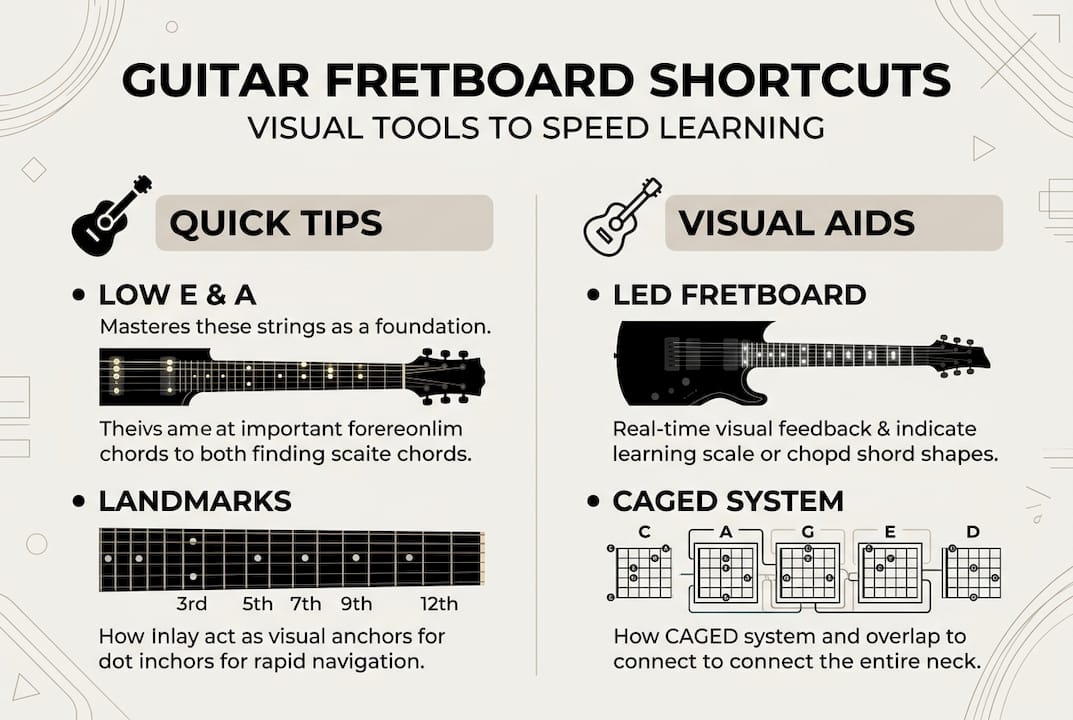
LED fretboards help beginners map and retain fretboard notes faster, supporting embodied cognition through physical practice. These devices light up note locations as you play, creating immediate visual feedback. Your brain connects the physical sensation of pressing a fret with its visual position and the resulting sound. This multi-sensory learning accelerates retention compared to studying diagrams alone.
The CAGED system offers another powerful shortcut. This method uses five basic chord shapes (C, A, G, E, D) that repeat up the neck. Each shape reveals note locations within its pattern. When you understand CAGED, you can quickly find any chord anywhere and identify the individual notes within it. Our CAGED system explained guide shows exactly how this works.
| Learning Tool | Best For | Limitation |
|---|---|---|
| LED fretboards | Visual learners, immediate feedback | Requires device, can create dependency |
| CAGED system | Quick chord navigation | Doesn’t teach every individual note |
| Note-by-note memorization | Complete fretboard knowledge | Time intensive, requires discipline |
| Interval recognition | Understanding relationships | Needs foundational note knowledge |
Some debate exists about full note memorization versus using shortcuts like intervals and CAGED. Purists argue you should know every note location by name. Pragmatists suggest understanding intervals and patterns provides sufficient navigation for most playing situations. The truth lies somewhere between these extremes.
Pro Tip: Use shortcuts to get playing quickly, but commit to learning actual note names over time. CAGED helps you find a G chord instantly, but knowing where every G note lives gives you creative options CAGED alone can’t provide.
Visual learning connects naturally to music education perspectives that emphasize embodied practice. Your body learns through repetition and physical feedback, not just mental study. Combine visual aids with actual playing to engage multiple learning pathways simultaneously.
Applying fretboard knowledge to improve your playing and improvisation
Knowing note locations means nothing until you apply that knowledge musically. The real payoff comes when fretboard mastery transforms how you play, compose, and improvise.
Fretboard mastery enables confident soloing and faster song learning by applying theory without a map. When you improvise, you think in terms of target notes and intervals rather than box patterns. Playing in A minor? You know where every A, C, and E lives, so you can emphasize chord tones anywhere on the neck. This creates solos that sound intentional and musical.
Song learning accelerates because you recognize patterns rather than memorizing finger positions. You see a melody uses notes from the C major scale and immediately know multiple ways to play it. Transposing becomes simple because you understand the interval relationships, not just the shapes.
Here’s how to practice applying your fretboard knowledge:
-
Zone practice. Divide the fretboard into three zones: frets 1-5, 6-10, and 11-15. Improvise a solo using only one zone, forcing yourself to find all necessary notes within that area.
-
Chord tone targeting. Play a backing track and solo using only chord tones. If the progression is C-F-G, play only C-E-G notes over C, F-A-C over F, and G-B-D over G. This trains you to hear and locate chord tones instantly.
-
Key jumping. Practice the same lick or riff in all 12 keys without looking at your hands. This forces deep note knowledge and reveals patterns across the fretboard.
-
Theory integration. When learning scales, identify the intervals (root, major third, perfect fifth) rather than just finger positions. This connects abstract theory to physical locations.
Confidence grows naturally as you stop hunting for notes. Your eyes stay on the music or audience instead of your fretboard. You experiment freely because you know where any note lives. This freedom separates hobbyists from serious musicians.
Our music theory for mastery resource connects fretboard knowledge to broader theory concepts, showing how everything works together.
Explore music theory tools to master fretboard memorization
Ready to accelerate your fretboard journey? MusicianGoods offers practical resources designed specifically for guitarists committed to mastery. Our theory books break down complex concepts into visual, actionable systems that complement your practice routine.

Our cheat sheets provide instant reference for scales, chord shapes, and note locations, perfect for keeping near your practice space. These tools were created by working musicians who understand exactly what learners need. The materials emphasize visual learning and practical application over dry theory, matching how guitarists actually learn best. Whether you need comprehensive books or quick-reference guides, our music theory tools and cheat sheets support every stage of your development. Combine these resources with consistent practice to build the fretboard mastery that unlocks your full potential as a guitarist.
FAQ
What is the best way to start memorizing the guitar fretboard?
Begin by focusing exclusively on the low E and A strings. Learn every natural note on these two strings using visual aids and note-per-day drills. Anchor your learning with familiar fret landmarks like the 5th and 12th frets, which provide instant orientation points. This focused approach builds a foundation you’ll expand to other strings. Our fretboard notes PDF offers visual support as you practice.
Are there shortcuts to memorizing the fretboard without learning every note?
Shortcuts like CAGED and interval recognition provide effective navigation without exhaustive memorization. The CAGED system uses five chord shapes that repeat up the neck, revealing note patterns within each position. Interval recognition helps you find notes by their relationship to known reference points. These methods work best when combined with some foundational note knowledge. Our CAGED system explained guide shows how to apply this shortcut effectively.
How can visual tools like LED fretboards help in learning the fretboard?
Visual aids like LED fretboards improve early fretboard mapping and note retention through physical interaction. These devices light up note locations as you play, creating immediate feedback that connects visual, physical, and auditory learning. Your brain forms stronger memories when multiple senses engage simultaneously. LED fretboards complement practice by linking abstract theory to actionable finger positions. Use them alongside our fretboard notes PDF for maximum learning efficiency.
How long does it typically take to memorize the entire guitar fretboard?
Timeline varies based on practice consistency and method quality. With focused daily practice using systematic approaches, most players achieve functional fretboard knowledge in three to six months. Complete mastery where you instantly recognize any note anywhere takes longer, typically 12 to 18 months of consistent work. The key is daily practice, even if only 10 to 15 minutes. Regular short sessions build stronger retention than occasional long practice marathons. Your progress accelerates when you apply new knowledge immediately to songs and improvisation.
Does memorizing the fretboard help with music theory understanding?
Absolutely. Fretboard knowledge transforms abstract theory into practical, visual concepts you can see and play. When you understand where intervals live physically, theory concepts like chord construction and scale relationships become obvious. You stop thinking about theory as separate from playing and start using it as a creative tool. This integration makes advanced concepts accessible because you experience them through your instrument rather than just reading about them. The connection between physical locations and theoretical relationships creates deeper, more lasting understanding.