4.8/5 on Trustpilot


Learning guitar music theory can feel overwhelming when you’re faced with confusing charts and unfamiliar symbols. You want clear steps that make sense and show you exactly how to connect notes, chords, and scales to your playing. The basics like the musical alphabet and proper chord structure are your foundation, but the details about scales, key relationships, and practical shortcuts often remain a mystery.
This list will give you actionable tools that make music theory easy to understand and apply. You’ll discover how to spot notes across the fretboard, recognize chord qualities, and use visual aids to build your skills faster. Get ready for simple, direct insights that turn theory into progress every time you pick up your guitar.
Quick Summary
| Key Message | Explanation |
|---|---|
| 1. Master the Musical Alphabet | Understand A, B, C, D, E, F, and G to navigate the guitar fretboard effectively. |
| 2. Learn Major and Minor Scales | Familiarize yourself with scale patterns to create melodies and convey emotions through music. |
| 3. Understand Chord Structure | Recognize how triads and chord qualities influence the sound and emotional impact of music. |
| 4. Explore the Circle of Fifths | Use this diagram to understand key relationships and improve songwriting and improvisation skills. |
| 5. Practice Ear Training | Develop listening skills to enhance your musicality and improve improvisation, transcription, and song learning. |
1. Master the Musical Alphabet and Notes
Understanding the musical alphabet is your first crucial step in learning guitar music theory. Just like the English alphabet has 26 letters, the musical alphabet is simpler: it contains only 7 core letters that repeat across different octaves.
The musical alphabet consists of the notes A, B, C, D, E, F, and G. These letters represent specific pitches that form the foundation of all musical compositions. Music theory for beginners explains these note names in greater detail, providing a comprehensive overview for new musicians.
Here’s how the musical alphabet works on a guitar:
- Each letter represents a specific fret and pitch on the fretboard
- Notes repeat in a consistent pattern across strings and octaves
- Understanding this pattern helps you navigate the entire instrument
The musical alphabet is your roadmap to understanding how music is constructed.
To effectively learn these notes, practice identifying them on your guitar neck. Start by memorizing the notes on the low E and high E strings, as these will serve as reference points for finding other notes.
Beginner guitarists should create a simple exercise of playing each note sequentially up and down the fretboard. This hands-on approach transforms abstract theory into muscle memory.
Pro tip: Create a visual note chart and stick it near your practice area to reinforce your understanding of the musical alphabet.
2. Learn Major and Minor Scales on Guitar
Scales are the building blocks of musical understanding, serving as fundamental roadmaps for guitar players to create melodies and understand song structures. Guitar theory explores major scale fundamentals and provides critical insights into musical composition.
Major and minor scales differ primarily in their emotional character and interval patterns. The major scale sounds bright and happy, while the minor scale typically conveys a more melancholic or serious mood.
Here are key differences between major and minor scales:
- Major scales follow a specific whole step and half step pattern
- Minor scales exist in three primary forms: natural, harmonic, and melodic
- The third interval determines whether a scale sounds major or minor
Understanding scale patterns helps you communicate musical emotions through your guitar.
To practice scales effectively, start by learning the standard major scale pattern across your guitar neck. Begin with the C major scale, which contains no sharp or flat notes and serves as an excellent starting point for beginners.
Practical scale learning involves:
- Memorizing interval patterns
- Practicing scale positions on the fretboard
- Listening to how different scales sound
- Experimenting with scale variations
Pro tip: Use a metronome while practicing scales to develop consistent rhythm and muscle memory.
3. Understanding Chord Structure Made Simple
Chord structure is the secret language of music that transforms individual notes into powerful musical statements. Guitar theory explores how chords are built and provides essential insights for aspiring musicians.
At its core, a chord is created by stacking notes in thirds. The most basic chord type is a triad, which combines three notes to create a harmonic sound. These foundational chords come in several flavors: major, minor, diminished, and augmented.
Key aspects of chord construction include:
- Triads are built by combining the first, third, and fifth notes of a scale
- Major chords have a bright, happy sound
- Minor chords create a more melancholic feeling
- Chord quality changes based on interval relationships
Understanding chord structure is like learning the grammar of musical language.
Practical chord learning involves recognizing patterns across the guitar neck. Start by mastering basic open chords like C, G, and D major. These fundamental chords appear in countless songs and provide a solid foundation for your musical journey.
To truly understand chord structure, practice these steps:
- Learn the notes on your guitar fretboard
- Identify root notes for different chords
- Experiment with chord voicings and inversions
- Listen to how different chord combinations sound
Pro tip: Use a chord chart and practice transitioning between chords slowly to build muscle memory and understanding.
4. Explore Circle of Fifths with Visual Guides
The Circle of Fifths is like a musical roadmap that unlocks the mysteries of key relationships and chord progressions. Circle of Fifths theory explained provides guitarists with a powerful visual tool for understanding musical harmony.
This circular diagram organizes the 12 major and minor keys in a way that reveals fundamental musical relationships. By moving clockwise, you add sharps to key signatures, while moving counter-clockwise adds flats.
Key benefits of understanding the Circle of Fifths include:
- Quickly identifying key signatures
- Understanding chord relationships
- Predicting harmonic progressions
- Improving improvisation skills
- Simplifying songwriting techniques
The Circle of Fifths is the secret language of musical connectivity.
To use the Circle of Fifths effectively, start by memorizing its basic structure. The diagram is divided into major keys on the outer ring and their relative minor keys on the inner ring. Each step represents a perfect fifth interval, which means moving one step clockwise adds one sharp to the key signature.
Practical ways to apply the Circle of Fifths:
- Identify related keys for smooth transitions
- Understand chord progressions
- Explore key modulations
- Develop better ear training
Pro tip: Create a printable Circle of Fifths chart and keep it near your practice space to internalize its patterns and relationships.
5. Apply Music Theory to Popular Songs
Transforming abstract music theory into real-world understanding happens when you analyze popular songs you already love. Music theory can illuminate popular music by revealing the structural secrets behind your favorite tracks.
Popular music is an incredible learning tool that makes music theory instantly relatable. Songs from genres like rock, pop, and blues often follow predictable chord progressions and structural patterns that become easier to understand once you start paying attention.
Key strategies for applying music theory to popular songs include:
- Identifying chord progressions in familiar tracks
- Analyzing song structures (verse-chorus-bridge)
- Recognizing common scale patterns
- Understanding rhythmic foundations
- Exploring melodic relationships
Music theory transforms listening from passive enjoyment to active understanding.
Start by selecting songs you know well and breaking them down systematically. Pay attention to how chords connect, where the song changes key, and how the melody interacts with underlying harmonic structures.
Practical steps to analyze popular songs:
- Listen to the song multiple times
- Write down the chord progression
- Identify the key signature
- Explore the rhythmic patterns
- Compare the song’s structure to typical forms
Pro tip: Create a music theory journal where you document your song analyses to track your growing understanding and see patterns emerge.
6. Use Cheat Sheets for Quick Reference
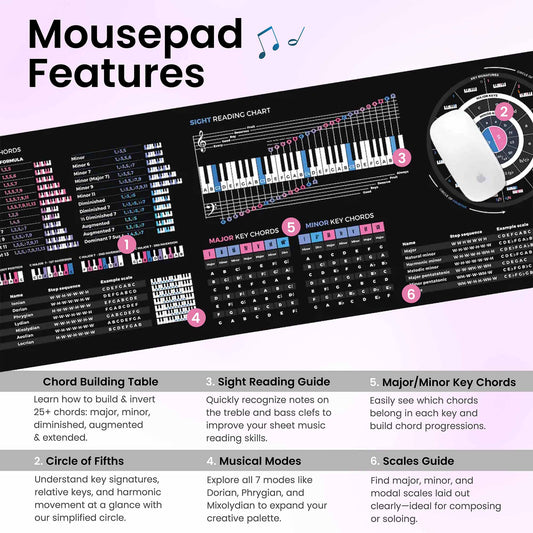
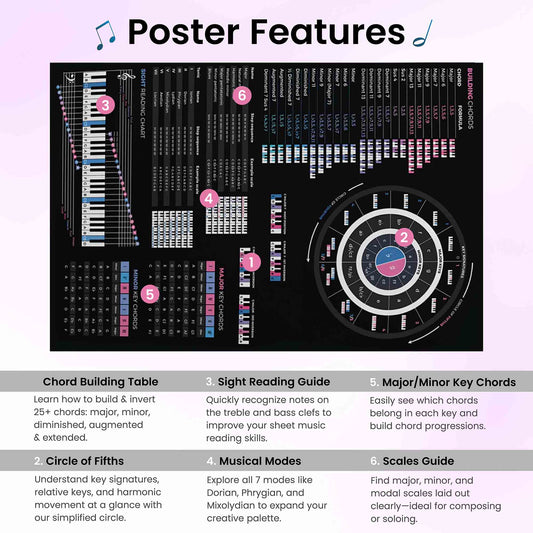
Cheat sheets are the ultimate shortcut to mastering complex music theory concepts quickly and efficiently. Music theory fundamentals can be simplified through well-designed visual reference guides that break down complicated information into digestible chunks.
These compact learning tools transform overwhelming musical information into accessible graphics. They serve as visual roadmaps that help guitarists navigate scales, chord progressions, and musical notation without getting lost in technical details.
Benefits of using music theory cheat sheets include:
- Instant visual reference for complex concepts
- Portable learning resource
- Quick memory triggers for key information
- Organized presentation of musical principles
- Reduced learning overwhelm
A great cheat sheet is worth a thousand textbook pages.
Effective cheat sheets typically cover essential topics like:
- Scale patterns and intervals
- Chord construction rules
- Fretboard note locations
- Key signatures and relationships
- Rhythm and timing fundamentals
To maximize their effectiveness, place your cheat sheets in strategic locations where you practice. Consider laminating them or using digital versions you can access on your smartphone or tablet.
Pro tip: Create your own personalized cheat sheets by handwriting key concepts, which helps reinforce learning through active engagement and visual memory.
7. Practice Ear Training Often
Ear training transforms musicians from mere players into intuitive musical communicators. Music theory instruction emphasizes ear training as a critical skill for developing musical intelligence and expression.
Developing strong listening skills goes beyond hearing notes. It involves understanding the deeper relationships between sounds, recognizing intervals, chord progressions, and musical patterns intuitively.
Key benefits of consistent ear training include:
- Improved improvisation abilities
- Better sight-singing techniques
- Enhanced musical transcription skills
- Faster song learning
- More intuitive musical communication
Your ears are your most important musical instrument.
Effective ear training strategies involve:
- Practice interval recognition exercises
- Listen to diverse musical genres
- Transcribe songs by ear
- Use online ear training apps
- Play along with recordings
Start with simple exercises like identifying major and minor intervals. Use online tools or smartphone apps that provide structured ear training modules to make the process engaging and systematic.
Pro tip: Dedicate 10-15 minutes daily to ear training exercises, treating it like a musical workout that builds your listening muscles.
Below is a comprehensive table summarizing the key learning points and practical strategies for mastering guitar music theory as discussed in the article.
| Topic | Description | Practical Strategies |
|---|---|---|
| Musical Alphabet | The basic set of notes (A-G) used to form musical concepts. | Memorize the notes on the low and high E strings; map these to the fretboard. |
| Major and Minor Scales | Patterns of notes defining melodies and emotion in music. | Practice the C major scale; use a metronome to maintain consistent rhythm. |
| Chord Structures | Construction of harmonious combinations of notes. | Master basic open chords; explore inversions and voicings across the fretboard. |
| Circle of Fifths | Visual tool showing relationships between keys. | Learn the diagram’s structure; apply it to analyze key progressions. |
| Song Analysis | Understanding applied theory through familiar music. | Write down chord progressions and structures of favorite songs. |
| Cheat Sheets | Handy references to simplify complex theory concepts. | Develop personalized guides covering scales, chords, and notes. |
| Ear Training | Recognizing intervals, chords, and patterns by ear. | Dedicate consistent practice time; use applications for interval recognition exercises. |
Unlock Your Guitar Potential with Musiciangoods
Mastering music theory can feel overwhelming when starting your guitar journey. Whether you struggle with remembering the musical alphabet, understanding major and minor scales, or applying the Circle of Fifths to real songs, these challenges can slow down your progress and dampen motivation. This article highlights practical learning tips like using cheat sheets, ear training, and visual aids—exactly the kind of support you will find at Musiciangoods.

Enhance your music theory skills with our carefully crafted educational tools designed specifically for guitar beginners. Discover easy-to-follow books, detailed cheat sheets, and visual diagrams that transform complex concepts into simple steps. Now is the perfect time to build your confidence and accelerate your learning with resources made by musicians who understand your goals. Visit Musiciangoods for exclusive bundles and start mastering the fundamentals today. Explore our range of music theory guides and make the most of your practice sessions with proven techniques.
Frequently Asked Questions
How can I memorize the notes on the guitar?
To memorize the notes on the guitar, focus initially on the low E and high E strings, as they serve as essential reference points. Practice identifying the notes on each fret and create a visual note chart to hang near your practice area for reinforcement.
What is the best way to learn major and minor scales?
Start by mastering the standard major scale pattern across the guitar neck, beginning with the C major scale, which contains no sharps or flats. Engage in consistent practice by memorizing interval patterns and using a metronome to develop rhythm and muscle memory, aiming for a few minutes daily.
How do I build and understand chords on the guitar?
To build and understand chords, start with basic triads made from stacking notes in thirds, focusing on open chords like C, G, and D major. Practice transitioning between these chords slowly to solidify your muscle memory and internalize their structures, aiming for improvement within a week.
How can I effectively use the Circle of Fifths in my practice?
To use the Circle of Fifths effectively, memorize its basic structure with major keys in the outer ring and their relative minor keys in the inner ring. Regularly practice identifying related keys and exploring chord progressions, dedicating at least 15 minutes a week to this exercise.
What are some practical steps to analyze my favorite songs using music theory?
Begin by listening to your favorite songs multiple times and writing down their chord progressions. Break down the song’s structure into sections like verses and choruses, applying your understanding of music theory to see patterns, and spend 30 minutes weekly doing this with different songs.
How can I incorporate ear training into my daily routine?
Dedicate 10-15 minutes daily to ear training exercises such as interval recognition and transcribing songs by ear. Make it a consistent part of your practice routine to enhance your listening skills and musical intuition, aiming for measurable results within a month.