4.8/5 on Trustpilot

Short answer: yes, but only if you finish one. The reason most self-taught players think theory books aren't worth it is that they bought one, opened it, made it through chapter two, and gave up. That's the actual question worth asking — not "are they worth it" but "what predicts whether you'll actually use one." Below, the honest answer to both.
This post is for adults who are teaching themselves an instrument and have heard a hundred times that they "should learn theory" without anyone explaining what that gives you, how long it takes, or whether the book is even the right format. It's written by people who have published a music theory book ourselves and watched thousands of self-taught readers either finish it or quit, so we're not naive about the failure rates.
What a music theory book actually does for you
A theory book gives you four things, in order of practical value. First, it gives you the names for patterns you already half-hear — why the chord progression in your favorite song lifts where it does, why a minor key feels a certain way, why some melodies resolve and others don't. Second, it teaches you to write progressions and melodies that feel right on purpose instead of by accident, which is the difference between a producer who makes one good track and a producer who makes ten. Third, it gives you the vocabulary to read tabs, lead sheets, and chord charts in any key, which dramatically expands your repertoire. Fourth — and this is the underrated one — it gives you a map for what to learn next, so you stop randomly drilling chord shapes and start understanding the system they sit inside.
What it doesn't do: make you a better player overnight, replace practice on the instrument, or matter at all if you only want to play three campfire chords for the rest of your life. If your goal is "play and sing five songs at parties," skip theory and go learn the songs. If your goal is "understand music well enough to write or arrange or improvise," theory is the gating skill and a book is by far the cheapest way to get it.
Will I actually finish one?
The single best predictor of whether someone gets value from a music theory book is whether they finish it. The data on this is consistent across every theory publisher we've talked to: roughly 30-40% of buyers complete a beginner-level theory book, and that completion rate is the difference between "this changed how I think about music" and "this is sitting on my shelf next to the unread programming book."
The factors that predict completion are mundane and worth taking seriously. Picking a book in your specific format preference matters more than picking the "best" book — visual learners get further in heavily-illustrated books than in text-heavy ones, even when the text-heavy book is technically more rigorous. Setting a fixed practice slot (twenty minutes, three times a week, same time of day) beats "I'll do it when I have time" by a wide margin. Reading with the instrument in your lap and trying every example as you go is non-negotiable; the readers who treat theory books like novels almost universally quit by chapter four.
One under-discussed factor: the book has to match your current playing level. A complete beginner picking up Tonal Harmony is going to bounce; a player who's been gigging for two years and picks up the Idiot's Guide is going to feel patronized. The cost of buying the wrong-level book is rarely the money — it's the discouragement that kills future attempts.

Aren't YouTube and free apps just as good?
For some things, yes. For learning theory in a structured way, no — and the reason is sequencing. YouTube creators optimize for the next video, not for cumulative understanding. A typical theory channel will publish forty videos over two years, and there's no canonical order to watch them in. You end up with isolated fragments — "what is a circle of fifths," "modal mixture explained," "what makes a song sad" — that don't compound into a working framework. The same instructor's book, in contrast, is a forced linear path: chapter one assumes nothing, chapter twenty assumes everything from one through nineteen.
Apps are better than YouTube on sequencing but worse on depth. Most music-theory apps are gamified ear-training drills with a thin theory layer on top, which is great for muscle memory and useless for understanding. A book is genuinely the only format that delivers a complete framework in 90-150 days of consistent reading.
The right pattern for most self-taught players is hybrid: one structured book as the spine, plus YouTube or apps for ear training, demonstration, and ornament. The book is what gives you the map. The videos and apps fill in the texture.
How much does the price actually matter?
Less than people think. A solid beginner theory book costs €20-30 paperback or €15-22 PDF. The decision is roughly the same as deciding whether to spend €25 on a single dinner out. The price you actually pay for theory education is the time, not the book — at twenty minutes a day for ninety days, that's thirty hours of focused work. If your time is worth even €15 an hour, you're investing €450 in your own attention regardless of which book you buy. The €20 difference between a great book and a mediocre one is rounding error against that.
What you should not do is buy a sub-€10 PDF off a course-marketplace site or a free "ebook" lead-magnet from a YouTube guitarist. The cheap-and-free tier is almost universally regurgitated content with no editorial standards. The hours you put into a bad book are the same hours, except you finish knowing less.
Are paid theory courses better than books?
For most people, no. Online courses in the €100-500 range pad out the same theory content with video lectures, fancier production, and a Discord community, but the underlying curriculum is the same as a €25 book and the actual instructional quality is often worse — courses optimize for completion rates and engagement metrics, which means easier exercises and slower pacing. A motivated reader works through a 200-page book in three months; the same motivated reader works through a course in nine.
The exception is structured courses with live feedback (Tomplay, Soundfly, university extension programs at the €500-2,000 tier). Those add real value because a teacher catches misconceptions early. If you have the budget for a live course, take one. If you don't, a book gets you 80% of the way there for 5% of the cost.
Who music theory books don't work for
Three groups should skip the book and pick a different format. First: total beginners who don't yet read music or know the names of the notes — start with a method book on your specific instrument first, then come back to theory after three months of playing. Second: highly social or auditory learners who genuinely retain better from conversation than from reading — these readers do better with private lessons or guided online courses, and forcing yourself through a book you find tedious is just paying for self-flagellation. Third: people whose musical interest is purely performance of existing material, especially in folk traditions, where theory is a useful but optional layer — you can be an excellent fingerstyle player or country-blues guitarist without ever opening a theory book.
Everyone else — producers, songwriters, jazz-curious learners, classical-curious learners, anyone who composes or arranges, anyone who wants to read and analyze music — gets meaningful value from a good theory book and almost certainly will not get the same value from any other format at the same cost.
What to do this week if you're sold
Pick one book. Don't pick three. The shelf-of-unfinished-theory-books is the modal outcome of buying multiple, and it's strictly worse than buying one and finishing it. Block twenty minutes in your calendar three times a week for the next twelve weeks, set the slot before something you'll do anyway (morning coffee works for most people), and read with your instrument in your lap. If by chapter four you find yourself reading without playing the examples, stop reading and play the examples. That's where the learning happens.
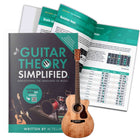
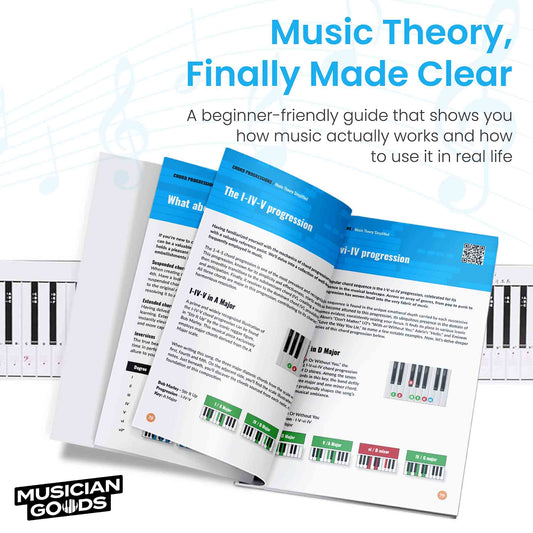
If you want a recommendation: we wrote Music Theory Simplified for exactly this audience — self-taught producers and instrumentalists who want the full framework in 160 visual, full-color pages instead of 600 of figured-bass exercises. We're biased about that recommendation, obviously. The honest version is: if our format clicks for you, finish ours; if a different format clicks better, finish that one. The goal is to finish a good theory book, not specifically ours.
View Music Theory Simplified →
Frequently asked questions
How long does a beginner theory book take to finish?
Ninety days at twenty minutes, three times a week, for most adult learners. That works out to roughly 25 hours of focused reading. Heavier classical textbooks like Tonal Harmony are designed to take a year or more, often alongside a teacher.
Should I read theory before I can play?
No. Spend the first three months of any new instrument on the instrument itself — basic chords, basic melodies, basic rhythm. Theory makes much more sense once your hands have something to attach the concepts to. Reading theory cold, before you can play anything, is the most reliable way to bounce off the topic permanently.
What's the best music theory book for producers vs guitarists vs pianists?
For producers and songwriters who work in a DAW, look for a theory book that uses pop and electronic-music examples instead of Bach chorales. For guitarists, an instrument-specific theory book (one with fretboard diagrams, not just a piano keyboard) cuts the translation cost and gets you applying concepts faster. For pianists, the standard general theory books all use piano-friendly notation by default. The shared trait of the right book is that it speaks your instrument's vocabulary, not the conservatory's.
Will a theory book make me a better songwriter?
Indirectly. It gives you the vocabulary to analyze why songs you love work, and the toolkit to attempt the same moves in your own writing. The actual songwriting craft — taste, lyric, narrative, melody — is a separate skill that theory doesn't teach. The combination of theory plus a regular writing habit is much stronger than either alone.
Do I need to read sheet music to use a theory book?
For most beginner theory books, no. Modern theory books for self-taught players use chord diagrams, piano-key visuals, and tablature alongside notation, and you can grasp the early chapters without reading staff fluently. Reading music becomes essential around the time you start analyzing actual scores, which is usually three to four months into a serious study program — by which point most readers have picked it up incidentally.