 4.8/5 on Trustpilot

If you have ever needed to play a song in a different key, you have already encountered the concept of chord transpose. Transposing chords is a core musical skill that allows you to adapt songs for singers, instruments, or different playing styles without rewriting the music from scratch.
This guide explains what chord transpose means, why it matters, and how to do it accurately and confidently.
What Does Chord Transpose Mean?
To transpose a chord means to move it up or down by the same musical distance so it fits a new key. Every chord in the song moves by the same number of steps, preserving the relationships between chords.
For example, if a song in the key of C is too high for a singer, you might transpose it down to the key of A or G. The melody feels the same, but the pitch range is more comfortable.
Why Chord Transpose Is So Important
Learning how to transpose chords gives you practical flexibility as a musician.
· Support vocalists by quickly changing keys
· Play with different instruments that favour certain keys
· Use easier chord shapes on guitar or ukulele
· Jam with others without stopping to relearn the song
Musicians who understand chord transpose can adapt on the fly, which is a major advantage in rehearsals and live settings.
1. Identify the Original Key
Look at the key signature or the chord progression. The first and last chords often reveal the key.
2. Choose the New Key
Decide how far up or down you want to move. This is usually based on vocal range or instrument comfort.
3. Count the Interval
Work out how many semitones you are moving. For example, C to D is two semitones up.
4. Move Every Chord Equally
Apply the same shift to every chord in the progression.
C → D
Am → Bm
Consistency is the rule. If one chord moves two semitones, they all do.
Using Capos for Quick Chord Transpose
Guitarists often use a capo to transpose chords without changing finger shapes. By placing the capo higher on the fretboard, you raise the pitch while playing familiar chords.
This is useful, but it is still important to understand the underlying chord transpose process so you know what key you are actually playing in.
Common Chord Transpose Mistakes
· Forgetting to transpose accidentals like sharps and flats
· Mixing enharmonic notes incorrectly (for example, using both A♯ and B♭ in the same key)
· Transposing some chords but not all of them
A strong grasp of intervals and key signatures helps avoid these issues.
Build Confidence with Chord Transposition
Chord transpose is not just theory. It is a practical skill that improves your musicianship across songwriting, performance, and collaboration. The more you practise transposing progressions, the faster and more instinctive it becomes.
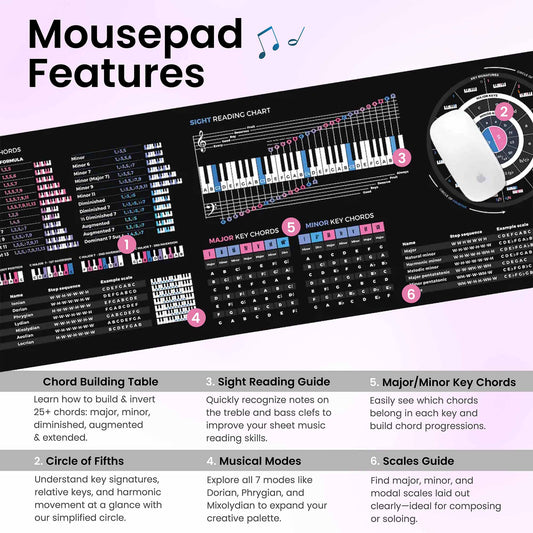
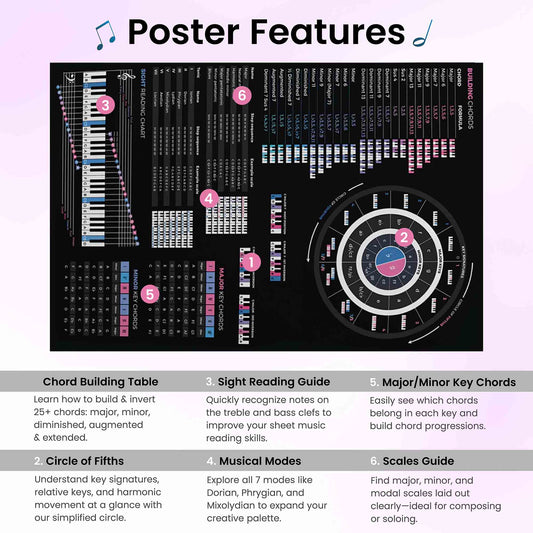
Using visual tools such as chord charts, fretboard guides, and theory references can dramatically speed up the learning process and reduce mistakes.
Final Thoughts
Understanding chord transpose gives you freedom. You are no longer locked into one key or one version of a song. Instead, you can adapt music to suit the situation, the singer, and the instrument in front of you.
If you want to progress beyond memorising songs and start truly understanding how music works, mastering chord transposition is a crucial step.






 Χάρτης Ακκόρντων Κιθάρας Mousepad
 Σημειωματάριο Θεωρίας Μουσικής Mousepad
 Φύλλο Απάτης Μίξης και Μάστερινγκ Mousepad


