4.8/5 on Trustpilot

Learning music theory from dense textbooks or rote memorization can feel overwhelming and confusing. Many musicians struggle to connect abstract concepts like chord progressions, key signatures, and harmonic relationships to their actual playing. Music diagrams offer a powerful solution by transforming these complex ideas into visual patterns that your brain can process faster and remember longer. This article explores why visual tools like the Circle of Fifths and chord charts have become essential for musicians and students who want to understand theory quickly, apply it confidently, and develop stronger musical skills without the frustration.
Key takeaways
| Point | Details |
|---|---|
| Visual patterns simplify theory | Music diagrams transform abstract concepts into recognizable shapes and colors that reduce cognitive load |
| Faster key and chord identification | Tools like the Circle of Fifths enable quick recognition of relationships needed for composition and improvisation |
| Improved memory and accuracy | Visual learning enhances retention and dramatically reduces performance errors compared to text-only methods |
| Best as learning complements | Diagrams work most effectively when combined with ear training and traditional notation practice |
How music diagrams simplify complex theory concepts
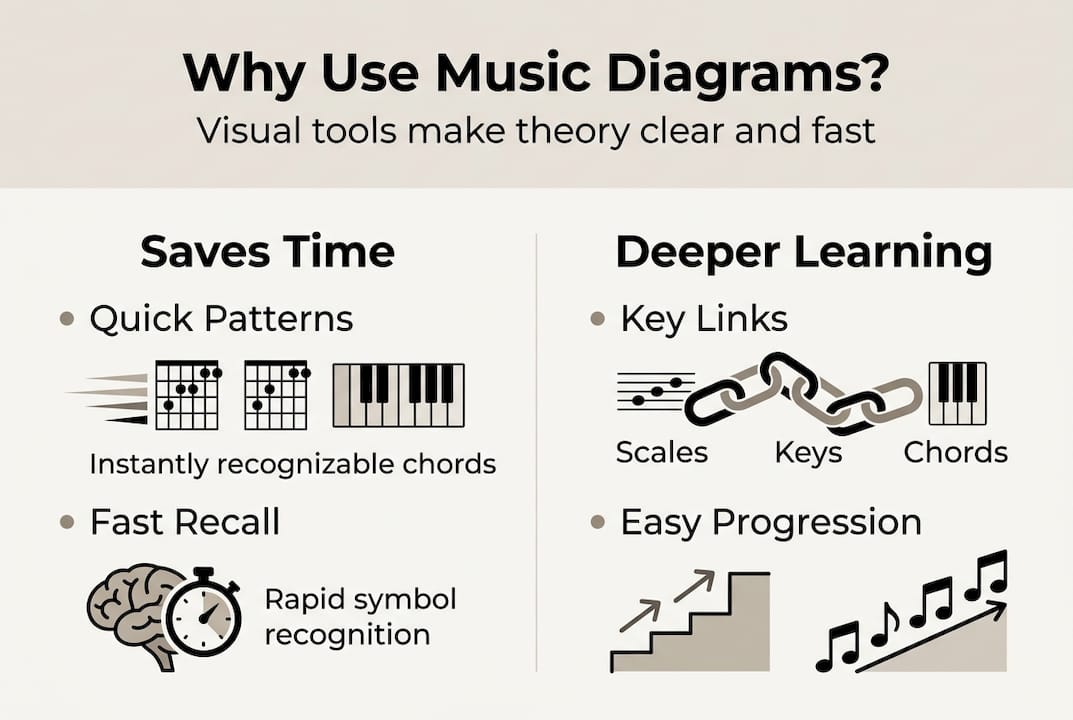
Traditional music theory instruction relies heavily on written explanations, formulas, and abstract rules that can overwhelm beginners and even challenge experienced players. Music diagrams like chord progression flow charts simplify complex music theory by visualizing relationships between chords, keys, scales, and harmony that are hard to grasp from text or rote learning. Instead of memorizing isolated facts, you see how musical elements connect and interact through spatial arrangements and visual cues.
The Circle of Fifths stands as one of the most recognized examples, arranging keys in a circular pattern that reveals their relationships at a glance. The Music Matrix uses geometric shapes and color coding to represent chord qualities and harmonic functions. These visual tools transform abstract concepts into tangible patterns your brain can process more efficiently. Diagrams use geometry, color, and paths to reduce cognitive load compared to abstract formulas, making theory accessible without requiring advanced mathematical thinking.
Visual paths show you how to move between related chords or modulate to new keys by following clear routes rather than calculating intervals mentally. Shapes communicate chord types instantly, with triangles indicating major chords and circles representing diminished harmonies in some systems. Color coding highlights harmonic tension and resolution, helping you understand why certain progressions sound stable or create anticipation. This approach speeds recognition dramatically and simplifies learning for both beginners taking their first theory steps and advanced players exploring sophisticated harmonic concepts.
The I-IV-V chord progression becomes immediately clear when you see it mapped visually rather than reading about Roman numeral analysis. You can trace the movement between tonic, subdominant, and dominant functions with your finger, building intuitive understanding that transfers directly to your instrument. This visual reinforcement creates mental shortcuts that make theory feel natural instead of academic.
Pro Tip: Use color-coded diagrams to quickly see harmonic tension and resolve patterns, then practice those progressions on your instrument to connect visual understanding with muscle memory and sound.
Key benefits of using music diagrams for musicians and students
Music diagrams deliver measurable advantages that extend beyond simple convenience. Visual aids like the Circle of Fifths enable quick identification of key signatures, relative minors, chord progressions, and modulation paths, making theory practical for transposition, composition, and improvisation. When you need to transpose a song to a different key during rehearsal, a quick glance at the diagram shows you exactly which chords to use without mental calculation or trial and error.
Memory retention improves dramatically when you engage visual learning pathways alongside verbal and auditory channels. Pattern recognition develops faster because your brain excels at remembering spatial relationships and visual associations. Research demonstrates that visual tools produce remarkable improvements in performance accuracy. Studies show that dynamics visualization cuts errors by 256 percent, while pitch deviation drops from 7.24 Hz to just 1.14 Hz when musicians use visual aids during practice.
“Visual perceptual mechanisms are key to fluent note recognition but hard to teach verbally; diagrams target these for efficient, personalized learning, especially for visual learners in multimodal music education.”
These benefits extend to real-world musical situations where speed and accuracy matter. During jam sessions, you can reference a diagram to find complementary chords or explore harmonic variations without interrupting the flow. Composition becomes more exploratory as you visually map out possible chord sequences and identify interesting modulations. Improvisation gains structure when you can see available scale tones and chord extensions laid out spatially rather than calculating them mentally while playing.
The circle of fifths particularly shines for understanding key relationships and building chord progressions that sound professional. You can instantly see which keys share the most common tones, making modulations smooth and natural. Borrowing chords from parallel keys becomes intuitive when you visualize their proximity on the diagram. These practical applications transform theoretical knowledge into creative tools you use every time you play.

Visual learners especially benefit from diagram-based instruction, but multimodal approaches that combine visual, auditory, and kinesthetic elements optimize learning for all personality types. Even musicians who don’t identify as primarily visual learners report faster comprehension when diagrams supplement traditional instruction methods.
Limitations and best practices for using music diagrams effectively
Diagrams provide powerful learning advantages, but they work best as part of a balanced musical education rather than as standalone solutions. While diagrams excel for theory understanding, some experts note notation can inhibit expressive performance or improvisation when over-relied upon. Alternatives like tabs suit certain styles but lack the theoretical depth that well-designed diagrams provide. The key lies in using visual tools strategically without allowing them to replace essential skills like ear training and sight reading.
Traditional notation conveys rhythmic nuance, articulation marks, and dynamic expression that diagrams typically omit. Tablature simplifies finger placement for guitarists and bassists but provides no harmonic context or transferable theory knowledge. Each format serves specific purposes, and skilled musicians develop fluency across multiple representation systems. Visuals transform abstract theory into tangible patterns but may create over-reliance that hinders aural independence if used exclusively.
| Format | Complexity | Expressiveness | Learning Curve | Best Use Case |
|---|---|---|---|---|
| Music Diagrams | Medium | Low | Fast | Theory understanding and pattern recognition |
| Traditional Notation | High | High | Slow | Classical performance and composition |
| Tablature | Low | Very Low | Very Fast | Quick song learning for fretted instruments |
| Chord Charts | Low | Low | Very Fast | Lead sheets and improvisation frameworks |
Balancing these approaches creates well-rounded musicianship. Use diagrams to grasp theoretical concepts and see relationships clearly. Practice with standard notation to develop reading fluency and interpretive skills. Train your ear regularly through interval recognition, chord identification, and transcription exercises. This combination builds both intellectual understanding and practical musical intuition.
Beginners sometimes rely too heavily on visual references during performance, which can slow down their playing and reduce musical spontaneity. The goal should be internalizing the patterns diagrams reveal so you can apply them instinctively. Start by studying diagrams away from your instrument to understand the concepts. Then practice applying those patterns while playing until they become automatic. Eventually, the visual framework becomes mental scaffolding you carry internally.
Basic music theory for beginners benefits tremendously from diagram use, but advancing students must gradually reduce their dependence on external visual aids. Think of diagrams as training wheels that help you learn faster initially, then become less necessary as your understanding deepens.
Pro Tip: Use diagrams to grasp theory concepts during study sessions, but regularly practice by ear and with standard notation to develop well-rounded musicianship that doesn’t depend on visual cues during performance.
Practical ways to integrate music diagrams into your learning and performance
Successfully incorporating visual tools into your musical development requires intentional practice strategies that connect diagram study with hands-on application. Start by selecting diagrams that address your current learning goals, whether that’s understanding chord construction, mastering key signatures, or exploring modal scales. Keep these references accessible during practice sessions but challenge yourself to recall information from memory before checking the diagram.
During composition and songwriting, use diagrams as creative springboards rather than rigid templates. The Circle of Fifths can suggest unexpected modulations or chord substitutions you might not discover through trial and error alone. Chord progression flowcharts reveal common patterns in your favorite genres while encouraging variations that add your personal touch. Map out your song structure visually before committing it to notation or recording, allowing you to experiment with harmonic movement efficiently.
Improvisation benefits enormously from diagram familiarity because visual memory helps you navigate chord changes confidently. Before a jam session, review relevant diagrams for the key you’ll be playing in. Visualize scale patterns and chord tones spatially so you can access them instinctively during spontaneous playing. This preparation builds a mental map that guides your musical choices without requiring conscious calculation.
Research shows that multimodal integration boosts retention over single-mode teaching, with combined visual and auditory training producing superior results across diverse musical contexts including non-Western systems and novel instruments. The data demonstrates clear advantages for learners who engage multiple sensory pathways simultaneously.
| Learning Mode | Retention Rate | Application Speed | Long-Term Recall |
|---|---|---|---|
| Visual Only | 65% | Medium | 58% |
| Auditory Only | 60% | Slow | 55% |
| Kinesthetic Only | 70% | Fast | 62% |
| Multimodal Combined | 88% | Very Fast | 81% |
Follow this progression to maximize diagram effectiveness in your practice routine:
- Study the diagram away from your instrument to understand its logic and organization without performance pressure.
- Identify specific patterns or relationships the diagram reveals, such as relative minor keys or common chord substitutions.
- Apply one concept from the diagram to your instrument, playing through examples until the pattern feels comfortable.
- Practice the concept in musical context by incorporating it into songs, exercises, or improvisation over backing tracks.
- Gradually reduce diagram reference during playing, testing your ability to recall and apply concepts from memory.
- Return to the diagram periodically to discover deeper insights as your skills advance and new questions emerge.
This systematic approach transforms passive diagram viewing into active learning that builds genuine musical competence. Practical music theory tips for guitar beginners emphasize this connection between visual understanding and physical application, ensuring theory knowledge translates directly to improved playing.
Set specific goals for each practice session that combine diagram study with instrumental work. For example, spend ten minutes analyzing chord relationships on the Circle of Fifths, then dedicate twenty minutes to playing progressions that demonstrate those relationships in different keys. This focused approach prevents diagrams from becoming decorative wall art that you glance at occasionally without deep engagement.
Explore essential music theory tools and resources
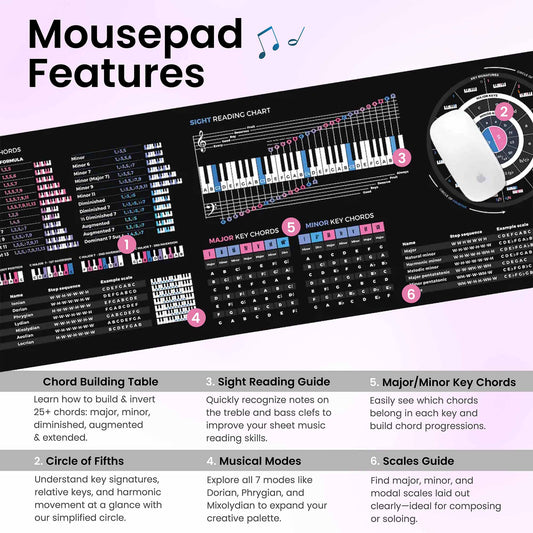
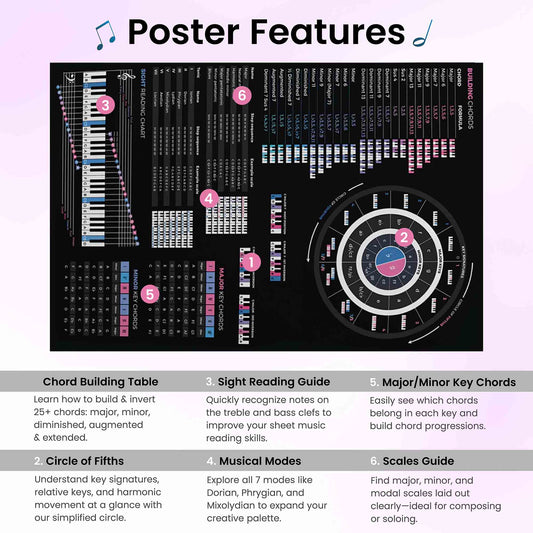
Taking your music theory understanding to the next level requires quality resources designed specifically for practical learning. Musiciangoods offers comprehensive tools that complement the diagram-based approach discussed throughout this guide. Our cheat sheets provide quick-reference visuals for scales, chords, and progressions that you can keep near your practice space or instrument case. Theory books break down complex concepts into manageable lessons with clear diagrams and exercises that reinforce learning through application.

These resources work together to support your musical journey whether you’re just starting to explore theory or refining advanced concepts. Each tool is created by musicians who understand the challenges of learning theory and the value of visual aids that make abstract ideas concrete. Visit music theory tools and cheat sheets to discover products designed to accelerate your progress and deepen your musical understanding through accessible, visually-rich content.
Frequently asked questions
Why are music diagrams important for beginners?
Music diagrams convert complex theoretical concepts into visual patterns that reduce cognitive load and improve early understanding. They help beginners see relationships between chords, keys, and scales that remain abstract when presented through text alone. Visual learners especially benefit from this approach, though multimodal methods combining diagrams with listening and playing produce the strongest results for all learning styles.
Can music diagrams replace traditional music notation?
Diagrams excel at teaching theoretical relationships and harmonic concepts but cannot replace traditional notation for conveying rhythm, articulation, dynamics, and other expressive elements essential to advanced playing. The most effective approach combines both formats, using diagrams to understand theory while developing notation reading skills for performance. Balanced fluency across multiple representation systems creates well-rounded musicianship.
How can I use music diagrams to improve improvisation?
Diagrams like the Circle of Fifths help you quickly identify related chords, available scale tones, and smooth modulation paths that inspire improvisation choices. Study relevant diagrams before playing to build mental maps of harmonic possibilities within a key. Combining visual preparation with ear training enhances spontaneous creativity because you understand both the theoretical options and how they sound, allowing confident exploration during performance.
Do all musicians benefit equally from music diagrams?
Visual learners gain the most immediate advantages from diagram-based instruction, but research shows that multimodal approaches combining visual, auditory, and kinesthetic elements optimize outcomes for everyone. Even musicians who don’t identify as visual learners report faster comprehension when diagrams supplement traditional teaching methods. The key lies in using diagrams as one component of comprehensive musical education rather than relying on them exclusively.