



Learning to play guitar or bass can feel overwhelming when faced with pages of complicated sheet music. Chord charts offer a clear path forward for beginners by breaking down songs into simple symbols and visual guides that reveal core harmonies and rhythms. These tools not only speed up music learning but also help unlock smoother practice sessions and more confident playing. Discover how chord charts can simplify complex theory and make every song feel within reach.
Table of Contents
- Chord Chart Basics And What They Show
- Comparing Popular Chord Chart Types
- How To Read Chord Charts Effectively
- Real-World Uses For Guitar And Bass
- Common Mistakes And How To Avoid Them
Key Takeaways
| Point | Details |
|---|---|
| Understanding Chord Charts | Chord charts simplify musical notation, allowing musicians to quickly comprehend and play songs. They are essential for both beginners and experienced players. |
| Different Notation Systems | Various chord chart types cater to specific genres, with styles like Jazz using complex notation and Pop favoring simpler formats. Understanding these can enhance musical versatility. |
| Reading Techniques | Developing systematic reading skills is crucial for musicians to interpret chord charts effectively, impacting performance and improvisation abilities. |
| Common Mistakes | Awareness of frequent errors, such as overlooking key signatures and misreading chord symbols, helps musicians improve their accuracy in reading charts. |
Chord Chart Basics and What They Show
Chord charts are essential visual guides that help musicians understand and play musical compositions quickly and effectively. These graphical representations break down a song’s harmonic structure into simple, easy-to-read notations that make learning music more accessible for beginners and experienced players alike. Musical notation systems provide musicians with critical information about chord progressions and harmonic foundations.
Chord charts typically include several key elements that help musicians navigate a song’s structure:
- Chord Symbols: Representations of specific chords to be played (major, minor, seventh)
- Rhythmic Indications: Slashes or specific rhythmic notations showing chord durations
- Optional Lyrics: Sometimes integrated to show chord placement relative to vocal lines
- Voicing Suggestions: Occasional notes about specific chord fingerings or variations
The primary purpose of a chord chart is to communicate musical information efficiently. Unlike traditional sheet music, which requires reading complex musical notation, chord charts use straightforward symbols that any musician can quickly understand. This simplification makes learning new songs dramatically faster and more intuitive.

Musical Styles and Chord Charts
Different musical genres utilize chord charts with slight variations. Jazz musicians might use more complex notation, while pop and rock charts tend to be more straightforward. Chord notation methods can even vary by region, with some using number-based systems like Nashville notation to facilitate easier key transpositions.
Pro tip: Always keep a chord chart reference guide nearby when practicing to quickly decode unfamiliar chord symbols and accelerate your musical learning journey.
Comparing Popular Chord Chart Types
Chord charts come in multiple variations, each designed to meet the specific needs of different musical genres and performance styles. Chord notation systems provide musicians with flexible tools for capturing musical information across diverse musical contexts.
The primary types of chord charts include:
- Rhythmic Notation Charts: Provide precise rhythmic patterns and exact chord placements
- Slash Notation Charts: Offer a more relaxed approach with general chord comping indications
- Nashville Notation Charts: Use numerical representations of chord degrees for easier transposition
Each notation system offers unique advantages for musicians. Rhythmic notation charts are particularly useful for complex jazz arrangements, where precise timing is critical. Slash notation provides more flexibility, allowing musicians to interpret chord placements more creatively. Notation variations typically include consistent elements like key signatures, time signatures, and section markers to help musicians navigate the musical landscape.
Comparative Analysis of Chord Chart Types
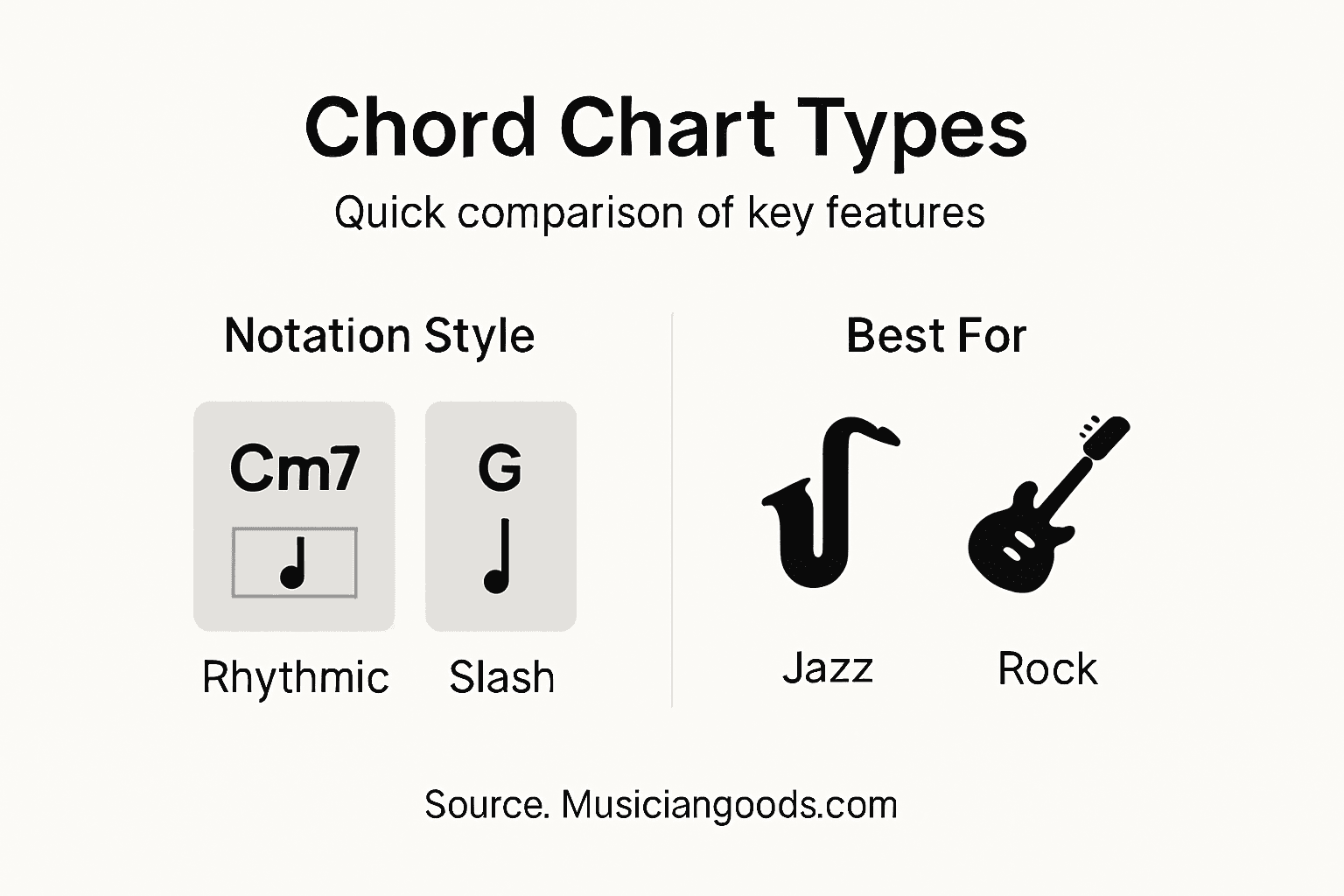
The choice of chord chart depends significantly on musical genre and performance context. Jazz musicians often prefer more detailed rhythmic notations, while rock and pop performers might opt for simpler, more straightforward chord representations. Nashville notation stands out as a particularly flexible system, enabling musicians to quickly transpose songs across different keys without redesigning the entire chart.
Here is a quick comparison of popular chord chart types and their ideal musical applications:
| Chart Type | Key Use Case | Genre Suitability | Notation Complexity |
|---|---|---|---|
| Rhythmic Notation | Precise chord timing | Jazz, Fusion | High detail, complex |
| Slash Notation | Flexible comping | Pop, Rock, Folk | Simple and informal |
| Nashville Number System | Rapid key changes | Country, Studio Work | Moderate, numbers-based |
Pro tip: Master multiple chord chart types to become a more versatile and adaptable musician, improving your ability to read and interpret music across different genres and styles.
How to Read Chord Charts Effectively
Reading chord charts is a fundamental skill that separates novice and advanced musicians. Chord chart interpretation requires understanding multiple layers of musical notation, from basic chord symbols to more complex rhythmic indications.
Key elements musicians must recognize include:
- Chord Symbols: Representing chord qualities (major, minor, diminished, augmented)
- Rhythmic Notations: Indicating precise timing and chord duration
- Section Markers: Highlighting verse, chorus, and bridge transitions
- Chord Progressions: Showing harmonic movement and musical structure
Successful chord chart reading involves developing a systematic approach. Musicians must quickly translate visual symbols into playable musical information, which requires consistent practice and understanding of fundamental music theory principles. The ability to read chord charts efficiently allows performers to adapt quickly to new musical arrangements and improvise more confidently.
Decoding Chord Symbols and Notations
Each chord symbol carries specific information about the notes to be played. A “C” might indicate a simple major chord, while “Cm7” suggests a minor seventh chord with additional complexity. Learning to recognize these nuanced symbols rapidly transforms a musician’s ability to interpret and perform music across different genres and styles.
To help you read chord charts more effectively, here are key notation elements and how they impact musical performance:
| Element | Meaning | Impact on Performance |
|---|---|---|
| Chord Symbols | Indicates chord quality | Guides harmony choices |
| Rhythmic Notations | Shows chord duration | Shapes song’s groove |
| Section Markers | Marks song structure | Enables smooth transitions |
| Progression Patterns | Sequence of chords | Influences improvisation |
Pro tip: Practice reading chord charts daily, starting with simple progressions and gradually increasing complexity to build muscle memory and visual recognition skills.
Real-World Uses for Guitar and Bass
Chord charts serve critical functions across diverse musical environments, transforming how guitarists and bassists learn, compose, and perform music. These visual tools bridge the gap between complex musical theory and practical application, enabling musicians to quickly understand and reproduce harmonic structures.
Practical applications of chord charts include:
- Learning New Songs: Rapidly understanding song structure and chord progressions
- Composition: Creating original music by experimenting with harmonic sequences
- Performance Preparation: Quickly memorizing and practicing complex arrangements
- Music Education: Providing a standardized method for teaching musical concepts
For guitarists and bassists, chord charts are particularly valuable in different musical contexts. In rock music, they help players quickly learn power chord progressions, while jazz musicians use more complex chord notations to understand sophisticated harmonic movements. Classical and acoustic performers rely on chord charts to maintain consistent interpretations of musical compositions.
Genre-Specific Chord Chart Applications
Each musical genre adapts chord charts uniquely. A punk rock band might use simplified chord charts emphasizing rhythm, while a jazz ensemble might require intricate charts showing multiple chord voicings and improvisational opportunities. The versatility of chord charts makes them an essential tool for musicians across skill levels and musical styles.
Pro tip: Collect chord charts from multiple genres to expand your musical vocabulary and improve your ability to adapt to different playing styles.
Common Mistakes and How to Avoid Them
Musicians frequently misinterpret chord chart details, leading to performance errors that can disrupt musical flow and cohesion. Understanding these common pitfalls is crucial for developing accurate reading and interpretation skills.
Most frequent chord chart mistakes include:
- Ignoring Time Signatures: Failing to recognize rhythm and timing indicators
- Overlooking Key Changes: Missing critical shifts in musical key
- Misreading Chord Symbols: Incorrectly interpreting chord quality or voicing
- Assuming Single Chord Measures: Not recognizing multiple chord changes within one measure
Technical misinterpretations often stem from insufficient practice and limited understanding of musical notation. Guitarists and bassists must develop a systematic approach to reading chord charts, which involves careful analysis of every notational element before performance. Consistent practice and close examination of chart details can significantly reduce errors and improve musical accuracy.
Strategies for Accurate Chart Reading
Effective chart reading requires more than visual recognition. Musicians should develop active reading techniques, such as mentally hearing the chord progression, tracking rhythmic patterns, and anticipating potential key or tempo changes. Breaking down complex charts into smaller, manageable sections can help musicians build confidence and reduce performance anxiety.
Pro tip: Create a personal chord chart reference guide with detailed annotations of symbols and notations you find challenging to remember.
Accelerate Your Music Learning with Practical Tools from Musiciangoods
Struggling to decode complex chord charts and master rhythm patterns? This article highlights how understanding chord symbols, rhythmic notations, and progression patterns is essential but can be overwhelming. If you want to avoid common mistakes like misreading chord qualities or ignoring time signatures, you need accessible, easy-to-understand learning aids that simplify these musical concepts. Musiciangoods specializes in exactly that by offering educational books, cheat sheets, and visual diagrams created by musicians for musicians to help you unlock faster music learning.

Discover step-by-step systems, practical accessories, and in-depth tutorials that align perfectly with the core challenges of reading and interpreting chord charts. Visit Musiciangoods to explore resources designed to boost your confidence with chord progressions and rhythmic details. Start your journey today and experience how our tools can transform your practice sessions into quicker, more effective learning moments. Empower your musical growth now by checking out our comprehensive offerings at Musiciangoods and deepen your understanding of chord charts with trusted resources.
Frequently Asked Questions
What is a chord chart?
A chord chart is a visual representation of a song’s harmonic structure, using chord symbols and rhythmic indicators to help musicians play music efficiently and intuitively.
What are the main types of chord charts?
The primary types of chord charts include rhythmic notation charts, slash notation charts, and Nashville notation charts, each catering to different musical styles and levels of complexity.
How can I improve my ability to read chord charts?
To enhance your chord chart reading skills, practice daily with simple progressions, familiarize yourself with chord symbols and rhythmic indicators, and develop a systematic approach to interpreting the visual symbols.
What are common mistakes musicians make when using chord charts?
Common mistakes include ignoring time signatures, overlooking key changes, misreading chord symbols, and assuming single chord measures when there may be multiple chord changes within one measure.