4.8/5 on Trustpilot

Most music theory books were written for one of two people: the conservatory undergraduate working through a four-year curriculum, or the absolute beginner who has never touched an instrument. If you're a self-taught producer, songwriter, or guitarist who can already play but wants to understand what you're playing, neither extreme is much help. One overshoots, the other underdelivers, and you finish the book either bored or no closer to writing a chord progression you actually like.
The list below is the result of working through every general-purpose music theory book that gets recommended on r/musictheory, the major method publishers' catalogs, and the syllabuses of the open-courseware schools. The seven books here are the ones that pass a single test: if a self-taught adult bought this book and worked through it for ninety days, would they leave understanding intervals, chord construction, key signatures, and basic functional harmony — enough to analyze a song they like? The rest didn't make the cut.
Quick comparison
| Book | Best for | Pages | Price range |
|---|---|---|---|
| Music Theory Simplified | Visual, self-taught learners | 160 | €22–€40 |
| Music Theory for Dummies | Plain-English beginners | 384 | $18–$28 |
| Alfred's Essentials of Music Theory | Workbook learners | 152 | $22–$30 |
| Idiot's Guide to Music Theory | Conversational learners | 352 | $18–$24 |
| Edly's Music Theory for Practical People | Working musicians | 160 | $20–$28 |
| Tonal Harmony (Kostka) | Serious depth, classical bias | 688 | $80–$160 |
| The Jazz Theory Book | Improvisers and arrangers | 522 | $35–$50 |
1. Music Theory Simplified — best for visual, self-taught musicians

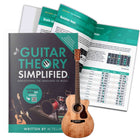
Author: Melvin Tellier · 160 pages, full-color · Paperback / PDF / Bundle
Full disclosure first: Music Theory Simplified is published by Musiciangoods, the company that runs this blog. We're putting it at #1 because it's the book we wish we'd had when we started, not because we wrote it. If you disagree, the next six entries are equally honest recommendations.
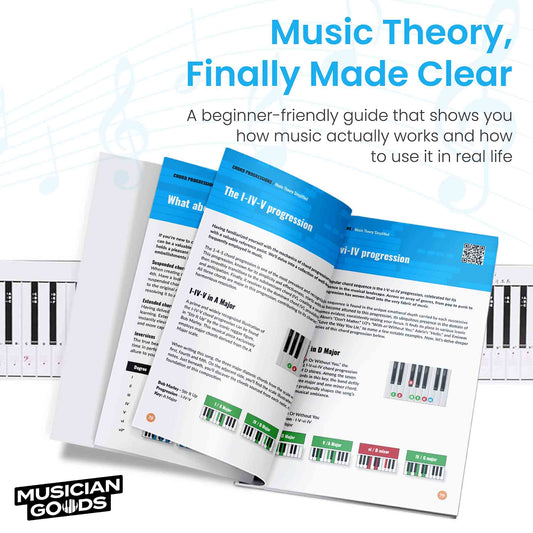
What makes Music Theory Simplified work for self-taught adults is what it leaves out. It teaches the same intervals, scales, key signatures, chord construction, and functional harmony that the heavy classical textbooks cover, but it does it in 160 pages of full-color diagrams instead of 600 pages of figured-bass exercises. Each chapter introduces one concept, shows the shape on a piano keyboard or staff, gives two or three exercises, and moves on. There is no thirty-page detour through species counterpoint before you can identify a key.
It is also the only book on this list written specifically for producers and songwriters rather than classical performers. The chord-progression chapters use pop and electronic-music examples instead of Bach chorales, and the harmony section treats Roman-numeral analysis as a tool for writing songs, not for passing a theory exam.
Best for: producers, songwriters, and self-taught instrumentalists who want to understand intervals, scales, and harmony in a season rather than a year.
View Music Theory Simplified →
2. Music Theory for Dummies — best for plain-English beginners

Authors: Michael Pilhofer, Holly Day · 384 pages · Wiley, paperback
The For Dummies brand has earned a reputation it doesn't fully deserve. The actual book is patient, well-sequenced, and covers more ground than most people expect: notation, rhythm, intervals, scales, modes, chord construction, basic counterpoint, song forms, and a brief section on orchestration. It is not flashy and the visual design is utilitarian, but the prose explains every concept twice — once in plain English and once in the technical vocabulary you will eventually need.
The downside is that it tries to cover everything, which means no single topic gets the deep treatment a focused theory book gives. Use it as a first read to build your map of the territory, then go deeper in the areas that matter for your instrument or style.
Best for: beginners who want one book that explains every term they have heard but never understood.
3. Alfred's Essentials of Music Theory — best for workbook learners

Authors: Andrew Surmani, Karen Farnum Surmani, Morton Manus · 152 pages · Alfred Music, paperback with audio
Alfred's three-volume set, often sold as the complete Essentials edition, is the textbook used in countless American middle-school and high-school music programs. It is structured around weekly lessons, each ending with a written exercise and an ear-training drill. If you learn best by doing rather than reading, this is the book on the list with the most actual practice built in.
Best for: learners who want a structured curriculum with built-in exercises and ear-training audio.
4. The Complete Idiot's Guide to Music Theory — best conversational entry

Author: Michael Miller · 352 pages · Penguin Random House, paperback
The Idiot's Guide branding is misleading. The actual book is one of the best plain-language introductions to functional harmony available, and Miller writes with genuine warmth. He covers notation, rhythm, intervals, scales, chord progressions, modulation, and an introduction to form, with frequent worked examples and a companion CD of audio illustrations.
Best for: learners who bounced off classical textbooks and want a friendly tour of the same material.
5. Edly's Music Theory for Practical People — best for working musicians

Author: Ed Roseman · 160 pages · Musedco, paperback
Edly's is the cult favorite on this list. Roseman writes for people who already play in bands, gig on weekends, or produce at home and have figured out they need theory but resent classical pedagogy. The tone is sarcastic, the diagrams are hand-drawn cartoons, and the focus is squarely on the practical skills working musicians use: building chords on the fly, transposing, navigating jam sessions, and figuring out songs by ear.
Best for: gigging musicians and self-taught players who want theory that translates directly to playing situations.
6. Tonal Harmony by Kostka and Payne — best for serious depth

Authors: Stefan Kostka, Dorothy Payne, Byron Almén · 688 pages · McGraw-Hill, hardcover
Tonal Harmony is the textbook used in roughly half of American university theory programs. It is rigorous, dense, and assumes you already read music fluently. If you want to understand secondary dominants, modal mixture, modulation, and chromatic harmony at the level a music-school graduate does, this is the book that gets you there.
Best for: learners who have already finished a beginner book and want to go deep on classical harmonic analysis.
7. The Jazz Theory Book by Mark Levine — best for improvisers and arrangers

Author: Mark Levine · 522 pages · Sher Music, paperback
Levine's book is the standard reference for jazz harmony, and it has quietly become the standard for any genre that uses extended chords, modal interchange, or non-diatonic improvisation — meaning fusion, neo-soul, modern R&B, and a great deal of cinematic scoring. Whether or not you intend to play jazz, the chapters on chord-scale relationships, ii-V-I progressions, and reharmonization will change how you hear chord progressions in any genre.
Best for: learners who already know basic theory and want to understand how chords work in jazz, fusion, and modern soul.
How to choose between them
If you have never studied theory at all, start with one of the three plain-language entries: Music Theory Simplified if you learn visually and want to apply the material to producing or songwriting, Music Theory for Dummies if you want the broadest possible map of the territory, or the Idiot's Guide if you respond to a conversational tone.
If you already know intervals and basic chord construction and want to go deeper, pick by goal. Tonal Harmony is the route to classical analytical fluency. The Jazz Theory Book is the route to improvisational and arranging fluency. Edly's is the route to practical band-and-session fluency.
One warning: the single most reliable predictor of whether someone learns music theory is whether they finish the first book they bought. Two unfinished theory books on the shelf is the same as zero. Pick one, work it cover to cover, and only buy the next when you actually need it.
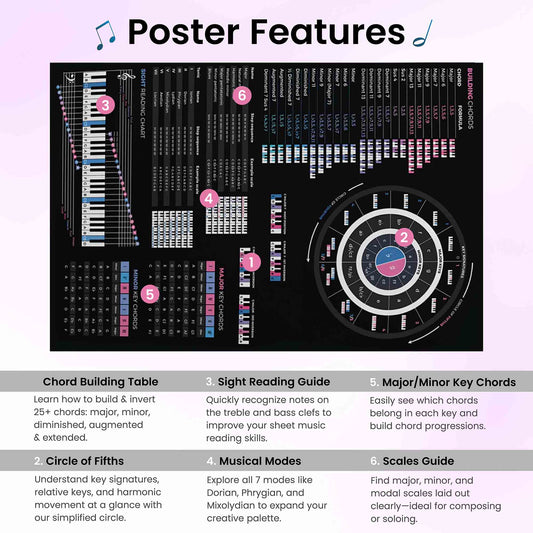
If you want to keep the basics within arm's reach while you work, our Music Theory Cheat Sheet Poster condenses scales, intervals, and key signatures onto a single sheet you can pin above the desk.
Frequently asked questions
Do I need to read music to learn music theory?
Eventually, yes — but not on day one. The first three books on this list teach the early chapters with chord diagrams, piano-key visuals, and audio examples alongside notation, so you can grasp intervals and basic harmony before you become fluent at sight-reading. Reading music is a separate skill that becomes essential around the time you start analyzing actual scores, which is usually a few months in.
How long does it take to work through a music theory book?
For most self-taught adults, ninety days of consistent thirty-minute practice sessions is enough to finish any of the focused beginner books on this list. The deeper books — Tonal Harmony, The Jazz Theory Book — are designed to be worked through over a year or more, often alongside a teacher or course.
Is online learning enough, or do I still need a book?
Online lessons are excellent for ear training and demonstration, but they are scattered for theory. You can stitch together a theory education from YouTube, but it will take longer than working through one structured book. Most learners we talk to use both: a book to anchor the curriculum, and videos to demonstrate the harder concepts in motion.
Should producers learn music theory differently from instrumentalists?
The fundamentals are the same — intervals, scales, chord construction, functional harmony — but the order of attack is different. Producers benefit from learning chord progressions and modal sounds early, since those are the day-to-day tools in arrangement. Instrumentalists benefit from drilling intervals and key signatures earlier because those skills feed directly into reading and ear training.