


Struggling to make sense of sheet music on your bass guitar can turn an exciting practice session into a frustrating chore. Setting up your learning space with minimal distractions and solid visual resources makes every note and rhythm easier to read from day one. By focusing on comfort, clear lighting, and easy-to-use digital tools, you build a practice zone that lets you learn faster and play better—so you spend less time guessing and more time making music.
Table of Contents
- Step 1: Set Up Your Sheet Music Reading Space
- Step 2: Identify Bass Clef Notes Quickly
- Step 3: Decode Rhythms with Visual Aids
- Step 4: Apply Note Reading to Your Bass Guitar
- Step 5: Test Your Progress with Simple Songs
Quick Overview
| Main Insight | Detailed Explanation |
|---|---|
| 1. Set Up a Distraction-Free Space | A dedicated area with good lighting and minimal distractions enhances focus during practice. |
| 2. Master Bass Clef with Mnemonics | Use mnemonic devices like “Good Boys Do Fine Always” to quickly memorize bass clef notes. |
| 3. Utilize Visual Aids for Rhythms | Techniques like color-coded charts and physical movement help simplify and internalize rhythms. |
| 4. Connect Notes to Fingerboard | Practice correlating written notes with finger placements to build confidence in playing. |
| 5. Test Skills with Simple Songs | Start with easy songs to apply your reading skills and gradually increase complexity to enhance learning. |
Step 1: Set Up Your Sheet Music Reading Space
Creating an optimal bass guitar sheet music reading space transforms your practice sessions from frustrating to focused. Your environment plays a crucial role in how effectively you learn and interpret musical notation.
Start by selecting a dedicated area with minimal distractions and excellent lighting. Position a sturdy, adjustable music stand at a height that allows you to read sheet music comfortably while maintaining good posture. You can generate custom practice sheets using online music notation tools to help streamline your learning process.
Consider these key elements for your sheet music reading space:
- Comfortable chair with proper back support
- Adjustable music stand positioned at eye level
- Well-lit area with natural or directed lighting
- Clutter-free surface for your sheet music and bass guitar
- Easy access to practice tools and reference materials
Ensure your sheet music is clearly visible and within easy reach. Music notation software can help you generate clean, easy-to-read bass guitar sheet music that enhances your learning experience.
A well-organized practice space is the foundation of effective musical skill development.
Pro tip: Keep a small clipboard or paperweight nearby to prevent sheet music from sliding or fluttering during practice sessions.
Step 2: Identify Bass Clef Notes Quickly
Mastering the bass clef is crucial for any bass guitar player who wants to read sheet music with confidence. This step will help you quickly recognize and memorize the notes in the bass clef, transforming your musical reading skills.
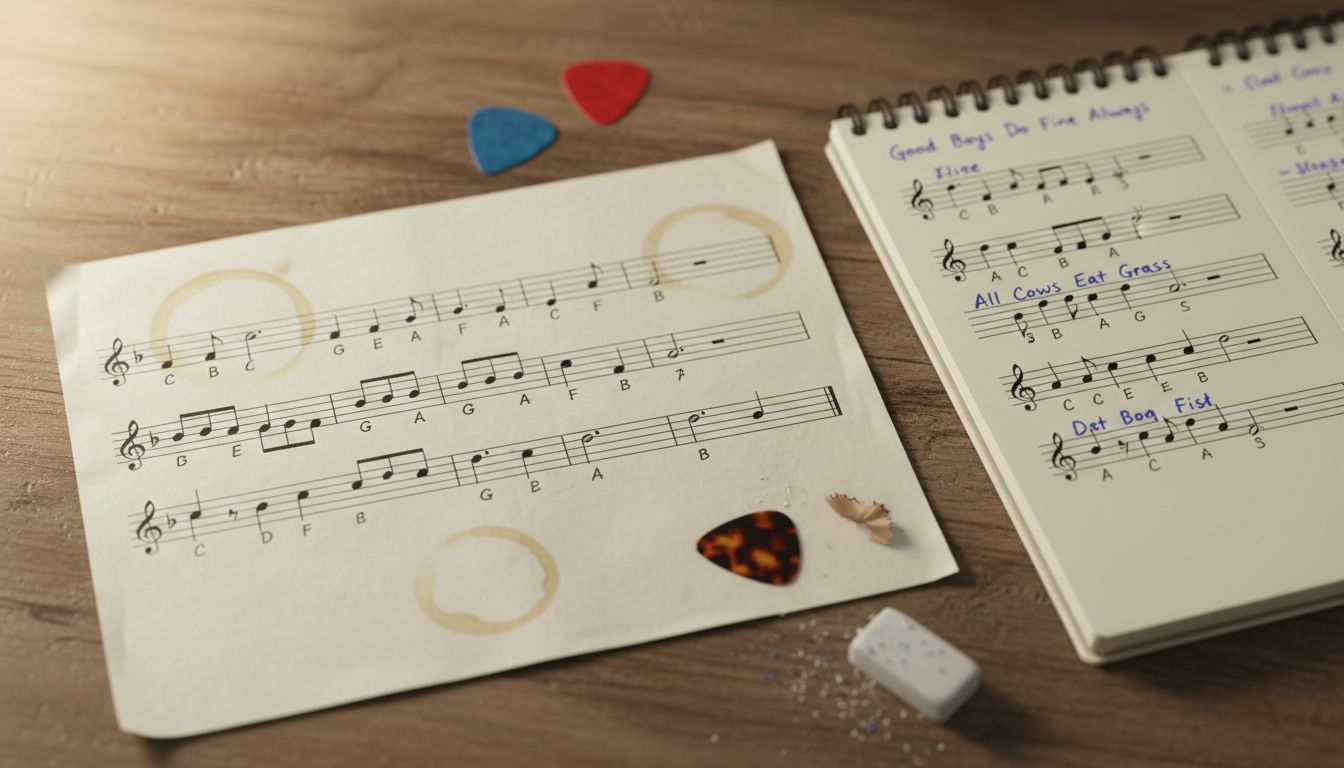
The bass clef, also known as the F clef, centers on the fourth line of the staff, which represents the note F below middle C. To learn bass clef notes rapidly, you’ll need to memorize both the lines and spaces using memorable mnemonic devices.
Here’s how to identify bass clef notes systematically:
-
Line notes from bottom to top: Good Boys Do Fine Always
- First line: G
- Third line: D
- Fourth line: F (center of bass clef)
- Fifth line: A
-
Space notes from bottom to top: All Cows Eat Grass
- First space: A
- Second space: C
- Third space: E
- Fourth space: G
Practice linking these notes to their actual positions on your bass guitar fingerboard. The more you associate written notes with physical finger placements, the faster you’ll become at reading sheet music.
Here’s a quick reference guide to common bass clef note positions on the staff and their fingerboard equivalents:
| Staff Position | Note Name | Fingerboard String | Typical Fret Location |
|---|---|---|---|
| 1st Line | G | E String | 3rd Fret |
| 2nd Line | B | A String | 2nd Fret |
| 3rd Line | D | D String | Open |
| 4th Line | F | D String | 3rd Fret |
| 5th Line | A | G String | 2nd Fret |
Consistent practice transforms complex musical notation into intuitive visual language.
Pro tip: Create flashcards with bass clef notes and quiz yourself during downtime to accelerate your learning process.
Step 3: Decode Rhythms with Visual Aids
Unlocking the mystery of rhythms is a game-changer for bass guitar players learning to read sheet music. Decoding musical rhythms requires a strategic approach that transforms complex notation into intuitive patterns you can easily understand.
Visual learning is key to mastering rhythm. Think of rhythmic notation like a musical language with its own unique grammar. Each note and rest has a specific duration, and understanding these visual symbols will help you translate sheet music into precise bass guitar performance.
Here are some powerful visual techniques to decode rhythms:
- Create rhythm charts with color-coded note durations
- Use physical movement to internalize timing
- Clap out rhythmic patterns
- Tap your foot to match written rhythms
- Practice reading rhythms without your instrument
- Break complex rhythms into smaller, manageable segments
Combining visual aids with multisensory rhythm learning transforms abstract symbols into tangible musical experiences. Physical actions like clapping or tapping help bridge the gap between written notation and actual sound.
The following table compares visual rhythm decoding techniques for improving sheet music reading:
| Technique | Visual Impact | Recommended Practice | Benefit to Bass Players |
|---|---|---|---|
| Color-coded charts | Distinguishes durations | Daily review | Faster rhythm recognition |
| Physical movement | Reinforces timing | Clap or tap | Improves timing accuracy |
| Segment breakdown | Simplifies notation | Analyze in sections | Eases complex rhythm learning |
Rhythm is the heartbeat of music - master its visual language, and you’ll unlock a new level of musical understanding.
Pro tip: Record yourself practicing rhythms and watch the playback to visually confirm your timing and accuracy.
Step 4: Apply Note Reading to Your Bass Guitar
Transforming sheet music into actual bass guitar playing is the ultimate goal of learning notation. Mapping notes to your fingerboard requires a strategic approach that connects visual symbols with physical finger placement.
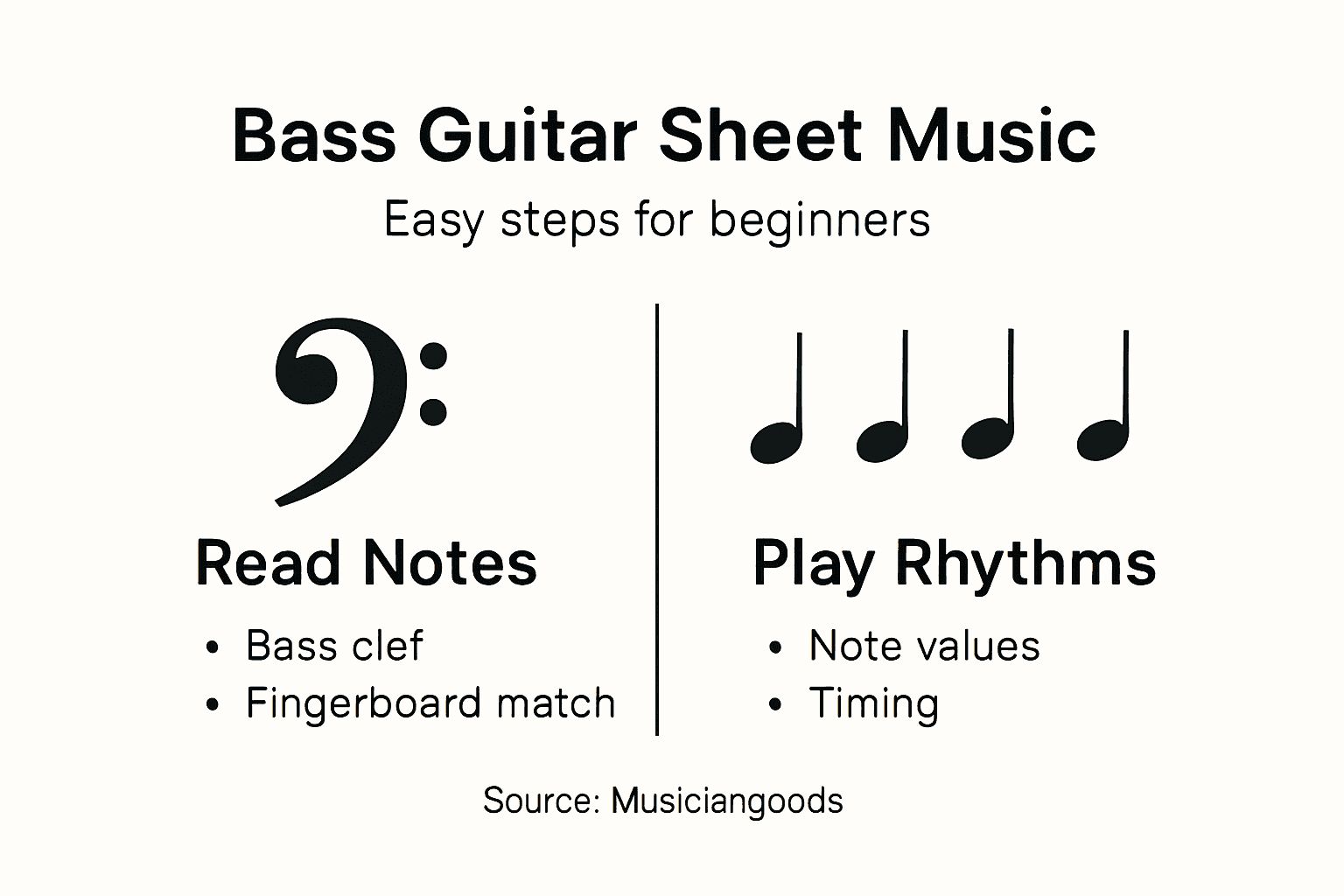
Your bass guitar’s standard tuning of E, A, D, G provides the foundation for translating written notes into sound. Begin by understanding how each note on the sheet music corresponds to a specific fret and string on your instrument. This process transforms abstract musical notation into tangible musical performance.
Here are key strategies for applying note reading to your bass guitar:
- Practice scales in standard notation
- Learn the fingerboard note locations for each string
- Start with simple, single-note exercises
- Gradually increase complexity of musical passages
- Use scale exercises combining notation and playing
Consistent practice bridges the gap between reading music and performing. Focus on developing muscle memory that connects what you see on the page with where your fingers should move on the bass guitar.
Musical fluency comes from transforming written symbols into confident, precise sound.
Pro tip: Practice reading and playing simultaneously using a metronome to develop rhythmic accuracy alongside note reading skills.
Step 5: Test Your Progress with Simple Songs
Reaching the final stage of sheet music reading means putting your newfound skills into practice through actual musical performance. This step transforms theoretical knowledge into real musical expression on your bass guitar.
Select simple songs that match your current skill level to build confidence and reinforce your sheet music reading abilities. Look for bass guitar arrangements with straightforward rhythms and minimal complex notation to start your practical learning journey.
Here are strategies for testing your sheet music reading progress:
- Choose songs with repetitive bass lines
- Start with chord progression exercises to build foundational skills
- Practice reading and playing simultaneously
- Record yourself to identify areas for improvement
- Gradually increase song complexity
Break down each song into manageable sections. Focus on maintaining steady rhythm and accurate note placement rather than playing perfectly. Consistent practice will help you develop muscle memory and reading fluency.
Musical mastery comes from patient, persistent practice - not overnight perfection.
Pro tip: Use a slow-motion practice technique where you play each musical passage at half speed, gradually increasing tempo as your reading skills improve.
Unlock Your Bass Guitar Potential with Expert Learning Tools
Mastering bass guitar sheet music can feel overwhelming when you struggle to swiftly identify bass clef notes or decode complex rhythms. This challenge often slows progress and saps motivation. If you want to turn those notes on the staff into confident, precise playing, you need clear, accessible resources designed with you in mind. Concepts like bass clef, rhythm patterns, and fingerboard mapping become easier when supported by visual diagrams, step-by-step tutorials, and practical cheat sheets.

Elevate your music learning experience today with Musiciangoods where you will find a curated selection of bass guitar educational tools and books crafted to simplify music theory. Whether you need bass clef flashcards, rhythm decoding guides, or method books that connect notation directly to your instrument, our resources help you practice smarter and faster. Start exploring our Educational Resources now and build your confidence by applying the exact skills covered in this article. Do not wait to make the music inside you shine through every sheet you read.
Frequently Asked Questions
How do I set up a good practice space for reading sheet music on bass guitar?
Creating an effective practice space involves minimizing distractions and ensuring good lighting. Position an adjustable music stand at eye level, use a comfortable chair with back support, and keep your sheet music clutter-free to facilitate focused practice.
What are some tips for quickly identifying bass clef notes?
To identify bass clef notes efficiently, use mnemonic devices like “Good Boys Do Fine Always” for line notes and “All Cows Eat Grass” for space notes. Practice regularly linking these notes to their respective positions on your bass guitar to strengthen your recognition skills.
How can I decode rhythms in sheet music for bass guitar?
Decoding rhythms can be simplified by using visual aids like color-coded charts and practicing physical movements such as clapping or tapping. Break complex rhythms into smaller parts to make them more manageable and reinforce timing.
What strategies should I use to apply note reading to my bass guitar playing?
Start by practicing scales and identifying fingerboard note locations for each string. Gradually increase the complexity of what you play while ensuring you connect the written music with your finger placements for seamless performance.
How do I test my progress in reading sheet music for bass guitar?
To test your progress, select simple songs that match your current skill level and practice reading and playing simultaneously. Record your sessions to identify areas for improvement and gradually increase the complexity of the music as you become more confident.
What techniques can I use to remember bass clef note positions?
Using flashcards to quiz yourself on bass clef notes is an effective technique. Regularly practice linking these notes to your bass guitar, aiming to recognize them instinctively within 30–60 days.