 4.8/5 on Trustpilot

Learning guitar feels overwhelming when you face hundreds of possible chords without knowing where to start. The good news is that mastering just a small core set of essential guitar chords unlocks the ability to play most beginner songs. This article presents practical examples of key chord types suited for your skill level and musical goals, helping you build versatility and confidence on the fretboard.
Key Takeaways
| Point | Details |
|---|---|
| Prioritize ease and frequency | Focus on chords that appear in 70% of beginner songs and require minimal finger complexity. |
| Open chords form your foundation | Major and minor open chords like C, G, D, A, E, Am, Dm, and Em cover most early repertoire. |
| Power chords simplify rock styles | Using just root and fifth notes, power chords enable fast transitions with 1-2 fingers. |
| Barre chords demand finger strength | Full-neck coverage comes at the cost of technique precision and hand development time. |
| Seventh chords add harmonic depth | Dominant, major, and minor seventh variations expand your tonal palette for intermediate playing. |
Selection Criteria for Guitar Chords
Chord selection criteria for beginner and intermediate players include ease of finger placement, frequency in popular music, and tonal versatility to support multiple genres. Understanding these factors helps you make informed decisions about which chords deserve your practice time first.
Ease of finger placement reduces frustration during early learning stages. Chords requiring fewer fingers or simpler hand positions let beginners focus on rhythm and strumming rather than wrestling with finger gymnastics. Chord frequency in popular songs ensures practical application. Learning obscure voicings before mastering common ones wastes valuable practice hours.
Tonal versatility supports playing across multiple genres. Some chords work equally well in folk, rock, pop, and country contexts, maximizing their utility. Choosing chords matched to your skill level enables steady progress without overwhelming your developing technique.
Consider these selection factors when building your chord vocabulary:
- Finger stretch requirements and hand size compatibility
- String clarity and ability to avoid muting adjacent strings
- Transition patterns between commonly paired chords
- Musical context where the chord appears most frequently
Pro Tip: Start with three-chord songs using only C, G, and D to build switching confidence before expanding your repertoire.
Common Beginner Chords
Open major chords form the backbone of beginner guitar playing. C, G, D, A, and E are the easiest to finger and appear most frequently in popular music. These voicings use open strings combined with fretted notes in the first three frets, creating full, ringing tones perfect for acoustic strumming.
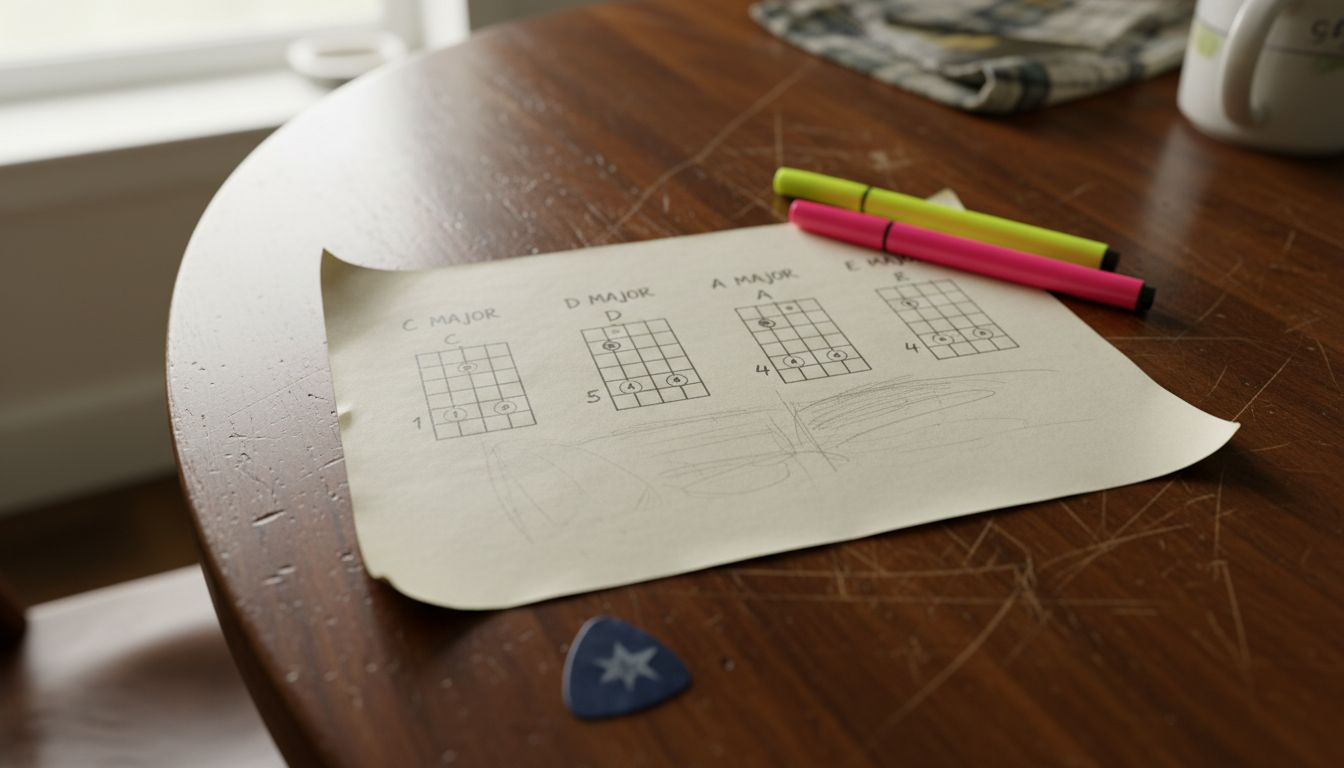
Open minor chords add harmonic variety to your playing. Am, Dm, and Em provide emotional contrast to bright major sounds. Most beginner songs use combinations of these eight fundamental chords, giving you access to hundreds of playable tunes within your first few months of practice.
Finger positioning tips improve clarity and switching speed. Place fingers close to frets without touching the metal for clean sound. Arch your fingers to avoid muting adjacent strings. Practice lifting and placing all fingers simultaneously rather than one at a time when changing chords.
These examples of easy guitar chords demonstrate proper technique:
- C major uses three fingers across three strings in a compact formation
- G major stretches across all six strings with a distinctive bass note
- D major focuses on the top four strings with a triangular finger shape
- A major concentrates three fingers on one fret for easier placement
- E major spreads fingers naturally across the first fret
- Am mirrors E major shape but on different strings
- Dm creates a stacked finger position on the top three strings
- Em uses only two fingers, making it the easiest chord to form
Most folk, pop, and country songs rely heavily on these foundational voicings. Master smooth transitions between them before moving to more complex chord types.
Power Chords
Power chords use root and fifth notes exclusively, creating a simplified two or three note structure. This minimal approach uses just one or two fingers on adjacent strings, making them exceptionally easy to form and move around the neck. Rock and punk music favor these voicings for their punchy, driving sound.
The simplified finger placement allows quick chord changes during fast-paced songs. You can slide the same shape up and down the neck to play different chords without learning new finger positions. This mobility makes power chords ideal for electric guitar playing with distortion effects.
Power chords serve as a bridge between beginner open chords and barre chords. They introduce movable shapes and fretboard navigation without the finger strength demands of full barre techniques. Many guitarists use them exclusively when playing heavier musical styles.
Key characteristics of power chords include:
- Neither major nor minor quality due to omitted third interval
- Movable shape that works anywhere on the neck
- Common notation as root note followed by 5, like A5 or E5
- Often played on lower strings for heavier bass response
Pro Tip: Practice power chord transitions using only your index and ring fingers to build consistency and speed across the fretboard.
Barre and Advanced Chord Forms
Barre chords require pressing multiple strings firmly with one finger while other fingers fret additional notes. This technique allows playing major and minor chords anywhere on the neck by moving a single shape. The index finger acts as a movable capo, creating the foundation for the chord.
They demand significant finger strength and precise technique. Over 65% of beginners report difficulties specifically with barre chords due to finger strength requirements. The index finger must press evenly across all strings without muting or buzzing, requiring weeks or months of gradual hand development.
Barre chords typically get learned after mastering open and power chords. Rushing into them too early often leads to frustration and poor technique habits. Building foundational finger strength through easier chord types prepares your hands for barre chord success.
Benefits of mastering barre chords:
- Access to all 12 major and minor chords using just two shapes
- Ability to play songs in any key without a capo
- Smoother transitions when playing up the neck
- Essential skill for intermediate and advanced repertoire
Start with partial barres covering fewer strings before attempting full six-string versions. Practice the E-shape and A-shape barre chords separately until each becomes comfortable. Use hand strengthening exercises away from the guitar to accelerate development.
Seventh and Extended Chords
Seventh chords add a fourth note to basic triads, creating richer harmonic textures. Three main types dominate guitar playing: dominant seventh (like G7), major seventh (like Cmaj7), and minor seventh (like Am7). Each type produces a distinct emotional quality suited to different musical contexts.
Dominant seventh chords create tension that wants to resolve, making them common in blues and rock progressions. Major seventh chords sound jazzy and sophisticated, appearing frequently in R&B and neo-soul. Minor seventh chords blend melancholy and smoothness, perfect for ballads and jazz standards.
These voicings require more nuanced finger positioning than basic chords. You often need to lift or add a single finger from a familiar shape, making them accessible to intermediate players who know foundational chords well. The subtle tonal differences between seventh chord types expand your musical vocabulary significantly.
Common applications for seventh chords:
- Blues progressions using all dominant seventh voicings
- Jazz standards built entirely on seventh and extended chords
- Funk rhythm guitar favoring ninth and thirteenth chords
- Pop ballads using major and minor sevenths for emotional depth
Seventh chords represent an intermediate skill milestone. They bridge the gap between basic playing and advanced harmonic understanding, opening doors to more sophisticated musical styles.
Chord Types Comparison
Understanding the strengths and challenges of each chord type helps you plan your learning progression strategically. This comparison clarifies which voicings suit your current skill level and musical goals.
| Chord Type | Fingers Required | Difficulty Level | Musical Versatility | Neck Portability |
|---|---|---|---|---|
| Open Major/Minor | 2-3 fingers | Easy | High for beginner songs | Limited to first position |
| Power Chords | 1-2 fingers | Easy to Moderate | Moderate, rock-focused | Full neck access |
| Barre Chords | Full hand press | Hard | Very high, all keys | Complete fretboard |
| Seventh Chords | 2-4 fingers | Moderate | High for intermediate styles | Varies by voicing |
| Extended Chords | 3-4 fingers | Moderate to Hard | Specialized, jazz-focused | Limited shapes |
Open chords provide immediate playability for beginners but restrict you to songs in specific keys. Power chords offer mobility and simplicity but lack harmonic richness. Barre chords unlock the entire fretboard but demand significant technique development. Seventh chords add sophistication without overwhelming complexity for players ready to advance.
Choose your focus based on immediate playing goals. Campfire strummers need open chords first. Rock players benefit from early power chord work. Jazz enthusiasts should prioritize seventh chord vocabulary after mastering basics.
Pedagogical Tools for Learning Chords
Visual chord diagrams significantly aid beginners by showing exact finger placement and strings to strum, improving the speed and accuracy of learning guitar chords. These simple graphics display the fretboard from a player’s perspective, marking where each finger goes with numbers or dots.
Studies show visual aids improve learning retention by approximately 30% compared to verbal instruction alone. Chord diagrams help beginners form correct finger habits from day one, preventing the frustration of relearning poor technique later. They also speed up the process of memorizing new voicings by providing a clear reference during practice sessions.
Using visual tools consistently builds finger memory faster. Keep chord diagram resources near your practice space for quick reference. Many guitarists print chord charts and tape them to music stands or walls for easy consultation during playing sessions.
Effective chord learning tools include:
- Printable chord charts showing multiple voicings per chord
- Interactive apps with audio playback for ear training
- Video tutorials demonstrating proper finger placement and transitions
- Physical chord stamps or stickers applied directly to fretboards
Musiciangoods offers comprehensive chord chart resources designed specifically for visual learners. These tools combine clear diagrams with music theory context, helping you understand not just where fingers go but why certain voicings sound the way they do.
Situational Recommendations
Your chord learning path depends heavily on skill level and musical aspirations. Absolute beginners should prioritize open major and minor chords before attempting anything more complex. These foundational voicings appear in thousands of songs and build essential finger coordination.
Rock or punk players benefit from learning power chords early in their journey. The simplified structure and distortion-friendly sound align perfectly with heavier musical styles. You can start playing recognizable riffs within your first few practice sessions using just power chord shapes.
Intermediate players should add barre and seventh chords gradually. Rushing into advanced techniques before solidifying basics creates frustration and technical problems. Spend at least three to six months with open chords before serious barre chord work.
Genre preferences strongly influence optimal chord choices:
- Folk and country players need open chords and basic barre shapes for capo alternatives
- Blues guitarists should focus on dominant seventh and ninth chords early
- Jazz students require comprehensive seventh chord knowledge as a foundation
- Metal players benefit from power chord mastery and drop tuning familiarity
- Pop acoustic players need a mix of open chords and simplified barre voicings
Follow step-by-step guitar theory guidance matched to your preferred style. Different guitar style considerations affect which chord types deserve priority in your practice routine. Focus your efforts according to immediate playing goals rather than trying to learn everything simultaneously.
Explore MusicianGoods for Essential Guitar Learning Tools
Ready to accelerate your chord mastery with proven educational resources? MusicianGoods offers comprehensive guides and visual tools designed specifically for guitar learners at every level. Our music theory beginner guide breaks down complex concepts into digestible steps.

Access downloadable chord chart resources and other pedagogical tools tailored for beginners and intermediates. Our visual diagrams, created by musicians for musicians, clarify finger placement and speed up your learning process. Visit MusicianGoods to find everything needed to improve your guitar skills efficiently.
Frequently Asked Questions
What Are Some Easy Guitar Chords for Beginners?
Open major chords C, G, D, A, and E form the easiest starting point for new players. These voicings use minimal fingers and appear constantly in popular songs across multiple genres. Adding minor chords Am, Dm, and Em expands your harmonic palette while maintaining beginner-friendly finger positions. Together, these eight chords unlock hundreds of playable songs within your first few months of practice.
Why Are Barre Chords Difficult for Beginners?
Barre chords require pressing multiple strings firmly with one finger while maintaining even pressure across the entire fretboard width. This demands finger strength and precision that beginners have not yet developed through easier chord work. Starting with partial barres covering fewer strings and incorporating daily hand strengthening exercises helps build the necessary technique gradually. Most players need several months of consistent practice before barre chords feel comfortable.
How Can I Improve Switching Between Chords Smoothly?
Practice slow, deliberate chord changes focusing on accurate finger placement and muting unwanted strings. Speed develops naturally through repetition, but rushing creates sloppy technique. Use metronome drills starting at 40-60 beats per minute, changing chords on each beat. Gradually increase tempo only after achieving clean transitions consistently. Focus on common chord pairs that appear together frequently in songs for maximum practical improvement.
Are Visual Chord Diagrams Really Helpful?
Research shows chord diagrams increase retention by about 30% compared to verbal instruction alone. Visual aids clarify finger placement and string contact in ways that verbal descriptions cannot match. They provide quick reference during practice sessions and help beginners form correct habits from the start. Most successful guitar learners rely heavily on chord diagrams during their first year of playing.


 Folha de Cola para Mistura e Masterização Mousepad


