4.8/5 on Trustpilot

You know how to build a C major chord — C, E, G. But when a pro plays that exact same chord, it sounds fuller, warmer, more interesting. Same three notes, completely different feel. The secret isn't a new chord. It's the voicing.
In this guide we'll break down what piano chord voicings actually are, how they differ from inversions, and four practical ways to reshape the chords you already know so your playing sounds richer and more professional — without learning a single new chord.

What are piano chord voicings?
A chord voicing is the way the notes of a chord are arranged and played on the keyboard. Instead of always stacking a chord in the traditional close position, a voicing gives you the freedom to spread those same notes into different octaves, change which note sits on top, or drop the bass note down — all while keeping the chord itself intact.
Take the basic C major chord: C, E, and G. In a standard voicing you might play all three notes close together in one hand. But in another voicing you could play the C low, the E in the middle, and the G high up the keyboard. It's still a C major chord. It just sounds different — more open, more spacious, more like a record and less like an exercise.
That's the whole idea. Voicings are what turn a correct chord into an expressive one.
Voicings vs. inversions — what's the difference?
These two get confused constantly, so let's settle it clearly.
An inversion rearranges the notes of a chord to change which note is at the bottom, while keeping all the notes within roughly the same range. A C major chord in root position has C at the bottom (C-E-G). Put E at the bottom (E-G-C) and you have first inversion. Put G at the bottom (G-C-E) and you have second inversion. The bass note changes; the chord quality stays major.
A voicing is broader. It also lets you spread notes into other octaves, double a note, or open the chord up so there's space between the tones. Every inversion is technically a voicing, but not every voicing is an inversion. Think of inversions as a specific tool inside the larger toolbox of voicings.

How piano chord voicings work
Every voicing is just a decision about three things: which notes go where, how far apart they sit, and which one lands on top. Change any of those and you change the color of the chord.
Here are the moves that do the most work:
- Drop the root an octave. Take the C in your C major chord and play it a full octave lower with your left hand. The chord instantly gets a stronger foundation and more depth, because there's now space between the bass and the rest of the chord.
- Spread across octaves. Instead of C-E-G clustered together, play C low, E in the middle, G high. Open voicings like this sound less boxed-in and are the backbone of ballad and pop piano.
- Change the top note. The highest note in a chord is the one the ear follows most. Rearranging the chord so E or G sits on top subtly shifts where the listener's attention goes.
- Split between hands. Let the left hand carry the root (and maybe the fifth) while the right hand plays the rest. This is how most real piano parts are built.
None of these change the fact that you're playing a C major chord. They change how it feels — and that feeling is what separates a beginner's chords from a musician's.
How to practice piano chord voicings (4-step plan)
Step 1 — Master the chord in root position first
Before you reshape a chord, you need to own it. Pick one chord — C major is perfect — and play it root position (C-E-G) until it's automatic. You can't voice a chord you don't know cold.
Step 2 — Lower the root one octave
Keep E and G where they are with your right hand, and play the C an octave lower with your left. Sit with that sound. Notice how much fuller and more grounded the same chord becomes when the bass note has room to breathe. This one move alone will upgrade your playing.
Step 3 — Spread the triad across octaves
Now open the chord up. Play C low, E in the middle register, and G higher up. Then try G on top, then E on top. Play each version slowly and listen. You're training your ear to hear that the arrangement of notes carries as much emotion as the notes themselves.
Step 4 — Apply voicings to a progression
Take a simple progression — C, F, G — and instead of playing every chord in tight root position, voice them so the transitions are smooth and the top notes move gently. This is where voicings stop being an exercise and start sounding like music. Let your ear be the judge.
Common mistakes to avoid
- Confusing voicings with new chords. A voicing is never a different chord. C-E-G spread across two octaves is still C major. If you're changing the actual notes, that's a different chord — not a voicing.
- Always playing tight, closed chords. Cramming every note into one hand in root position is the number-one reason beginner piano sounds thin. Give the notes some space.
- Ignoring the top note. The highest note is the one people hear most. If your voicings sound random, it's often because the top notes are jumping around instead of moving smoothly.
- Skipping the listening. Voicings are an ear skill, not a math problem. If you're not stopping to actually hear the difference each arrangement makes, you're missing the whole point.
- Trying to learn voicings before you know the chord. Reshaping a chord you haven't memorized just creates confusion. Lock in the root-position chord first.
Why piano chord voicings matter
Voicings are the difference between playing the right notes and playing them musically. Two pianists can hit the exact same chords in the exact same order, and one will sound like a textbook while the other sounds like a record. That gap is almost entirely voicing.
Once you understand voicings you get three things: the ability to make simple chords sound rich and professional, smoother transitions between chords in a progression, and a genuine sense of texture and mood in your playing. Best of all, you get all of that from chords you already know — you're not learning more theory, you're getting more out of the theory you have. That's chord voicings, simplified.
Take it further
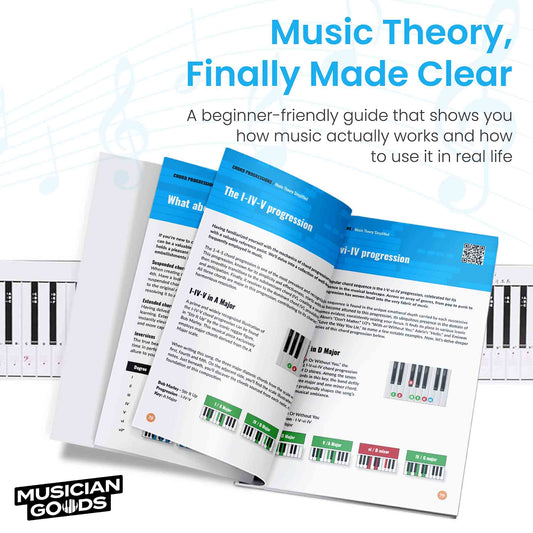
The full walkthrough of chords, inversions, and voicings — with charts for every key and a visual, step-by-step layout — is covered in Music Theory Simplified. It's the same premium, no-fluff style you're reading here.
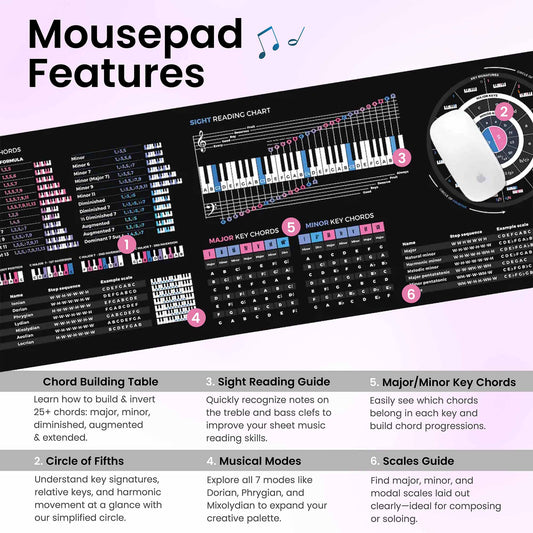
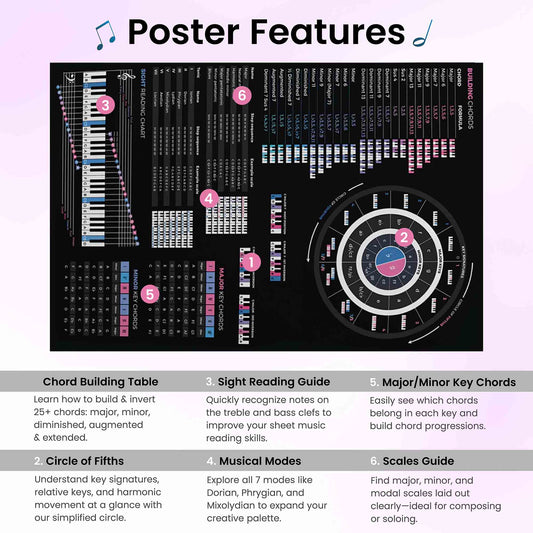
Want the chord shapes and formulas right next to your keyboard while you practice? The Music Theory Cheat Sheet Poster and Cheat Sheet Mousepad keep chords, scales, and intervals in view whenever you sit down to play.
Prefer a digital reference you can pull up on any screen? Grab the Music Theory Cheat Sheet PDF, or get everything together in the Music Theory Bundle.

Every chord, inversion and voicing — mapped out visually.
Music Theory Simplified turns harmony into diagrams you can actually play from.
FAQs about piano chord voicings
What is a chord voicing on piano?
A chord voicing is the specific way the notes of a chord are arranged and played on the keyboard — which octaves they sit in, how spread out they are, and which note is on top. The chord stays the same; the arrangement changes its sound.
What's the difference between a voicing and an inversion?
An inversion changes which note is at the bottom of the chord (the bass note). A voicing is broader — it can also spread the notes across octaves or open them up. Every inversion is a voicing, but not every voicing is an inversion.
Why do my piano chords sound thin or boring?
Usually because you're playing every chord in tight root position with one hand. Try dropping the root an octave into your left hand and spreading the remaining notes out. That single change adds depth and makes chords sound fuller.
Do voicings change the chord?
No. A voicing rearranges the same notes — it never adds or removes notes. C-E-G spread across two octaves is still a C major chord, just voiced differently.
How do I start using voicings in a song?
Take a chord progression you already know and, instead of playing each chord in root position, spread the notes so the top notes move smoothly from chord to chord. Let your ear guide which arrangement sounds best.
This post is part of Musiciangoods' Music Theory Simplified series — practical music theory, taught visually, for musicians who want to understand what they're playing. Explore more music learning tools here.