 4.8/5 on Trustpilot

Reading sheet music looks like decoding a foreign alphabet, and that impression scares off more beginners than the skill itself ever would. The truth is plainer. Standard notation is a small set of symbols that answer two questions over and over: which note do I play, and how long do I hold it. Once you can answer those two questions, everything else on the page is detail you add gradually.
This roadmap takes you from a blank staff to playing your first piece of written music, in the order that actually makes sense. You do not need to memorise everything at once. Work through it section by section, play a little at each step, and the page stops being a wall of symbols and starts being a set of instructions you can follow.

The staff: where notes live
Everything starts with the staff: five horizontal lines with four spaces between them. A note's vertical position on the staff tells you its pitch, which is how high or low it sounds. The higher a note sits on the staff, the higher it sounds; the lower it sits, the lower it sounds.
Notes sit either on a line, with the line running through the middle of the notehead, or in a space, between two lines. That is the first thing to train your eye to see at a glance: is this note on a line, or in a space. When five lines are not enough for very high or very low notes, short extra lines called ledger lines extend the staff above or below, but you can ignore those until later.
Clefs: the key that names the lines
A staff on its own does not tell you which pitches the lines and spaces represent. The clef, the symbol at the far left of every staff, does that. It anchors the whole staff to specific notes.
The treble clef, also called the G clef, is used for higher-pitched instruments and the right hand on piano. Its curl wraps around the line that represents the note G. The bass clef, or F clef, is used for lower instruments and the left hand on piano, and its two dots sit around the line for the note F.
Piano music uses both at once, joined into a grand staff: treble clef on top for the right hand, bass clef below for the left. If you are learning piano, you will read both clefs together, which is one reason the piano is such a clear instrument for seeing how music is built. If you are unsure whether to learn on a weighted piano at all, our guide to piano vs keyboard covers that choice first.
Note names: reading the lines and spaces
Music uses only seven letter names, A through G, that repeat up and down the staff. To read pitch fluently you only need to learn which line or space each letter sits on for your clef, and beginners use simple mnemonics to start.
On the treble clef, the lines from bottom to top spell E, G, B, D, F, remembered as "Every Good Boy Does Fine." The spaces from bottom to top spell F, A, C, E, which conveniently spells the word "face." On the bass clef, the lines are G, B, D, F, A, remembered as "Good Boys Do Fine Always," and the spaces are A, C, E, G, "All Cows Eat Grass."
Do not try to memorise all of these in one sitting. Learn the treble spaces first because they spell "face," then add the treble lines, then move to the bass clef once the treble feels automatic. The goal is not to recite the mnemonic each time but to eventually skip it and see the note name directly, the way you read a word without spelling it.
Note values: how long each note lasts
Pitch is only half the page. The shape of a note tells you its duration, how many beats you hold it. This is where written music encodes rhythm, and it is more intuitive than it looks because the values divide neatly in half each time.
A whole note is an open oval with no stem and lasts four beats. A half note is an open oval with a stem and lasts two beats. A quarter note is a filled oval with a stem and lasts one beat. An eighth note is a filled note with a stem and a single flag, lasting half a beat, and a sixteenth note adds a second flag for a quarter of a beat. Each step down the list cuts the length in half.
Silence is written too. Rests are symbols that tell you not to play for a set number of beats, and each note value has a matching rest of the same length. A whole rest hangs below a line, a quarter rest looks like a small squiggle, and so on. Reading rests is as important as reading notes, because the gaps are part of the rhythm.
A dot after a note adds half of that note's value again, so a dotted half note lasts three beats rather than two. A tie, a small curved line joining two notes of the same pitch, adds their values together into one held sound. These two small marks let written music express any length without inventing new note shapes.
Time signatures: counting the beat
The two stacked numbers at the start of a piece, just after the clef, are the time signature. They tell you how the beats are grouped so you know how to count. The top number is how many beats are in each measure, the small segment of music between two vertical bar lines. The bottom number tells you which note value counts as one beat.
The most common time signature is 4/4, four beats per measure with the quarter note getting the beat. It is so common it is often just called "common time." Count it as a steady one, two, three, four, repeating. In 3/4, you count three beats per measure, which gives music the feel of a waltz: one, two, three, one, two, three.
Once you know the time signature, the bar lines become checkpoints. Each measure must add up to the number of beats the time signature promises, so counting the note and rest values within a measure is also how you check you are reading the rhythm correctly. If a measure does not add up, you have misread a value somewhere.

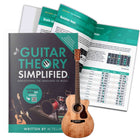
View Music Theory Simplified →
Sharps, flats, and key signatures
So far we have only used the seven natural letter names. The notes between them, the black keys on a piano, are named with accidentals. A sharp raises a note by a half step, the smallest distance in Western music. A flat lowers a note by a half step. A natural sign cancels a sharp or flat and returns the note to its plain letter name.
When a piece uses the same sharps or flats throughout, it would be tedious to mark every one. Instead, a key signature at the start of each staff lists the sharps or flats that apply to the whole piece. If the key signature has one sharp on the F line, every F in the piece is played as F sharp unless a natural sign says otherwise. Reading the key signature first tells you which notes are altered before you play a single bar.
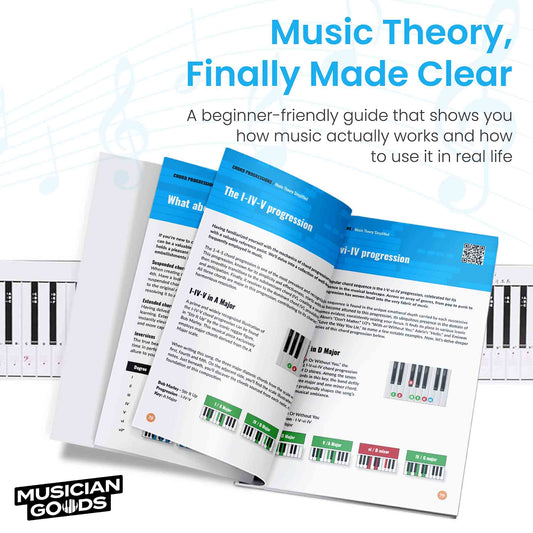
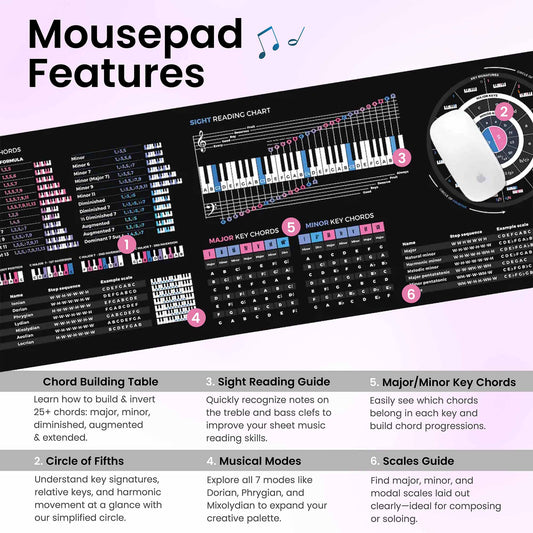
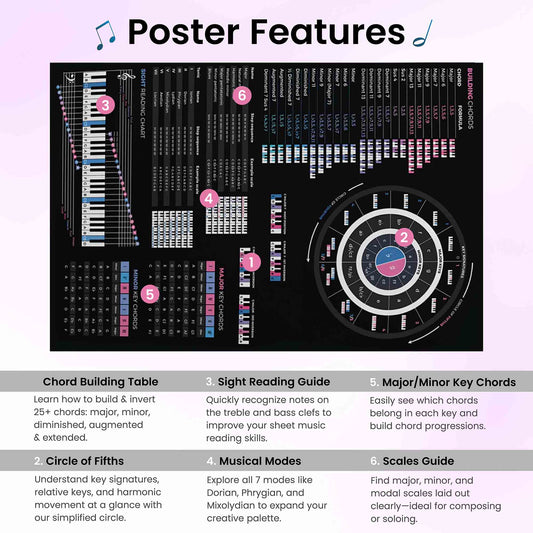
You do not need to memorise all key signatures to start. Learn to spot how many sharps or flats are shown and which notes they sit on, and treat that as a set of standing instructions for the page. Understanding why those particular notes are sharp or flat comes from a little theory, which is exactly what tools like the circle of fifths make visual, and what we unpack step by step in Music Theory Simplified.
The finishing marks: dynamics and repeats
A few more symbols turn correct notes into actual music. Dynamics are letters below the staff that tell you how loud to play: p for soft (piano), f for loud (forte), and combinations like mf for moderately loud. Gradual changes are shown with the words crescendo, getting louder, and decrescendo, getting softer, or with long hairpin wedges.
Repeat signs save space and your eyes. Two dots before a thick bar line mean go back and play the section again. Other markings, like a curved slur over several notes, tell you to play them smoothly and connected. You can safely learn these as you meet them in real pieces rather than memorising them in advance.
A four-week roadmap to actually reading music
Knowing the symbols is not the same as reading fluently, and fluency only comes from playing. Here is a realistic order to practise in. In your first week, learn the treble clef line and space names until you can name any note without the mnemonic, and clap simple quarter-note and half-note rhythms in 4/4. Do not add the left hand or bass clef yet.
In the second week, add note values and rests, and play very simple single-line melodies slowly, counting out loud. Counting aloud feels awkward and is the single most effective habit for reading rhythm correctly. In the third week, bring in the bass clef and, if you play piano, start joining both hands on easy pieces, hands separately first, then together.
By the fourth week, work through short beginner pieces end to end, slowly enough that you never have to stop, then gradually increase the tempo. Speed is a result of accuracy, not a goal you chase directly. Reading music is a skill that compounds, and most people are slower than they expect at first and faster than they hoped within a couple of months. For a realistic sense of that timeline, our piece on how long it takes to learn piano sets fair expectations.
Frequently asked questions
How long does it take to learn to read sheet music? Most beginners can read simple single-line melodies within a few weeks of consistent practice, and read comfortably across both clefs within a few months. The pace depends on how often you actually play what you read rather than just study the symbols. Fifteen focused minutes a day beats a long session once a week.
Do I need to read music to play an instrument? No, and many musicians play well by ear or from chord charts and tabs. But reading standard notation opens up the entire written repertoire, makes communicating with other musicians easier, and deepens your understanding of how music works. It is a skill that pays back far more than it costs to learn.
Is reading sheet music harder on piano than other instruments? Piano asks you to read two clefs at once, which feels harder at first, but the piano also lays the notes out in a straight, visible line that makes pitch easier to understand than on almost any other instrument. Most teachers consider the piano one of the best instruments for learning to read.
What is the fastest way to memorise the notes on the staff? Use the mnemonics to start, but do not stop there. Practise naming notes on flashcards or a simple app for a few minutes daily, and play short pieces that force you to recognise notes in context. Recognition in real music is what turns the mnemonic into instant reading.
Should I learn music theory at the same time? A little theory makes reading far less mysterious, because it explains why key signatures, time signatures, and accidentals work the way they do. You do not need a deep course to begin, just the basics of how notes, scales, and keys fit together, which is what we teach in plain language in Music Theory Simplified.
Written by Melvin Tellier, founder of Musiciangoods. Musiciangoods publishes plain-language books and cheat sheets that help self-taught musicians learn the theory and craft behind their instrument, including Music Theory Simplified.






 Gitarrenakkorde Diagramm Mousepad
 Bassgitarren-Theorie-Spickzettel Mousepad
 Musiktheorie-Spickzettel Mousepad
 Ukulele Theorie Spickzettel Mousepad
 Gitarrentheorie-Spickzettel Mousepad


