 4.8/5 on Trustpilot

The headphone you mix on is the second-most-important purchase in a bedroom studio, behind the interface and ahead of the monitors. A neutral, well-known pair lets you hear what is actually in the mix; a flattering pair makes every mix sound great in your room and terrible everywhere else. The difference between those two outcomes is almost entirely down to the choice you make at this price point.
The seven headphones below are the ones that get recommended consistently across r/audioengineering, r/musicproduction, the staff picks at Sound on Sound and MusicRadar, and the working engineers who post tier lists on YouTube. We've kept everything under €300 because that's where almost every first mixing pair should sit, and because the headphones above that price are aimed at mastering engineers and studio buyers, not at someone trying to finish their first EP from a desk in their bedroom.

Quick comparison
| Headphone | Best for | Type | Price range |
|---|---|---|---|
| Sennheiser HD 560S | Best open-back overall | Open, 120Ω | €150–€180 |
| Beyerdynamic DT 770 PRO 80Ω | Best closed-back workhorse | Closed, 80Ω | €140–€180 |
| AKG K371 | Best closed-back for accuracy | Closed, 32Ω | €140–€170 |
| Audio-Technica ATH-M40x | Best mixing pair under €100 | Closed, 35Ω | €90–€120 |
| Sennheiser HD 600 | Premium open-back reference | Open, 300Ω | €280–€320 |
| Sony MDR-7506 | Best for tracking and monitoring | Closed, 63Ω | €95–€130 |
| Samson SR850 | Tightest budget | Semi-open, 32Ω | €50–€70 |
Open-back vs closed-back, and why it actually matters for mixing
The single decision that shapes every other choice on this page is open-back versus closed-back. Open-back headphones have a perforated outer cup that lets the driver breathe — sound leaks out, room sound leaks in, and the resulting presentation is wider, more natural, and less fatiguing over a long session. Closed-back headphones seal the driver inside a solid cup — they isolate from outside noise, prevent bleed into a microphone during tracking, and present a more direct, bass-forward sound at the cost of a narrower stage.
For mixing, open-back is the default recommendation because the wider stereo image makes panning and depth decisions more obvious, and because the bass response tends to be flatter and less hyped. For tracking — recording vocals or acoustic instruments with a microphone in the same room — closed-back is mandatory, because open headphones will leak click track and rough mix into the microphone. Most bedroom producers eventually want one of each. If you can only afford one pair, the right choice depends on whether you mix more than you record.
The second decision is impedance. Headphones rated at 32Ω to 80Ω run loud enough from a phone, a laptop, or the headphone output on any modern audio interface. Anything over 150Ω will sound thin and quiet without a headphone amplifier — the higher-impedance Sennheisers below are excellent, but only if you have something to drive them.
1. Sennheiser HD 560S — best open-back overall

Open-back over-ear, 120Ω, 6Hz–38kHz frequency response, 240g, 3m detachable cable with 3.5mm jack + 6.3mm screw adaptor, replaceable velour pads
The HD 560S is the headphone we point bedroom producers at when they ask the bare question, "What should I mix on?" It runs an analytical, almost ruler-flat frequency response with a slight bass roll-off below 50Hz and an honest midrange — the kind of sound that does not flatter anything. Mixes done on it tend to translate well to car speakers, phone speakers, and other people's earbuds, which is the single test that matters when your end listener is somewhere else.
The soundstage is wider than is normal at this price, which means panning decisions and reverb depth are easier to hear. The 120Ω impedance is the sweet spot — loud enough from any modern interface, demanding enough that an amplifier still adds detail if you have one. The build is plastic but light at 240g, which matters more than it sounds when a mix runs four hours into the night. The honest trade-off is that the bass roll-off below 50Hz means you cannot fully trust the bottom octave; check your final low-end balance on a different speaker before you commit.
Best for: bedroom producers and first-time mixers who want one neutral open-back pair that translates honestly to other systems.
2. Beyerdynamic DT 770 PRO 80Ω — best closed-back workhorse

Closed-back over-ear, 80Ω, 5Hz–35kHz frequency response, 270g, 3m coiled cable hardwired with 3.5mm jack + 6.3mm screw adaptor, replaceable velour pads, hard plastic ear cups, handmade in Germany
The DT 770 PRO has been the default closed-back recommendation in pro studios for more than two decades, and the 80Ω version is the one to buy. It sits between the 32Ω consumer variant (slightly too bass-heavy) and the 250Ω mastering variant (needs a real headphone amp) at exactly the impedance that runs cleanly from any modern interface. The frequency response is gently V-shaped — a small bass bump and a slightly elevated treble — which makes the headphone exciting to listen to and easy to track vocals on for hours.
For mixing the V-shape is honest enough that experienced engineers know how to compensate, but it is not the headphone we would recommend to someone who is still learning what a balanced mix sounds like. Treat it as your closed-back complement to a flatter open-back pair, or as a tracking headphone that is also good enough to make first-pass mix decisions on. The velour pads are comfortable for genuinely long sessions and replaceable when they wear out — which they will, in two or three years of daily use.
Best for: tracking vocals and acoustic instruments, noisy rooms, and anyone who wants one closed-back pair that will outlast the laptop it plugs into.
Where to buy on Beyerdynamic →
3. AKG K371 — best closed-back for accuracy

Closed-back over-ear, 32Ω, 5Hz–40kHz frequency response, 255g, three detachable cables included (1.2m straight, 3m straight, 3m coiled) with 3.5mm + 6.3mm adaptors, foldable, replaceable pads
The K371 is the closed-back that finally took the accuracy crown away from the DT 770. Its frequency response is tuned to the Harman target curve, which is a research-backed model of what most listeners perceive as neutral — meaning the headphone sounds correct rather than exciting. For someone learning to mix, that distinction matters: when a kick drum sounds boomy on the K371, the kick drum actually is boomy, not just hyped by the headphone. Mixes made on this pair translate notably well to consumer playback systems.
The hardware case is unusual for the price. Three included cables, fully foldable cups, and a 255g weight that makes long sessions painless. The 32Ω impedance runs from anything, including a phone. The honest weakness is that the seal against the head is sensitive to glasses and hair — a poor seal drops the bass by 6dB and shifts the whole tonal balance, so a pair tried briefly in a shop is the surest way to check fit. When it seals, this is arguably the most accurate closed-back you can buy under €200.
Best for: mixers who want closed-back isolation without giving up neutral tonal balance, especially in shared or noisy rooms.
4. Audio-Technica ATH-M40x — best mixing pair under €100

Closed-back over-ear, 35Ω, 15Hz–24kHz frequency response, 240g, two detachable cables included (1.2–3m coiled, 3m straight) with 3.5mm jack + 6.3mm adaptor, foldable cups
The ATH-M40x is the quieter sibling of the famous M50x, and for mixing it is the better choice. The M50x is tuned with a bass bump that makes everything sound impressive — fine for tracking, less fine for hearing what your mix actually contains. The M40x flattens that bump out and presents a closer-to-neutral response, which is exactly what you want from a learning headphone. At its price the closest competitor is the Sony below, and the M40x is the easier headphone for most listeners.
The build is professional — detachable cables, hinged folding cups, replaceable pads, an unfashionable but durable matte plastic. The clamping force runs slightly firm out of the box and loosens to comfortable after a week. The honest weakness is that the soundstage is narrow even for a closed-back, which makes panning decisions less obvious and is the main reason an open-back pair is the better long-term mixing reference if you can have both.
Best for: first-time mixers on a sub-€100 budget who want a closed-back pair that does not lie to them about the bass.
Where to buy on Audio-Technica →
5. Sennheiser HD 600 — premium open-back reference

Open-back over-ear, 300Ω, 12Hz–39.5kHz frequency response, 260g, 3m detachable cable with 6.3mm jack, hand-assembled drivers matched to within 0.1dB, replaceable velour pads, made in Ireland
The HD 600 is the headphone that working mix engineers have used for almost thirty years to check what the speakers are not telling them. The frequency response is genuinely neutral through the midrange — voices, snares, guitars, and pianos sit exactly where they sit on every other system — and the long-term reliability is unmatched in the price band. Spare drivers, cables, headbands, and pads are still in production. A pair bought today will be a sensible recommendation in 2046.
The catch is the 300Ω impedance. The HD 600 is loud enough from most interface headphone outs to be usable, but it does not come to life until it is paired with even a modest headphone amp — a €100 amp pulls a clearer top end and a deeper bass extension out of these. Pair it with one, and the HD 600 stops sounding like a headphone and starts sounding like a reference. The other honest cost is that the bass is genuinely linear rather than hyped, which can feel polite to ears trained on consumer headphones. Trust the polite presentation; the mixes made on it travel better than the ones made on something exciting.
Best for: producers ready for a long-term reference pair, willing to add a small headphone amp, and who value mix translation over immediate excitement.
6. Sony MDR-7506 — best for tracking and monitoring

Closed-back over-ear, 63Ω, 10Hz–20kHz frequency response, 230g, 3m coiled cable hardwired with 3.5mm + 6.3mm adaptor, foldable into included case
The MDR-7506 is the most-recommended tracking headphone in broadcast and film for forty years, and the reasons it has not been replaced are practical. The closed-back design isolates well enough to monitor a singer six feet from a condenser microphone without bleed. The slightly bright tuning makes consonants, sibilance, and edit points obvious on the first listen. The coiled cable, the folding cups, the hard travel case, and the replaceable everything mean a single pair will survive a decade of going in and out of bags.
For mixing it has the same caveat the DT 770 has — the brightness is helpful for catching detail and unhelpful for judging tonal balance, so a final mix should be checked on something flatter before bouncing. Used for what it was designed for — tracking, editing dialogue, monitoring on location, catching clicks and digital glitches — there is no better headphone at the price. Used as a primary mixing reference it works if you know its tilt and compensate.
Best for: tracking vocals, podcasting, location recording, and anyone who needs a near-indestructible closed-back pair for fieldwork.
7. Samson SR850 — tightest budget

Semi-open over-ear, 32Ω, 10Hz–30kHz frequency response, 280g, 2.5m hardwired cable with 3.5mm jack + 6.3mm screw adaptor, self-adjusting headband, velour pads
The SR850 is the answer when €70 is the ceiling and a real mixing headphone is non-negotiable. It is widely understood to be built on the same driver platform as the AKG K240 Studio, which sells for twice the price and ships in the same body shell with different branding. The semi-open design splits the difference between open and closed — wider than a closed-back stage, less leak than a fully open pair — and the tuning is more neutral than anything else in this price bracket has any right to be.
The honest trade-offs are real but predictable. The plastic build will not survive a fall. The hardwired cable cannot be replaced without soldering. The 280g weight is heavier than it needs to be. The clamp is firm enough to leave a dent in a haircut. But the sound quality on a desk, at home, used carefully, is competitive with closed-back pairs that cost three times more — and the only honest competition under €70 is buying a used pair of something else. For a producer who has not yet decided whether mixing on headphones is a long-term commitment, the SR850 is the lowest-risk entry point in the entire category.
Best for: students, first-time producers, and anyone testing whether headphone mixing fits their workflow before committing to a serious pair.
How to choose between them
Under €70 the choice is made for you. The Samson SR850 is the only headphone at this price that we would recommend mixing on, and it is good enough to keep using as a B-pair after you upgrade.
Under €130 the choice is the Audio-Technica ATH-M40x if you need closed-back isolation, or the Sony MDR-7506 if you also need to track vocals or work in the field. Both are honest at the price; the M40x is the flatter of the two, the MDR-7506 the more durable.
In the €140–€180 band, this is where most bedroom producers should be shopping. Pick by what you do most. If you mix more than you record, the Sennheiser HD 560S open-back is the answer. If you record more than you mix, the Beyerdynamic DT 770 PRO 80Ω closed-back is. If you want the most-accurate closed-back for mixing and don't need the brightness of the DT 770, the AKG K371 is the third option.
At €280–€320, the Sennheiser HD 600 is the long-term reference pair — the headphone you keep when you replace the rest of the studio. Add a small headphone amp to its purchase and the upgrade is complete.
Two things to avoid regardless of pick. Don't buy a wireless or Bluetooth headphone for mixing — the codec compression and latency both compromise what you hear. And don't buy a headphone with active noise cancellation engaged during mixing — the noise-cancelling DSP alters the frequency response in ways that change with how well the headphone seals on your head.
What to do once you have the headphones
The headphones are the easy decision. The harder one — and the one that separates a mix that travels from one that does not — is knowing what to listen for once you have them on. Frequency masking, compression decisions, reverb depth, stereo width, the difference between a mix that sounds loud and one that sounds good: every one of those is a learned skill, and none of them are taught by the headphones themselves.
We wrote Mixing & Mastering Simplified as the book we wished existed when we started mixing in a bedroom: a full-colour, plain-English walk through gain staging, EQ, compression, reverb, stereo imaging, and the final mastering chain that gets a track loud without crushing it. It is the most natural companion to any of the seven pairs on this list.
View Mixing & Mastering Simplified →
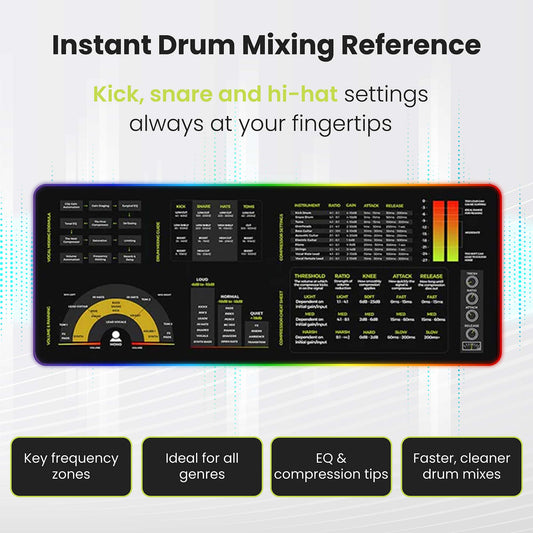
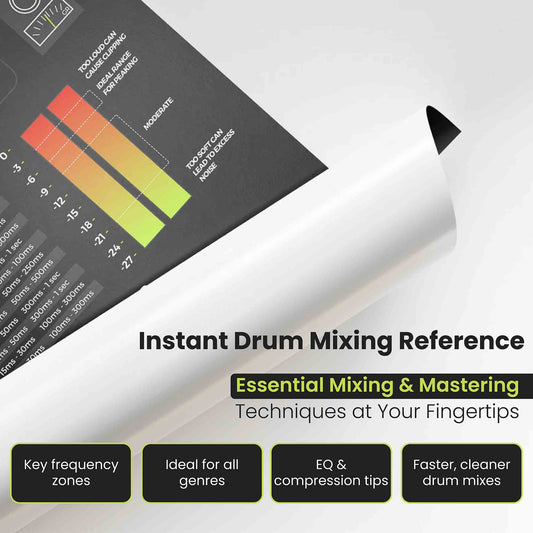
For a printed reference at your desk, the EQ Frequency Cheat Sheet Mousepad puts the per-instrument frequency map within arm's reach while you mix.
Frequently asked
Can you really mix on headphones, or do you need studio monitors?
You can mix entirely on headphones — many working engineers do, particularly on tour or in untreated rooms. The honest caveat is that headphones present the stereo image differently than speakers, exaggerating panning and under-representing room sound, so the final mix should always be checked on at least one alternative system before it ships. A pair of monitors in a treated room is the easier path. A neutral pair of headphones is the cheaper one.
Should I get open-back or closed-back headphones for mixing?
Open-back is the default recommendation for mixing because the wider stereo image makes pan and depth decisions more obvious and the bass response tends to be flatter. Closed-back is mandatory for tracking — recording with a microphone in the same room — because open headphones will leak click track into the microphone. If you can only afford one pair, choose by which you do more often. If you can afford two, the natural pairing is one open-back for mixing and one closed-back for tracking.
Do I need a headphone amplifier?
For 32Ω to 80Ω headphones, no — any modern audio interface or even a phone will drive them loud enough. For 150Ω and above, including the Sennheiser HD 600 above, yes. A €100 dedicated headphone amp like a JDS Atom or a Schiit Magni adds noticeable clarity and bass extension to a high-impedance pair and is the single most cost-effective upgrade after the headphones themselves.
What is the Harman target curve and why does it keep coming up?
The Harman target is a research-backed frequency-response curve developed by Sean Olive and colleagues at Harman International, derived from controlled blind listening tests. It represents what most listeners perceive as a neutral and pleasing tonal balance through a headphone. Headphones tuned to it — including the AKG K371 above — tend to produce mixes that translate well to consumer playback systems, because they sound close to what most listeners are used to hearing.
Why are some headphones called "studio" and others "audiophile" — what's the difference?
Studio headphones are tuned for accuracy first; audiophile headphones are tuned for enjoyment first. A studio pair like the HD 600 sounds correct but not always exciting. An audiophile pair often emphasises the bass and treble for a more impressive listening experience. For mixing, choose studio every time — your job is to hear what is actually there, not what is flattering. For everyday listening, either category works.
How long do studio headphones last?
Mechanically, a well-built pair like the HD 600, DT 770, or MDR-7506 will last ten to twenty years of bedroom use. The parts that wear are the pads and the cables, both of which are replaceable on every headphone above except the Samson and the Sony (which has a hardwired cable). Plan to replace pads every two to three years of daily use. The drivers themselves rarely fail.






 Gitarrenakkorde Diagramm Mousepad
 Bassgitarren-Theorie-Spickzettel Mousepad
 Musiktheorie-Spickzettel Mousepad
 Ukulele Theorie Spickzettel Mousepad
 Gitarrentheorie-Spickzettel Mousepad


