 4.8/5 on Trustpilot

It is one of the most divisive questions in music production. One camp insists theory is essential and that skipping it caps your ceiling. The other points at a long list of self-taught producers who never learned a scale and still topped charts. Both are partly right, which is why the honest answer is more useful than either slogan.
The short version: no, you do not need formal music theory to produce music, and plenty of successful producers work largely by ear. But a small, practical subset of theory removes so much trial-and-error that avoiding it on principle mostly just slows you down. The question worth answering is not whether to learn theory, but how much, and in what order.

So do you actually need music theory to produce?
No, not in the formal sense. You can open a digital audio workstation today, draw notes into a piano roll, and make finished music without naming a single chord. Many producers do exactly that, especially in electronic and hip-hop styles where sound design, rhythm, and arrangement carry more of the weight than harmony does.
Here is the part the no-theory camp tends to skip. The producers who work successfully without naming theory have almost always absorbed it anyway, through years of listening, copying, and trial and error. They cannot tell you they are playing a I–V–vi–IV progression, but their fingers find it because they have heard it ten thousand times. That is still theory. It is just stored as instinct instead of vocabulary.
So the real choice is not theory versus no theory. It is whether you learn the patterns the slow way, by absorbing them over years, or the fast way, by spending a few weeks learning the handful that explain most of the music you already like. Formal study is simply the shortcut to the instinct the self-taught producers built the long way.
What music theory do producers actually use day to day?
Far less than a conservatory teaches. The working subset that covers the vast majority of popular production is small enough to list.
You need the major and minor scales, because they tell you which notes sound at home together and stop you reaching for the wrong ones. You need a handful of chord types, mainly major, minor, and seventh chords, which is enough to build most pop, electronic, and hip-hop progressions. You need to understand keys, so your bassline, melody, and chords agree with each other. And you need a rough sense of how common progressions move, because four or five of them underpin an enormous share of released music.
That is most of it for getting started. A producer who knows the major scale, the minor scale, three or four chord types, and how to stay in key can write the harmony for the great majority of popular songs. Everything beyond that, modes, advanced voice leading, reharmonisation, is genuinely optional and can be added later if a style demands it.
Worth noting: your DAW already encodes a lot of this. Scale-lock features grey out the wrong notes, chord tools build triads for you, and the piano roll is itself a theory diagram. Modern production software quietly hands you a chunk of theory whether you studied it or not. Learning the underlying ideas just means you understand what those tools are doing instead of guessing.
Can you produce a hit with no theory at all?
Yes, and it happens regularly. Some of the most commercially successful producers of the last two decades have said openly that they do not read music or think in formal theory. Genres built on sampling, sound design, and rhythm, including much of hip-hop, trap, and electronic music, can be produced to a professional standard without ever naming a chord.
The honest caveat is survivorship. For every self-taught producer who broke through without theory, there are many more who plateaued, hit the same wall every session, and could not work out why their tracks felt stuck. The famous exceptions are real, but they are exceptions, and most of them compensated with an extraordinary ear, relentless output, or collaborators who handled the harmony.
If your goal is one track that sounds good, you can almost certainly get there by ear with enough patience. If your goal is to make music reliably, to fix a progression that is not working instead of randomly nudging notes until it does, a little theory turns a long guessing game into a short, deliberate decision.
Will learning theory make my music sound formulaic or less original?
This is the fear that keeps a lot of producers away from theory, and it has the relationship backwards. Theory is descriptive, not prescriptive. It does not tell you what you must do; it explains what is already happening in music you like, which means it expands the set of choices you can make on purpose rather than narrowing it.
The producers whose music sounds formulaic are usually not the ones who studied theory. They are the ones who only know one or two progressions and reuse them because they have nothing else to reach for. Knowing more about how harmony works gives you more ways to surprise a listener, not fewer, because you can break a rule deliberately once you know it is there.
Originality comes from taste, sound selection, arrangement, and the specific combination of influences you bring. Theory is a tool that serves those decisions. A larger vocabulary has never made a writer less original, and it works the same way in music.
Does the genre you produce change how much theory you need?
It changes it a lot, and this is the detail most blanket answers miss. The honest amount of theory you need is not a fixed number; it scales with how much the harmony of your genre is doing.
At the lighter end sit styles where rhythm, texture, and sound design carry the music. Techno, ambient, house, and a good deal of trap can be built on one or two chords, a held drone, or a single sampled loop. Here you can go a very long way with almost no harmonic theory, because the interest lives in the groove and the sound rather than the chord changes. Time spent learning synthesis or sampling will pay back faster than time spent on chord theory.
In the broad middle sit pop, hip-hop, rock, and most electronic music with melodies. These lean on four or five chord progressions and clear melodies, so the practical subset, scales, basic chords, and a few progressions, is genuinely enough to produce them well. This is the zone most bedroom producers work in, and it is also where a small amount of theory gives the biggest return.
At the demanding end sit jazz, neo-soul, gospel, fusion, and film scoring. These genres are built on extended chords, frequent key changes, and voice leading, and you cannot fake your way through them by ear nearly as easily. If this is where you are headed, deeper theory stops being optional and becomes part of the craft itself.
So the useful version of the question is not whether you need theory, but how harmonically rich the music you want to make is. Match your study to your genre and you will never waste weeks learning theory your style does not use.
How much theory is enough to get unstuck, and in what order?
Enough to stop guessing is a much lower bar than most people assume. You can reach the point where theory actively helps your productions in a few focused weeks, not years, if you learn it in the order that pays off fastest.
Start with the major scale and how to find the notes of a key, because that alone stops most wrong-note problems. Next, learn how to build major and minor chords from that scale, which lets you turn a single melody into a progression. Then learn three or four common progressions, the I–V–vi–IV chief among them, so you have reliable starting points when a session stalls. Add seventh chords for warmth and tension once the basics are automatic.
The mistake is trying to learn theory in the abstract, away from the music. The fastest route is to learn each idea and immediately apply it in your DAW, building the progression you just read about and hearing what it does. Theory absorbed at the piano roll sticks. Theory read from a textbook and never used evaporates.
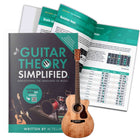
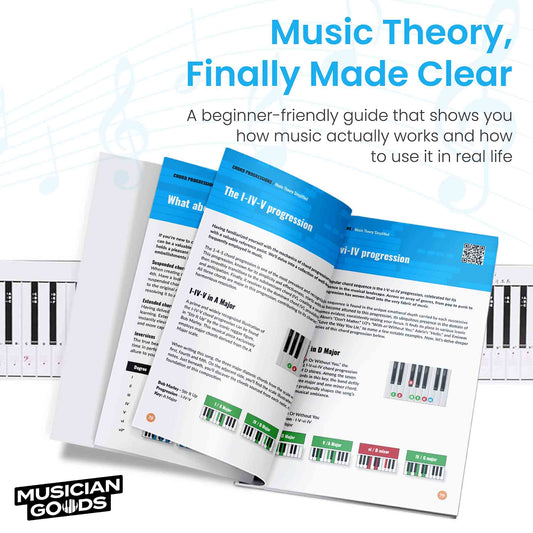
This is exactly why we wrote Music Theory Simplified: a full-colour, plain-English guide that teaches the practical subset producers actually use, in the order that makes each idea immediately usable, without the notation-heavy detour of a traditional course. It is built for self-taught producers who want the theory that earns its place in a session and none of the theory that does not.

View Music Theory Simplified →
The honest bottom line
You do not need music theory to start producing, and you should not let the lack of it stop you from opening your DAW today. Make things by ear, copy songs you love, and trust that you are already absorbing theory whether you name it or not.
But treating theory as optional forever is a slower path dressed up as a principled one. The small, practical subset of theory is the difference between fixing a stuck progression in thirty seconds and nudging notes for an hour. Learn it the way it actually helps, applied at the piano roll, a few weeks at a time, and it stops being homework and becomes the thing that keeps your sessions moving.






 Gitarrenakkorde Diagramm Mousepad
 Bassgitarren-Theorie-Spickzettel Mousepad
 Musiktheorie-Spickzettel Mousepad
 Ukulele Theorie Spickzettel Mousepad
 Gitarrentheorie-Spickzettel Mousepad


