 4.8/5 on Trustpilot

Finding the right guitar can be the difference between quick progress and frustrating setbacks. For beginners, choosing an instrument that fits your hands and body is more than just a style decision. Selecting the proper guitar and mastering core basics like tuning, chords, and strumming helps you play confidently and connect with fellow musicians. This guide delivers practical steps and clear comparisons to make your musical journey smoother and more rewarding.
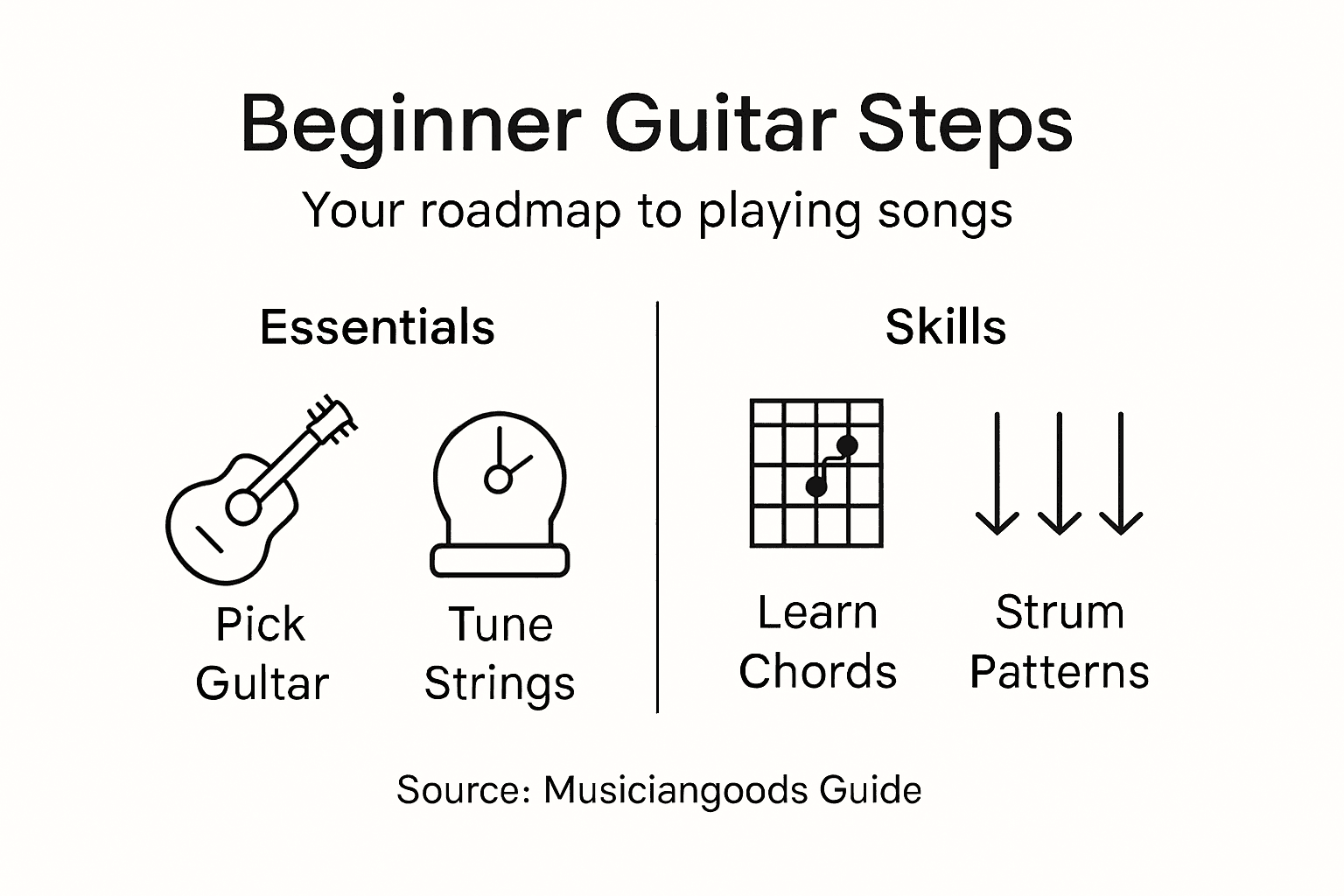
Quick Summary
| Key Message | Explanation |
|---|---|
| 1. Choose the Right Guitar | Select between acoustic and electric based on your musical preference for an enjoyable learning experience. |
| 2. Properly Tune Your Guitar | Use electronic tuners or apps to achieve accurate tuning for best sound quality before each practice session. |
| 3. Learn Essential Chords | Master basic open chords like A, D, and G to create a foundation for playing popular songs. |
| 4. Practice Strumming Techniques | Start with down-up strumming to enhance your rhythm and connect chords with musical expression. |
| 5. Track Your Progress | Regularly assess your skills and document practice routines to identify areas for improvement and celebrate achievements. |
Step 1: Select the Right Guitar and Accessories
Choosing your first guitar is an exciting journey into the world of music. The right instrument can transform your learning experience and set you up for success from day one. When selecting a guitar, you need to consider several key factors that will impact your comfort, enjoyment, and progress.
Beginners have two primary guitar options: acoustic and electric. Understanding guitar fundamentals helps narrow down your choice. Acoustic guitars are great for folk, country, and singer-songwriter styles, while electric guitars work well for rock, blues, and metal genres. Your musical preferences should guide your selection.
-
Acoustic Guitars
- Ideal for unplugged performances
- No additional equipment required
- Great for learning basic chords
-
Electric Guitars
- Require an amplifier
- More versatile sound options
- Better for rock and modern genres
When trying out guitars, pay attention to body size and comfort. The instrument should feel natural in your hands, with a neck width that allows easy finger placement. Smaller-bodied guitars work well for players with smaller hands, while full-sized instruments suit those with larger frames.

Here’s a quick comparison of acoustic and electric guitars to help you decide which suits you best:
| Guitar Type | Typical Music Styles | Portability | Sound Adjustability |
|---|---|---|---|
| Acoustic | Folk, country, singer-songwriter | Easy to carry, no cables | Natural, limited via playing style |
| Electric | Rock, blues, metal | Needs amp and cable | Highly adjustable with effects |
Essential Accessories:
- Guitar picks
- Tuner
- Extra strings
- Soft carrying case
- Guitar strap
Select a guitar that feels comfortable and matches your musical style, not just what looks cool.
Pro tip: Visit a local music store and try multiple guitars before purchasing to find the perfect fit for your body and playing style.
Step 2: Tune Your Guitar Properly
Tuning your guitar is a critical first step that transforms random string sounds into beautiful music. Proper guitar tuning techniques ensure your instrument sounds crisp, clear, and professional from the moment you start playing.
Beginners have multiple tuning options to choose from. Electronic tuners are the most straightforward method, providing precise pitch guidance through digital displays. For those without a dedicated device, smartphone apps offer accurate tuning capabilities right from your phone. Here are the primary tuning methods:
-
Electronic Tuner
- Most accurate method
- Easy for beginners
- Provides visual pitch guidance
-
Smartphone Apps
- Convenient and free
- Use microphone for tuning
- Work with most smartphones
-
Tuning by Ear
- Advanced technique
- Requires practice
- Develops musical skills
The standard guitar tuning follows the EADGBE pattern from the thickest to thinnest string. Start by plucking each string individually and adjusting the tuning pegs until the electronic tuner indicates the correct pitch. Make small, precise movements to avoid overshooting the correct note.
Consistent and accurate tuning is the foundation of great guitar playing.
Pro tip: Tune your guitar every time before you practice to train your ear and maintain instrument quality.
Step 3: Learn Basic Guitar Chords
Chord progression fundamentals are the gateway to playing your favorite songs and expressing yourself through music. Learning basic guitar chords transforms those six strings from a mysterious instrument into a powerful tool for musical creativity.
Beginners typically start with open chords, which are the foundation of most popular music styles. These chords use a combination of fingered and open strings to create rich, resonant sounds. The most essential chords for new guitarists include:
-
A Major Chord
- Three-finger position
- Commonly used in rock and pop
- Relatively easy to learn
-
D Major Chord
- Bright, crisp sound
- Essential for folk and country music
- Requires precise finger placement
-
G Major Chord
- Versatile chord shape
- Used in multiple music genres
- Slightly more complex fingering
When practicing chords, focus on clean finger placement and smooth transitions. Start by placing your fingers carefully, ensuring each string rings out clearly. Practice switching between two chords slowly, gradually increasing your speed as muscle memory develops.
Below is a summary of standard beginner open chords and their key characteristics:
| Chord | Fingering Difficulty | Common Use Cases | Notable Sound Quality |
|---|---|---|---|
| A Major | Easy, uses 3 fingers | Pop, rock, folk | Warm, full tone |
| D Major | Moderate, precise | Country, acoustic music | Bright, ringing sound |
| G Major | Challenging for starters | Many genres | Rich, resonant, versatile |
Mastering basic chords is like learning the alphabet before writing a novel.
Pro tip: Practice chord changes with a metronome, starting slow and gradually increasing speed to build muscle memory and precision.
Step 4: Practice Simple Strumming Patterns
Basic strumming techniques transform your chord knowledge into actual music. Strumming is the heartbeat of guitar playing, turning static chord shapes into dynamic, rhythmic expressions.
Beginners should start with down-up strumming, a fundamental pattern that forms the backbone of most popular music styles. Your strumming hand should move like a pendulum, creating consistent rhythm and energy. Here are key techniques to master:
-
Down Strumming
- Basic foundational technique
- Provides strong, clear rhythm
- Used in many musical genres
-
Down-Up Strumming
- Adds complexity to rhythm
- Creates more dynamic sound
- Essential for pop and rock styles
-
Accent Strumming
- Emphasizes specific beats
- Adds musical expression
- Requires precise hand control
When practicing, hold your pick loosely and keep your wrist relaxed. Start slowly, focusing on maintaining a steady rhythm. Count out loud (1-2-3-4) to help internalize the beat, gradually increasing speed as you become more comfortable.
Rhythm is the heartbeat of music - master your strumming, and the songs will follow.
Pro tip: Practice strumming patterns with a metronome, starting at a slow tempo and incrementally increasing speed to build muscle memory and precision.
Step 5: Play Your First Complete Song
Song performance techniques transform isolated chord practice into a musical journey. Your first complete song represents an incredible milestone in your guitar-playing adventure, connecting all the skills you’ve learned into a single, satisfying musical expression.
Choose a beginner-friendly song with simple chord progressions and a steady rhythm. Three-chord songs are perfect for new guitarists, typically using chords like G, C, and D. Here are strategies for successful song learning:
-
Song Selection
- Pick songs with 3-4 chords
- Choose familiar, motivating music
- Start with slower-paced tracks
-
Learning Approach
- Break song into small sections
- Practice chord transitions slowly
- Use online tutorial resources
-
Performance Techniques
- Focus on steady rhythm
- Maintain consistent strumming
- Keep relaxed hand position
Practice the song section by section, starting with the simplest parts. Play each chord transition multiple times, gradually increasing your speed. Listen to the original track to understand the rhythm and feel of the music.
The first song you play completely is a moment of pure musical magic.
Pro tip: Record yourself playing the song and listen back to identify areas for improvement, celebrating your progress along the way.
Step 6: Check Your Progress and Refine Skills
Progress in guitar playing comes from honest self-assessment and targeted practice. Developing a systematic approach to skill evaluation helps you transform potential frustrations into meaningful improvements.
Critical areas to assess in your guitar journey include technical skills, muscle memory, and musical expression. Break down your progress into specific, measurable components:
-
Technical Skills Assessment
- Chord transition smoothness
- Strumming rhythm consistency
- Finger placement accuracy
-
Performance Evaluation
- Song completion rate
- Memorization of chord sequences
- Overall musical confidence
-
Practice Tracking
- Daily practice duration
- Skill improvement over time
- Areas needing extra attention
Record yourself playing periodically to gain objective insights. Video recordings allow you to observe your technique from an external perspective, revealing subtle improvements and areas requiring focused practice.
Small, consistent improvements create extraordinary musical journeys.
Pro tip: Create a practice journal to document your progress, noting specific skills mastered and challenges encountered each week.
Unlock Your True Guitar Potential with the Right Tools and Guidance
Starting your guitar journey comes with challenges like choosing the right instrument, mastering chords, and developing solid strumming techniques. This guide helps you build confidence by teaching essential skills such as tuning, chord transitions, and playing your first complete songs. However, many beginners struggle to find the right educational resources and practice aids that make learning smooth and enjoyable.
At Musiciangoods, we understand these pain points and offer specially designed books, cheat sheets, and visual tools to simplify complex music theory and accelerate your progress. Whether you want to perfect your chord transitions or develop reliable tuning habits, our resources support your learning every step of the way with clear, step-by-step systems created by musicians for musicians.
Take your beginner guitar skills to the next level today by exploring our educational tools crafted to keep you motivated and on track. Don’t wait to turn those first chords into your favorite songs. Visit Musiciangoods now and equip yourself with everything needed to play with confidence and joy.
Frequently Asked Questions
What type of guitar should I choose as a beginner?
Choosing between an acoustic and electric guitar depends on your musical interests. If you prefer folk or country music, start with an acoustic guitar. For rock or blues, an electric guitar may suit you better. Try both types at a local music store to find out which feels more comfortable for you.
How can I ensure my guitar is in tune before playing?
Use an electronic tuner or a smartphone app to tune your guitar accurately. Pluck each string and adjust the tuning pegs until they hit the correct pitch indicated by your device. Tune your guitar every time before you practice to develop your ear and maintain accuracy.
What are the basic chords I should learn first?
Begin learning with open chords such as A Major, D Major, and G Major as they are commonly used in many songs. Focus on clean finger placement and transitions between these chords. Practice switching between two chords slowly before gradually increasing your speed.
How can I practice strumming patterns effectively?
Start with down-up strumming, which is a fundamental pattern for most songs. Focus on maintaining a steady rhythm, using a metronome to keep your timing consistent. Begin slowly and increase your speed as you gain confidence in your strumming technique.
What is the best way to learn my first complete song?
Select a beginner-friendly song with a simple chord progression, like a three-chord song. Break the song down into sections and practice each part independently before connecting them. Record yourself playing to identify areas for improvement and celebrate your progress.
How can I track my progress in learning guitar?
Maintain a practice journal to document your daily practice, noting skills mastered and challenges faced. Periodically record yourself playing to gain insights into your technique and improvements. Review your performance to understand where to focus your efforts for maximum growth.


 Χάρτης Ακκόρντων Κιθάρας Mousepad
 Σημειωματάριο Θεωρίας Μουσικής Mousepad
 Φύλλο Απάτης Μίξης και Μάστερινγκ Mousepad


