 4.8/5 on Trustpilot


A chord progression is the harmonic spine of almost every song you know. It is the sequence of chords that repeats under the melody and gives a piece its mood, its sense of movement, and its moment of arrival. Writing one that sounds good is not a matter of luck or talent. It follows a small set of patterns that have held up across centuries of music, and once you can see those patterns, you can build progressions of your own in any key.
This guide walks through the whole process: how chords relate to a key, why some chords pull toward others, the handful of moves that do most of the work in popular music, and a repeatable method for writing a progression from a blank page. It assumes you can already play a few basic chords and read chord names like C, Am, or G7. You do not need to read standard notation.
Start with a key, not a chord
Every progression lives inside a key. A key is a home base of seven notes and the chords built from them, and choosing one first is what keeps the chords sounding like they belong together. Most beginners pick C major or A minor to start, because neither uses sharps or flats.
From the seven notes of a major scale, you can build seven chords, one rooted on each note. In C major those chords are C, Dm, Em, F, G, Am, and Bdim. Three are major, three are minor, and the last one is diminished. This pattern of qualities never changes in a major key, which is the first useful shortcut: learn it once and it applies everywhere.
The chords drawn only from the notes of the key are called diatonic chords. A progression built entirely from them will sound coherent almost no matter what order you put them in. That is the safety net that makes writing your first progressions forgiving.
Number the chords so you can move any idea to any key
Musicians rarely talk about a progression as "C, F, G." They talk about it as "one, four, five," because numbering the chords frees the idea from a single key. Each diatonic chord gets a Roman numeral based on its position in the scale, with uppercase numerals for major chords and lowercase for minor.
In any major key the pattern is the same: I and IV and V are major, ii and iii and vi are minor, and vii is diminished. In C major that reads as I = C, ii = Dm, iii = Em, IV = F, V = G, vi = Am, vii° = Bdim.
The payoff is portability. A "I–V–vi–IV" progression is C–G–Am–F in C major and G–D–Em–C in G major, but it is the same progression with the same emotional shape. Learn progressions as numbers and you learn them once for every key at the same time. If the relationship between a key and its chords is still fuzzy, our explainer on relative major and minor keys fills in the background.
Why chords pull: the three functions
Chords are not interchangeable. They fall into three jobs, and understanding those jobs is the difference between arranging chords at random and writing a line that feels like it goes somewhere.
The first job is rest. The I chord, and to a lesser extent vi and iii, sound stable. They feel like home. A progression that starts here begins on solid ground.
The second job is motion away from home. The IV and ii chords sound like they have left the front door but have not gone far. They create gentle movement and set up what comes next.
The third job is tension that wants to resolve. The V chord, especially when you add a seventh to make it V7, sounds unfinished on its own. It leans hard back toward the I chord. That pull from V to I is the single strongest gravitational force in Western harmony, and most satisfying progressions use it to land.
Think of a progression as a short trip: leave home, wander, build a little tension, then return. Tonic is home, subdominant is the wandering, dominant is the tension that pulls you back. Almost every famous progression is a different route through those three stops.
The moves that do most of the work
A small number of progressions account for an enormous share of popular music. Learning them is not copying. It is learning the vocabulary so you can later write your own sentences.
The I–IV–V is the backbone of blues, early rock, folk, and country. In C that is C–F–G. It states home, moves away, builds tension, and usually loops back to I. Nothing sounds more grounded.
The I–V–vi–IV is the progression behind a remarkable number of pop hits across decades. In C that is C–G–Am–F. The vi chord adds a touch of melancholy without ever leaving the key, which is why the same four chords can feel both uplifting and wistful. We took this pattern apart in detail in why so many pop songs use the same four chords.
The ii–V–I is the engine of jazz and a great deal of sophisticated pop. In C that is Dm–G–C. It is the cleanest example of the function cycle: subdominant, dominant, tonic, with each chord setting up the next. Add sevenths to get Dm7–G7–Cmaj7 and it immediately sounds more polished.
The vi–IV–I–V is the same four chords as the pop progression in a different order, starting on the minor vi. In C that is Am–F–C–G. Starting on the minor chord gives a darker, more emotional opening that brightens as it resolves.
To hear each of these and play them in any key, PlayTheory spells out these common chord progressions in all 12 keys, with a keyboard to play along.
A five-step method for writing your own
Patterns are a starting point. Here is a repeatable way to write a progression from scratch rather than borrowing one.
Step one: pick a key and write out its seven chords. Use C major or A minor if you want to keep things simple, and list the diatonic chords with their numerals so you can see your whole palette.
Step two: start and end with the tonic. Beginning on I establishes home, and ending on I gives a sense of resolution. For now, anchor both ends there. You can break this rule deliberately later, but it is the most reliable way to sound finished.
Step three: choose a chord that creates motion in the middle. Drop in a IV or a ii to move away from home. This is the part of the trip where the listener leaves the front door.
Step four: add tension before you return. Place a V or V7 right before the final I. That dominant chord is what makes the return feel earned rather than arbitrary. A progression as plain as I–IV–V–I already has a complete shape because it visits all three functions.
Step five: play it in a loop and trust your ear. Theory narrows the options to the ones likely to work, but the final judge is whether the loop feels good to play and sing over. If a chord sticks out, swap it for another chord with the same function: try ii instead of IV, or vi instead of I, and listen again.
Adding motion once the basics work
A progression built from plain triads can start to feel flat after a few bars. A few small techniques add color without requiring you to leave the key.
Seventh chords are the easiest upgrade. Adding the seventh note to a chord thickens it and sharpens its pull. A V7 leans harder toward I than a plain V, and a Imaj7 or vi7 sounds warmer and more modern. Jazz and neo-soul lean on sevenths constantly. Our guide to seventh chords shows how to build each type.
Inversions change which note sits in the bass without changing the chord itself. Playing a C chord with E or G in the bass lets you move the bass line smoothly from one chord to the next, which often matters more to the ear than the chords themselves. A descending bass line under a static set of chords is one of the oldest tricks for making a simple progression sound deliberate.
A single borrowed chord can lift a whole progression. Borrowing a chord from the parallel minor — most commonly the IV turning minor, or a flat-VII appearing in a major key — introduces a moment of surprise that still resolves cleanly. Used once, sparingly, it sounds like a choice. Used everywhere, it sounds like you have lost the key.
Writing in a minor key
Minor keys follow the same logic with a different home chord. In A minor the diatonic chords are Am, Bdim, C, Dm, Em, F, and G, and the tonic is now the minor i chord. The progression i–iv–V (Am–Dm–E) is the minor-key counterpart of I–IV–V.
One detail trips people up. To get a strong pull back to the minor tonic, the V chord is usually made major rather than minor, which means raising one note from outside the natural scale. In A minor that turns the v (Em) into a V (E or E7). This is the most common reason a beginner's minor progression sounds like it never quite resolves: the dominant was left minor and lost its gravity.
Common mistakes that flatten a progression
A few habits weaken otherwise sound progressions. Changing chords on every beat leaves no room for a melody to breathe; most songs hold each chord for a full bar or two. Avoiding the V chord entirely removes the main source of tension and resolution, which is why some beginner loops feel pleasant but directionless. And drifting outside the key with chord after chord erases the sense of home that made the progression coherent in the first place.
The fix for all three is the same: return to function. Ask what job each chord is doing, make sure you have at least one chord of rest, one of motion, and one of tension, and give each chord enough time to register.
Frequently asked questions
How many chords does a progression need? As few as two can work, and a great many songs use only three or four. More chords are not better. A I–IV–V loop has carried entire genres. Focus on the order and the function of the chords rather than the count.
Do I have to know music theory to write a progression? No, but a little goes a long way. You can find chords that sound good by ear alone. Knowing the numbering system and the three functions simply means you can repeat what worked, move it to a singer's key, and fix a progression that is not landing instead of guessing.
What key should I write in? For writing and experimenting, C major or A minor keep the theory clean because they use no sharps or flats. When you actually record or perform, choose the key that best fits the singer's range, then transpose the progression using its numerals.
Why does my progression sound unfinished? Usually because it does not end on the tonic, or because there is no dominant chord setting up that ending. Try placing a V or V7 right before a final I. In a minor key, make sure that V chord is major rather than minor.
Can I just reuse a famous progression? Yes. Chord progressions themselves are not copyrighted, which is why I–V–vi–IV appears in hundreds of songs. What makes a song yours is the melody, rhythm, lyrics, and arrangement built on top of the progression.
Take it further
Writing progressions gets easier the moment the numbering system and the three functions become second nature, because then every key looks the same and every chord has an obvious job. That fluency is exactly what turns trial and error into deliberate writing.
If you want the full picture — how scales, intervals, keys, and chords fit together in one visual system you can actually remember — that is the book we wrote for it.





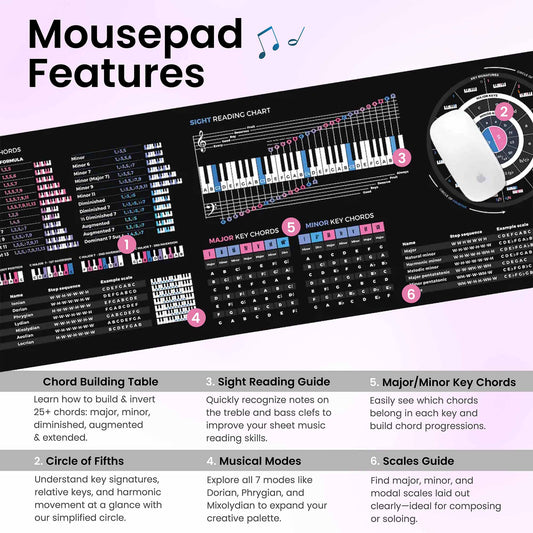




 Χάρτης Ακκόρντων Κιθάρας Mousepad
 Σημειωματάριο Θεωρίας Μουσικής Mousepad
 Φύλλο Απάτης Μίξης και Μάστερινγκ Mousepad


