 4.8/5 on Trustpilot

Every scale, every chord, every melody is built by moving small distances between notes. Those distances have just two basic sizes: half steps and whole steps. Learn to see them on the keyboard and the logic behind scales and chords stops being a mystery — it becomes a pattern you can count.
In this guide, we'll break down whole steps and half steps the simple way — what each one is, how to spot them on a piano, the two spots on the keyboard that trip people up, and why these tiny intervals are the foundation of everything else in music.

What are whole steps and half steps?
A half step — also called a semitone — is the smallest distance between two notes. On a piano, it's the distance from any key to the very next key, whether that neighbour is black or white. C to C♯ is a half step. E to F is a half step. There's nothing smaller.
A whole step — also called a whole tone — is simply two half steps stacked together. On the keyboard, it's the distance of two keys: you skip one key to land on the next. C to D is a whole step, because you pass over C♯ to get there.
That's the whole idea. Half step = one key over. Whole step = two keys over. Every scale and chord is just a specific recipe of these two moves.
How whole steps and half steps work
To move a half step, go to the key immediately next to your current one — left or right, black or white. Most white keys have a black key just to their right (a half step above) and a black key just to their left (a half step below). So from C, the black key up-and-to-the-right is C♯, a half step above C.
Here's the part that catches everyone out: there are two pairs of white keys with no black key between them — E to F, and B to C. Because there's no key in between, E to F and B to C are already half steps, white key to white key. Miss this and your step-counting will be off by one every time you cross those spots.

To move a whole step, skip one key to reach the next. Pairs of white keys that do have a black key between them — A-B, C-D, D-E, F-G, G-A — are all a whole step apart, because you pass over that black key. And a whole step above E is the black key next to F (since E-F is only a half step, you need one more); a whole step above B is the black key next to C, for the same reason.

The reason this matters so much is that scales are defined entirely by patterns of whole and half steps. The major scale, for example, follows the fixed recipe whole–whole–half–whole–whole–whole–half. Start on any note, follow that pattern of steps, and you've built a major scale in that key. Change the pattern and you get a different scale with a different mood. The steps are the scale.
How to practice whole steps and half steps (4-step plan)
This is a see-it-and-count-it skill. A little hands-on practice makes it stick fast.
Step 1 — Play half steps up the keyboard
Start on C and play every single key in order — white, black, white, black — saying "half step" with each move. Feel how each key is the immediate neighbour of the last. Do it slowly enough to notice E-F and B-C, where two white keys sit side by side.
Step 2 — Play whole steps up the keyboard
Now start on C again but skip a key each time: C, D, E, F♯, G♯, A♯, C. Say "whole step" with each jump. Notice how you always pass over exactly one key to get to the next.
Step 3 — Spot the two natural half steps
Point to E and F, then B and C, and confirm there's no black key between them. Play them and remind yourself: these are half steps even though both keys are white. This is the single fact that fixes most step-counting errors.
Step 4 — Build a major scale by steps
Start on C and apply the major-scale recipe out loud: whole (C-D), whole (D-E), half (E-F), whole (F-G), whole (G-A), whole (A-B), half (B-C). You'll land on all white keys — the C major scale. You just built a scale purely by counting steps.
Common mistakes to avoid
- Forgetting E-F and B-C are half steps. These are the only white-to-white half steps. Treating them as whole steps is the number-one beginner error and throws off every scale you try to build.
- Thinking a half step means "white to black." A half step is the next key in either direction — it can be white to black, black to white, or white to white. It's about distance, not colour.
- Counting keys instead of gaps. A whole step is two half steps of distance, meaning you skip one key. Count the moves between keys, not the keys themselves.
- Ignoring direction. Steps go both ways. A half step below a key is just as valid as a half step above — useful when you're building scales or lowering notes.
- Memorizing scales without the steps. If you learn scales as finger patterns only, you're stuck. Learn the whole-and-half-step recipe and you can build any scale from any note.
Why whole steps and half steps matter
Whole steps and half steps are the building blocks of Western music. Grasp them and a lot of theory suddenly makes sense.
- You can construct any scale from scratch — major, minor, and beyond — because every scale is just a pattern of these two steps.
- Chords make more sense, since the intervals inside them are measured in half steps too.
- You start hearing and seeing structure instead of memorizing shapes, which makes every next concept — keys, chords, progressions — faster to learn.
It looks elementary, and it is — but it's the foundation the rest of music theory stands on. Intervals, simplified, start here.
Take it further
The full guide to intervals, scales, and how whole and half steps build the entire system is laid out in Music Theory Simplified. It's the same clear, visual style you're reading now.
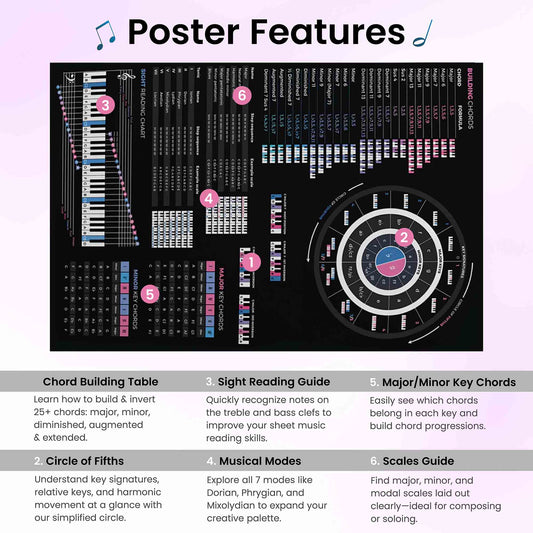
Want the step patterns and scale formulas next to your keyboard while you practice? The Music Theory Cheat Sheet Poster and Cheat Sheet Mousepad keep intervals, scales, and chord formulas in view whenever you sit down to play.
Prefer a digital reference for any screen? Grab the Music Theory Cheat Sheet PDF, or get everything together in the Music Theory Bundle.

Every scale starts with two steps.
Music Theory Simplified turns intervals, scales and chords into keyboard diagrams you can count straight from.
FAQs about whole steps and half steps
What is the difference between a whole step and a half step?
A half step (semitone) is the smallest distance between two notes — the very next key on the piano. A whole step (whole tone) is two half steps combined, meaning you skip one key. C to C♯ is a half step; C to D is a whole step.
Is E to F a whole step or a half step?
E to F is a half step. There's no black key between E and F, so those two white keys are already the closest possible distance apart. The same is true for B to C.
How many half steps are in an octave?
There are twelve half steps in an octave. That's why there are twelve unique notes before the pattern repeats — seven white keys and five black keys, each a half step from the next.
Why do whole steps and half steps matter for scales?
Every scale is defined by a specific pattern of whole and half steps. The major scale is whole-whole-half-whole-whole-whole-half. Follow that pattern from any starting note and you build a major scale in that key, which is why the steps are so important.
Can a half step go down as well as up?
Yes. A half step is the next key in either direction. A half step below a note is the key immediately to its left, just as a half step above is the key to its right. Direction doesn't change the size of the step.
This post is part of Musiciangoods' Music Theory Simplified series — practical music theory, taught visually, for musicians who want to understand what they're playing. Explore more music learning tools here.









 Guitar Chords Chart Mousepad
 Guitar Theory Simplified (Paperback/PDF)
 Bass Guitar Theory Cheat Sheet Mousepad
 Bass Theory Simplified (Paperback/PDF)
 Music Theory Simplified - (Paperback/PDF)
 Music Theory Cheat Sheet Mousepad
 Ukulele Theory Simplified (Paperback/PDF)
 Ukulele Theory Cheat Sheet Mousepad
 Guitar Theory Cheat Sheet Mousepad
 Mixing Mastering Cheat Sheet Mousepad


