 4.8/5 on Trustpilot

Pachelbel's Canon in D is the most quietly influential piece of music most people have heard a thousand times without ever learning its name. It plays at weddings, over film montages, in phone hold music, and in the background of graduation slideshows. It has also been borrowed, consciously or not, by an enormous number of pop and rock songs. The reason it travels so well is not sentiment. It is structure, and the structure is worth understanding.
Written by the German composer Johann Pachelbel most likely in the late seventeenth century, the full title is Canon and Gigue in D major for three violins and basso continuo. Almost nobody plays the gigue that follows. The canon is the part that lodged itself in the culture, and underneath its serene surface is one of the clearest teaching examples in Western music of how a tiny amount of material can generate a great deal of music.
The engine: a two-bar bass that never changes
Everything in the Canon sits on top of a repeating bass line. Just eight notes, two bars long, played by the cello and continuo, over and over, from the first bar to the last. In the key of D major those notes are D, A, B, F-sharp, G, D, G, A. The piece repeats this pattern twenty-eight times without alteration.
A short, unchanging bass figure repeated as the foundation of a whole piece has a name: a ground bass, or basso ostinato, from the Italian for stubborn. It is one of the oldest compositional devices in Western music, and it is the true engine of the Canon. Every melody, every flourish, every moment of tension in the piece is invented over the top of those same eight recurring notes.
The chords implied by that bass line are equally fixed: D major, A major, B minor, F-sharp minor, G major, D major, G major, A major. Written in the Roman-numeral shorthand that describes chords by their position in the key, that is I, V, vi, iii, IV, I, IV, V. If the first four of those look familiar, they should. The opening of the Canon's progression is a close cousin of the four-chord loop that runs under a huge share of modern pop, which we unpack in our piece on why pop songs use the same four chords.
Why the progression feels like it is always moving home
The magic of the sequence is in the bass. Look at the direction of those eight notes and a pattern emerges: the line descends in steps for much of its length, D down to A, then B down to F-sharp, then G down to D. This stepwise downward motion is what musicians call a descending sequence, and the ear reads it as a gentle, continuous falling.
A descending bass has a particular emotional gravity. It sounds like settling, like relaxation, like something easing toward rest. But because the pattern loops back to the top every two bars, the sense of arrival is never final. The music keeps resolving and keeps reopening, an endless controlled descent that never actually lands. That combination of constant resolution and constant renewal is why the Canon can play for five minutes and feel both restful and forward-moving at once.
The chords themselves alternate between the strong pillars of the key, the I and the V, and the softer minor chords, the vi and the iii. Each strong chord grounds the ear and each minor chord tints it. The progression is a slow oscillation between brightness and shade, laid over a bass that is always walking downhill. Nothing about it is accidental.
Where the canon actually is
Most people who love the piece could not tell you why it is called a canon, because the famous part, the melody, is not the canon. The word describes a specific technique: a single melodic line played by several voices that enter one after another, each starting the same tune a fixed distance behind the last, so that the parts overlap and interweave. A round like "Row, Row, Row Your Boat" is the simplest kind of canon.
In Pachelbel's piece, three violins play in exactly this way. The first violin begins a melody. Two bars later the second violin starts the same melody from the top while the first plays on. Two bars after that the third violin enters with the same line again. All three are playing the identical tune, staggered by two bars, which is precisely the length of the repeating bass. The voices chase each other across the whole piece, always two bars apart, always fitting together, because they were designed to harmonise with any point in the loop.
This is the real feat of composition. Pachelbel wrote a melody that works as a harmony against delayed copies of itself, over a fixed bass, for the length of the piece. The serene wash of sound most listeners hear is actually three identical lines woven into a lattice by nothing more than careful timing.
Variation over a fixed frame
If the bass never changes and all three violins play the same tune, why does the Canon feel like it grows and builds rather than merely repeating. The answer is the variation Pachelbel layers into the melody across its twenty-eight cycles.
The melody begins with long, slow notes, spanning whole bars. As the piece progresses, each new statement of the tune subdivides the beat more finely, into quarter notes, then eighths, then rippling sixteenth-note runs, before relaxing again toward the end. The harmony under all of it stays identical. What changes is the rhythmic density on top, so the listener feels a rising and falling intensity even though the chords are a locked loop.
This is the deeper lesson of the Canon for anyone who writes music. A completely fixed harmonic frame is not a limitation. It is a stage. Because the chords never surprise the listener, the ear is free to follow the melodic invention happening above them, and small changes in rhythm and register read as large changes in feeling. Constraint is what makes the variation legible.
Why pop music kept borrowing it
The Canon's chord loop turns out to be a near-universal adhesive, and generations of songwriters have reached for it. The progression, in whole or in part, underlies a long list of pop and rock songs across decades. A well-known comedy routine by the musician Rob Paravonian is built entirely around a rock guitarist's exasperation at how many songs recycle Pachelbel's eight chords. The routine is funny because, like the Axis of Awesome four-chord medley, it is demonstrably true.
The Canon lends itself to this borrowing for the same reasons it works in the first place. The descending bass gives a song an automatic sense of momentum and emotional depth. The alternation of major and minor chords supplies both lift and melancholy. And the loop is seamless, so it can run under verse after verse without announcing its own repetition. A songwriter who drops this progression under a new melody inherits three hundred years of proven structural gravity for free.
None of this diminishes the original. If anything it confirms how well made it is. A piece of music that can be stripped to eight chords and still generate hit after hit in other people's hands is a piece built on unusually sound foundations.
What the Canon teaches
Strip away the reputation and the wedding associations, and Pachelbel's Canon is a masterclass in a handful of ideas that sit at the centre of music theory: the ground bass, the descending sequence, the canon as a device, and the art of variation over a fixed harmony. Understanding those four ideas does more than explain one famous piece. It hands you a lens for hearing structure in almost any music you listen to afterward.
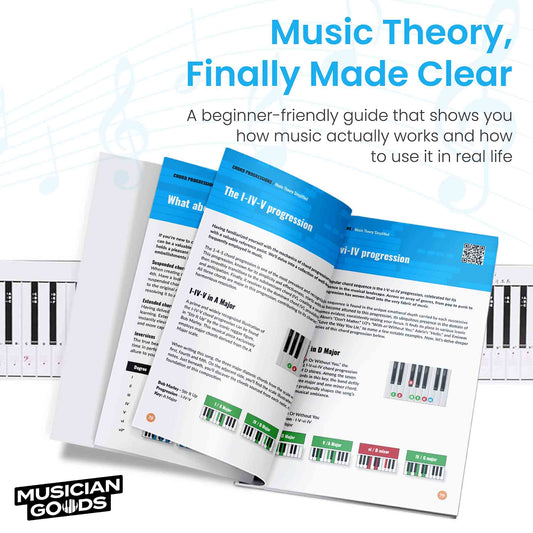
That is the quiet argument the Canon makes for learning a little theory. The piece is beautiful whether or not you understand it, but understanding it changes what you can hear, and what you can hear changes what you can make. If you want the vocabulary behind the ideas in this article, that is exactly what our Music Theory Simplified book is built to teach, in plain language and without assuming a conservatoire background. The relationships between the Canon's chords, incidentally, are the same ones mapped by the circle of fifths.

View Music Theory Simplified →
Written by Melvin Tellier, founder of Musiciangoods. Melvin writes plain-language theory books and learning tools for self-taught musicians, with the aim of making the logic of music reachable without a conservatoire.






 Guitar Chords Chart Mousepad
 Guitar Theory Simplified (Paperback/PDF)
 Bass Guitar Theory Cheat Sheet Mousepad
 Bass Theory Simplified (Paperback/PDF)
 Music Theory Simplified - (Paperback/PDF)
 Music Theory Cheat Sheet Mousepad
 Ukulele Theory Simplified (Paperback/PDF)
 Ukulele Theory Cheat Sheet Mousepad
 Guitar Theory Cheat Sheet Mousepad
 Mixing Mastering Cheat Sheet Mousepad


