 4.8/5 on Trustpilot

A steady tempo is the one skill every musician needs and the one most players skip. Scales, chords and repertoire all get the practice hours, while timing is left to chance. A good metronome fixes that, and the right one for you depends on whether you want a physical device on your music stand or an app in your pocket.
This guide ranks six metronomes worth using in 2026, split across hardware and apps. Each pick includes who it suits best, so you can match a tool to how you actually practice rather than to a spec sheet. Prices are approximate and quoted in USD.
Quick comparison
| Metronome | Type | Best for | Approx price |
|---|---|---|---|
| Korg TM-60 | Hardware | Students who also need a tuner | $30 |
| Boss DB-90 | Hardware | Drummers and studio use | $150 |
| Soundbrenner Core 2 | Wearable hardware | Silent and on-stage practice | $130 |
| Wittner Taktell Super-Mini | Mechanical hardware | Traditionalists and piano | $35 |
| Pro Metronome | App (iOS/Android) | Best free everyday app | Free / $3.99 pro |
| Tempo (Frozen Ape) | App (iOS/Android) | Setlists and complex meters | $3.99 |
Hardware or app: which is right for you
Before the individual picks, settle the format question, because it narrows the field fast. Hardware metronomes cost more up front but stay dedicated to one job. There are no notifications, no software updates and no battery anxiety mid-practice, and a physical dial or pendulum is quicker to adjust than a touchscreen for many players.
Apps win on convenience and price. Your phone is already in your pocket, most apps are free or a few dollars, and the better ones match mid-range hardware on features like subdivisions, polyrhythms and setlists. The cost is focus, since the same device that keeps time also carries every distraction you own.
A useful rule of thumb: if you practise at home and have decent discipline with your phone, an app is plenty. If you gig, teach, play drums, or find screens too tempting, a dedicated device pays for itself. The six picks below cover both camps so you can commit to one and move on.
1. Korg TM-60 — best for students who also need a tuner

The Korg TM-60 is the metronome most teachers put in a beginner's case, and for good reason. It combines a chromatic tuner and a metronome in one slim, battery-friendly unit, so a student carries a single device to lessons instead of two.
The tempo runs from 30 to 252 beats per minute, with a range of beat patterns and rhythm subdivisions covering duplets, triplets and quarter-note groupings. A large backlit display keeps the tempo readable on a dim stage or a cluttered practice desk.
What makes it a first choice is value. For around thirty dollars you get reliable timekeeping and accurate tuning in a package small enough to forget in a gig bag. If you are buying one metronome for a child or an adult beginner, this is the safe pick.
2. Boss DB-90 — best for drummers and the studio

Drummers ask more of a metronome than anyone, and the Boss DB-90 answers. Its standout feature is a human-voice count that speaks the beat aloud, which trains internal timing far better than a plain click.
Beyond that it offers a rhythm coach mode that mutes random beats to test whether you can hold tempo unassisted, plus a note-detection input that can trigger the click from a drum pad. A large dial makes tempo changes fast during a session.
At around one hundred and fifty dollars it is an investment, but for a working drummer or a home studio that needs a rock-solid reference it earns the price. Guitarists and bassists tracking to a grid will appreciate the same stability.
3. Soundbrenner Core 2 — best for silent and on-stage practice

The Soundbrenner Core 2 is a metronome you feel rather than hear. Worn on the wrist or upper arm, it pulses a strong vibration on each beat, letting you keep time in a loud room or on a stage where a click would be lost or intrusive.
The Core 2 doubles as a tuner and a smartwatch, and it pairs with a phone app for setting complex time signatures and tempo maps. For ensemble players the silent pulse is a genuine advantage, since it keeps the whole section locked without a shared audible click.
It is the most expensive way to solve a simple problem, so it suits gigging musicians and anyone who practices late without disturbing a household. If you only ever play alone at a desk, a cheaper option will serve you just as well.
4. Wittner Taktell Super-Mini — best for traditionalists and piano

Some players simply prefer a wind-up metronome, and the Wittner Taktell Super-Mini is the classic pyramid shape in a compact, wallet-friendly form. There is no battery, no menu and no screen, only a pendulum and a sliding weight.
The mechanical swing gives a warm, woody tick that many pianists and classical students find easier to sit beside for long stretches than a digital beep. The visual sweep of the arm also helps some learners internalise the pulse by watching as much as listening.
The trade-offs are real: no subdivisions, no tuner and a tempo you set by eye rather than by number. For a purist, that simplicity is the appeal, and at around thirty-five dollars it is an affordable piece of practice furniture.
5. Pro Metronome — best free everyday app

If your phone is always within reach, Pro Metronome removes the argument for buying hardware at all. The free tier covers everything a practising musician needs day to day: a clear click, adjustable tempo, and common beat patterns.
The interface is clean and the visual beat indicator is large enough to follow at a glance. A one-off upgrade of around four dollars unlocks polyrhythms, custom subdivisions and setlists, which is fair for players who want more without a subscription.
The only caveat applies to every app: a phone metronome competes with notifications and a draining battery. For focused home practice, though, Pro Metronome is the most convenient option here and costs nothing to start.
6. Tempo by Frozen Ape — best for setlists and complex meters

Tempo is the app to reach for when your music is not in a plain four-four. It handles odd time signatures, gradual tempo changes and stacked subdivisions with a depth that suits progressive, jazz and film players.
Its setlist feature is the real draw. You can program a run of songs, each with its own tempo and meter, then step through them hands-free during a rehearsal or performance. That turns a metronome into a lightweight practice director.
At around four dollars it is a paid app, but it replaces several hardware features for a fraction of the cost. Casual players will not need its full range, yet anyone working through demanding material will use it constantly.
How to choose the right metronome
Start with a single question: do you want something physical or something on your phone. A dedicated device stays out of your notifications and lasts for years, while an app is free or cheap and always with you.
Next, match the features to your instrument. Drummers benefit from voice counting and rhythm-coach modes, pianists and classical students often prefer a mechanical tick, and ensemble or stage players gain the most from a silent wearable.
Finally, be honest about how much timing work you plan to do. A beginner is well served by a thirty-dollar combo unit or a free app. A gigging or recording musician will get daily value from the more capable tools and should treat the extra cost as an investment in tighter playing.
Whichever you pick, the metronome only helps if you understand what the beats and subdivisions mean. Knowing how time signatures, note values and rhythmic groupings fit together is what turns a click into musical timing, and that theory is the same whether you play guitar, piano or drums.
Getting the most from your metronome
Buying the device is the easy part. Using it well is what actually tightens your playing, and a few habits separate players who improve from players who just have a clicking box on the desk.
Practise slower than feels natural. Most players set the tempo too high and rehearse their mistakes at speed. Drop the tempo until every note lands cleanly on or between the clicks, then raise it in small increments of a few beats per minute once the passage is even. Speed earned this way tends to stick.
Move the click off the downbeat once you are comfortable. Setting the metronome to sound only on beats two and four, or only on the offbeats, forces you to keep your own internal pulse rather than leaning on the device. It feels awkward at first and builds timing quickly.
Use the metronome to measure, not just to accompany. Note the tempo at which a passage starts to fall apart and log it. Watching that number climb week to week turns vague practice into visible progress and tells you exactly where to focus next.
Frequently asked questions
Do I really need a metronome if I have good natural rhythm?
Yes. Natural rhythm helps, but almost everyone drifts in tempo without noticing, usually rushing hard passages and dragging slow ones. A metronome shows you exactly where that happens so you can fix it rather than rehearse it.
Is a metronome app as good as a hardware metronome?
For most players, yes. A good app matches a mid-range device on features. Hardware wins when you want to avoid phone distractions, need a device that survives a gig bag, or prefer a physical dial and a mechanical tick.
What tempo should a beginner start with?
Set the tempo slow enough to play every note cleanly, often around 60 beats per minute for new material. Speed is a reward for accuracy, so raise the tempo by small steps only once a passage is comfortable and even.
Why does a metronome make me feel like I have no rhythm?
Because it is honest. Playing against a fixed click exposes the small timing errors that get hidden when you play alone. That discomfort is the point, and it fades quickly as your internal pulse steadies over a few weeks of practice.
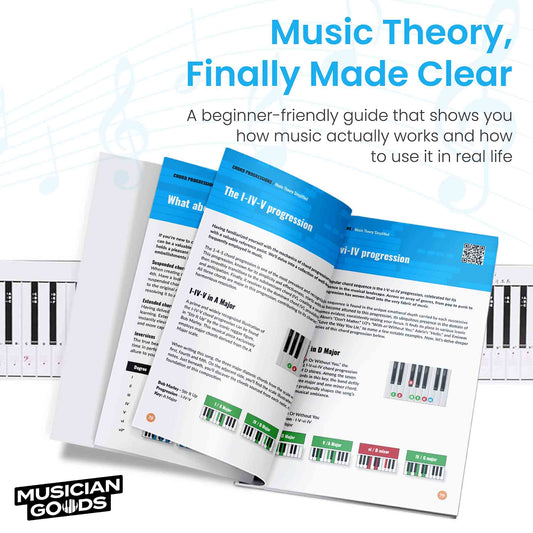
Once you have a metronome, the next step is understanding the rhythm you are counting. Music Theory Simplified breaks down time signatures, note values and subdivisions in plain language, so your practice time builds real timing instead of guesswork.

View Music Theory Simplified →
Written by Melvin Tellier, founder of Musiciangoods. Melvin builds plain-language music education tools for self-taught players and has spent years distilling music theory into resources that work at a practice desk, not just in a classroom.






 Guitar Chords Chart Mousepad
 Guitar Theory Simplified (Paperback/PDF)
 Bass Guitar Theory Cheat Sheet Mousepad
 Bass Theory Simplified (Paperback/PDF)
 Music Theory Simplified - (Paperback/PDF)
 Music Theory Cheat Sheet Mousepad
 Ukulele Theory Simplified (Paperback/PDF)
 Ukulele Theory Cheat Sheet Mousepad
 Guitar Theory Cheat Sheet Mousepad
 Mixing Mastering Cheat Sheet Mousepad


