 4.8/5 on Trustpilot

Ask ten musicians whether piano or guitar is harder and you get ten answers, because they are quietly answering different questions. Harder to make a first sound? Harder to play a song? Harder to master over years? The instruments swap places depending on which one you mean.
This is an honest comparison for someone deciding where to start, or choosing for a child. Neither instrument is harder in any absolute sense. They put their difficulty in different places. Here is where each one is easy, where each one is hard, and how to pick.
The short version
Guitar is easier to start and gets hard later. You can strum a few chords and play real songs within weeks, but the early weeks hurt your fingertips, and barre chords and lead playing are a real wall. Piano is harder to start and stays evenly demanding. The notes are laid out logically and sound the moment you press a key, but coordinating two hands and reading two staves is a slow burn from day one.
If you want to play songs and sing along quickly, guitar usually wins. If you want the clearest path to understanding music itself, piano usually wins. Most of the difficulty difference is about when the hard part arrives, not how much there is.
| Piano | Guitar | |
|---|---|---|
| First sound | Easy — press a key | Harder — fretting buzzes at first |
| First song | Slower (two hands) | Faster (a few chords) |
| Physical discomfort | Minimal | Sore fingertips for weeks |
| Reading music | Two staves, but visual layout helps | Often tab; standard notation later |
| Theory clarity | Highest — notes laid out in a line | Less obvious — same note in many spots |
| Portability & cost | Bulkier, usually pricier | Portable, cheaper to start |
Piano: easy to sound good, slow to coordinate

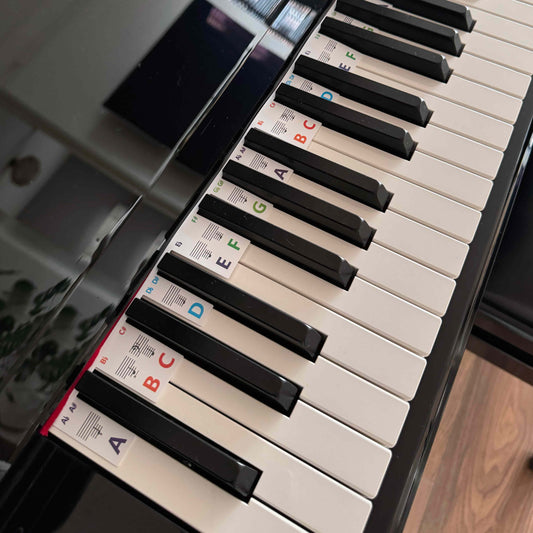
The piano is the friendliest instrument to make a decent sound on. Press a key and you get a clean, in-tune note with no buzzing, no calluses, and no fight. A complete beginner can play a recognizable melody in the first sitting, which is encouraging in a way the guitar rarely is at first.
The layout is also the clearest in all of music. Low notes sit on the left, high notes on the right, and every note appears exactly once in order. That straight line makes scales, chords, and intervals genuinely visible, which is why so many people learn theory faster on a keyboard than anywhere else.
The difficulty is coordination. From early on you use both hands doing different things, often reading two staves at once, and that independence takes patient, steady work. There is no quick win equivalent to strumming three chords; piano progress is even and gradual rather than front-loaded.
That even curve is also its strength. Because the instrument never lets you skip the fundamentals, pianists often end up with a strong reading and theory foundation. If you want to see how cleanly chords stack up on a keyboard, our walk-through of piano chord progressions and the major scale on piano show why the layout helps.
Guitar: quick first songs, a steeper wall later

The guitar's appeal is how fast you can play music people recognize. Learn three or four open chords and a simple strum, and you can back a huge number of songs and sing along within a few weeks. That early payoff keeps a lot of beginners motivated through the rough patches.
The rough patches are real, though, and they come first. Pressing steel strings onto a fingerboard hurts until your fingertips toughen up, chord changes feel clumsy for a while, and a beginner's notes buzz and mute until the fretting hand learns its job. The first month asks more of your hands than the piano does.
Later, the guitar has its own walls. Barre chords, where one finger holds down every string across a fret, defeat many players for weeks. Lead playing, scales across a fretboard where the same note lives in several places, and clean fingerpicking are all genuine long-term challenges.
The guitar's quirk for theory is that the fretboard repeats notes in many positions, so the logic is less obvious than a keyboard's straight line. It is learnable, but it asks for more mapping. The upside is portability and cost: a starter guitar is cheaper and lighter than a decent keyboard, and you can take it anywhere.
Which should you choose?
Start with what you want to do with the instrument. The fastest way to a wrong choice is picking the one that sounds more impressive rather than the one that fits your goal.
Choose the guitar if you want to play and sing songs quickly, you like the idea of a portable instrument you can take to a friend's place, you are on a tighter budget, or you are drawn to rock, folk, pop, or singer-songwriter material. The early payoff is strong, as long as you push through a few weeks of sore fingers.
Choose the piano if you want the clearest possible understanding of how music works, you plan to read sheet music seriously, you are interested in classical or jazz, or you want a foundation that transfers to almost any other instrument later. The start is slower, but the theory you absorb is worth it. For a young child, the piano's lack of finger pain and its visual logic often make it the gentler first instrument.
One reassuring truth: the music theory underneath is identical on both. Notes, scales, chords, and progressions work the same way whichever instrument you read them on, so time spent learning the language is never wasted. If you ever switch or add a second instrument, that knowledge comes with you. You can see the shared logic in our look at why so many pop songs use the same four chords.
Frequently asked questions
Is piano harder than guitar for beginners? In the first weeks, no. Piano makes a clean sound instantly with no finger pain, while guitar asks you to toughen your fingertips and fight buzzing strings. Guitar gets you to a first song faster, but it front-loads the physical discomfort.
Which is harder to master long term? Both have high ceilings. Piano demands lifelong two-hand independence and dense reading; guitar demands barre chords, lead technique, and mapping a repeating fretboard. Neither is objectively harder at the top; they are hard in different ways.
Which is better for learning music theory? Piano, for most people. The keyboard lays every note out in a single line, so scales, chords, and intervals are visible in a way the guitar's repeating fretboard is not. Many guitarists use a keyboard to study theory.
Which should a child start on? Piano is often the gentler first instrument for young children because there is no finger pain and the layout is intuitive. That said, an enthusiastic child who wants a guitar will practice more, and motivation beats theory every time.
Can I learn both? Yes, and many people do. The theory transfers completely, and the physical skills, while different, reinforce your overall musicianship. Most teachers suggest getting comfortable on one before adding the second.
The bottom line
Guitar is easier to start and rewards you fast, then asks for grit later. Piano starts slower and stays evenly demanding, but hands you the clearest view of music itself. Pick the guitar for quick songs and portability, the piano for theory and a deep foundation, and remember that the language underneath is the same on both.







 Guitar Chords Chart Mousepad
 Guitar Theory Simplified (Paperback/PDF)
 Bass Guitar Theory Cheat Sheet Mousepad
 Bass Theory Simplified (Paperback/PDF)
 Music Theory Simplified - (Paperback/PDF)
 Music Theory Cheat Sheet Mousepad
 Ukulele Theory Simplified (Paperback/PDF)
 Ukulele Theory Cheat Sheet Mousepad
 Guitar Theory Cheat Sheet Mousepad
 Mixing Mastering Cheat Sheet Mousepad


