 4.8/5 on Trustpilot

There's a reason so many pop songs sound strangely familiar the first time you hear them. A huge share of them are built on the same four chords, in the same order. Learn this one progression on piano and you can play the harmonic core of hundreds of hits.
In this guide we'll break down the I-V-vi-IV progression — the famous "four chord song" — show you how to build it on piano in any key, and walk through the real songs that use it, from U2 to Adele.

What is the pop chord progression (I-V-vi-IV)?
The I-V-vi-IV progression is the most enduringly popular chord sequence in modern music. It takes the first, fifth, sixth, and fourth chords built from a major key and plays them in that order. Three of those chords are major (I, V, IV) and one is minor (vi), and that single minor chord is what gives the progression its bittersweet, emotional pull.
The Roman numerals describe the position of each chord within a key, not a fixed set of chord names. That's what makes the progression portable: the same I-V-vi-IV pattern works in every major key — you just fill in the actual chords for whatever key you're in. Because of how often it appears across pop, punk, and country, it's earned the nickname "the four chord song."
The diatonic chords behind the progression
To build the progression you first need the chords of your key. Every major scale produces seven diatonic chords — one chord built on each note of the scale — following a fixed major/minor pattern:
- I — major
- ii — minor
- iii — minor
- IV — major
- V — major
- vi — minor
- vii° — diminished
Uppercase numerals (I, IV, V) are major chords; lowercase ones (ii, iii, vi) are minor. For the pop progression you only need four of them: the I, the V, the vi, and the IV.

How to build I-V-vi-IV on piano in any key
Pick a key, find its I, V, vi, and IV chords, and play them in order. Here it is in three beginner-friendly keys:
- C major: C (I) – G (V) – A minor (vi) – F (IV)
- G major: G (I) – D (V) – E minor (vi) – C (IV)
- D major: D (I) – A (V) – B minor (vi) – G (IV) — the key of U2's "With Or Without You"
In the key of D, U2 takes exactly three major chords and one minor chord from the seven diatonic chords available, and that choice is what shapes the song's yearning, evocative atmosphere. Play D, A, Bm, and G in a loop on the piano and you'll hear it instantly.
Want it in another key? PlayTheory has the I–V–vi–IV progression in all 12 keys, with a keyboard to hear it and play it chord by chord.
Famous songs built on I-V-vi-IV
Once you know this progression, you'll hear it everywhere:
- "With Or Without You" — U2 (D major)
- "Hello" — Adele
- "Don't Matter" — Akon
- "Love the Way You Lie" — Eminem & Rihanna
These songs span rock, pop, hip-hop, and ballads — proof that the emotional depth of the progression carries across genres. The order of the chords, and especially that lift into the minor vi, is what gives all of them their familiar, heart-tugging feel.
How to practice the pop progression on piano (4-step plan)
Step 1 — Start in an easy key
Begin in C major (C – G – Am – F) or G major (G – D – Em – C). Both use chords that beginners already know and avoid awkward black-key shapes. Get the four chords under your fingers before worrying about anything else.
Step 2 — Loop it with a steady rhythm
Play each chord for four beats, in order: I – V – vi – IV, then repeat. Use a simple, steady pattern in both hands — root in the left hand, full chord in the right — until the changes are smooth. Don't add rhythmic tricks yet; clean transitions come first.
Step 3 — Change keys
Once one key feels comfortable, move the same pattern to a new key. Go from C to G, then to D. This trains your ear to hear the function of each chord — I as home, V as movement, vi as the emotional dip, IV as the lift — no matter what the actual chord names are.
Step 4 — Play along with a real song
Pick a song from the list and play the progression along with the recording. Matching a real track's groove is where the theory clicks — you stop counting chords and start hearing why the progression works.
Related progressions built from the same idea
The pop progression is one of a family of sequences drawn from the same diatonic chords. Two close relatives are worth knowing.
The I-IV-V progression uses only the three major chords (for example, in A major: A, D, E — the backbone of Bob Marley's "Stir It Up" and most blues). The IV-I-V-vi progression — nicknamed the "pop-punk progression" — starts on the fourth chord instead of the tonic, giving an uplifting, unexpected lift; Rihanna's "Umbrella" is the classic example. All three are the same diatonic chords, simply reshuffled into a different order.
Common mistakes to avoid
- Thinking I-V-vi-IV is a fixed set of chords. It isn't. It's a pattern that transposes to any key. C-G-Am-F and D-A-Bm-G are the same progression in different keys.
- Getting stuck in one key. Practice the progression in C, G, and D at minimum. Real fluency comes from being able to move it around.
- Forgetting the vi is minor. Playing all four chords as major kills the progression's emotional character. The minor vi is the whole reason it tugs at you.
- Rushing the rhythm. Adding fancy patterns before your chord changes are clean just makes the whole thing sound sloppy. Lock in smooth transitions first.
- Skipping ear training. Knowing the theory is half the job. The other half is being able to hear the progression in songs you've never played. Play along with records to build that ear.
Why the pop progression matters
The I-V-vi-IV progression is one of the highest-leverage things a piano player can learn. Master it and you get a shortcut to the harmonic core of hundreds of songs, a ready-made framework for writing your own music, and an ear that starts recognizing the progression the moment it appears in a new track.
Because it's just four diatonic chords in a fixed order, it's simple enough for a beginner to play and deep enough to have carried decades of hit songs. Learn it in a couple of keys, and you've unlocked a huge slice of popular music. That's the pop chord progression, simplified.
Take it further
The complete guide to chord progressions — diatonic chords in every key, Roman numerals, scale degrees, and the I-IV-V, I-V-vi-IV, and IV-I-V-vi progressions — is laid out visually in Music Theory Simplified. Same clear, no-fluff style you're reading now.
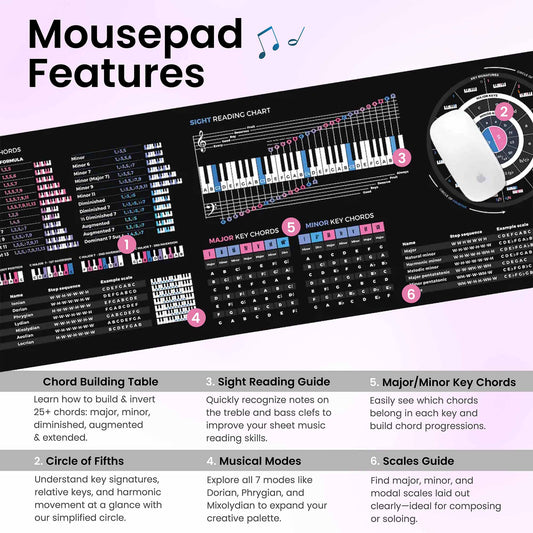
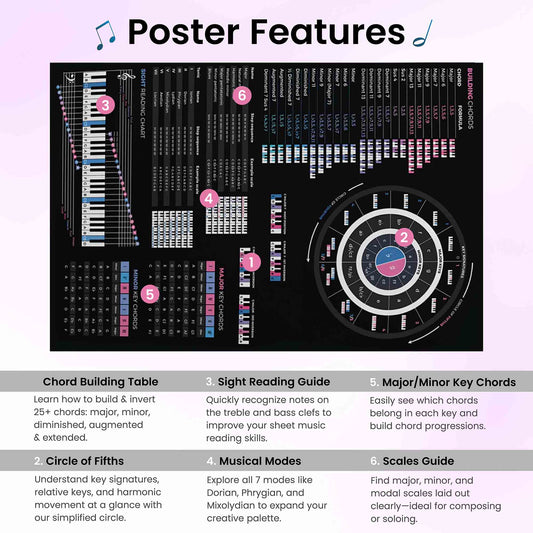
Want the chords and progressions next to your keyboard while you play? The Music Theory Cheat Sheet Poster and Cheat Sheet Mousepad keep chords, scales, and Roman numerals in view.
Prefer a digital reference for any screen? Grab the Music Theory Cheat Sheet PDF, or get everything together in the Music Theory Bundle.

Every chord progression — mapped out visually.
Music Theory Simplified turns diatonic chords, Roman numerals and progressions into diagrams you can actually play from.
FAQs about the pop chord progression on piano
What is the four chord pop progression?
It's the I-V-vi-IV progression — the first, fifth, sixth (minor), and fourth chords of a major key, played in that order. In C major that's C, G, A minor, F.
What are the four pop chords in C major?
C (I), G (V), A minor (vi), and F (IV). Loop them in that order and you have the harmonic core of countless pop songs.
Why do so many songs use the same four chords?
Because the I-V-vi-IV progression has a naturally satisfying emotional arc — the lift of the major chords and the bittersweet dip into the minor vi — and it works in any key. It's simple, effective, and endlessly reusable.
Is I-V-vi-IV the same in every key?
The pattern is the same, but the actual chords change with the key. C-G-Am-F in C major and D-A-Bm-G in D major are both I-V-vi-IV — the same progression, transposed.
What's the easiest key to play the pop progression in on piano?
C major (C-G-Am-F) and G major (G-D-Em-C) are the most beginner-friendly, since they use common chord shapes and mostly white keys.
This post is part of Musiciangoods' Music Theory Simplified series — practical music theory, taught visually, for musicians who want to understand what they're playing. Explore more music learning tools here.








 Guitar Chords Chart Mousepad
 Guitar Theory Simplified (Paperback/PDF)
 Bass Guitar Theory Cheat Sheet Mousepad
 Bass Theory Simplified (Paperback/PDF)
 Music Theory Simplified - (Paperback/PDF)
 Music Theory Cheat Sheet Mousepad
 Ukulele Theory Simplified (Paperback/PDF)
 Ukulele Theory Cheat Sheet Mousepad
 Guitar Theory Cheat Sheet Mousepad
 Mixing Mastering Cheat Sheet Mousepad


