 4.8/5 on Trustpilot

Open any piece of piano sheet music and you'll see two curly symbols at the far left of the staves. One looks like a stylized "G," the other like a backwards "C" with two dots. These are the treble and bass clefs — and once you understand them, sheet music stops looking like a code and starts reading like a map.
In this guide we'll explain what clefs are, break down the treble clef and bass clef, show you which one your right and left hand read on the piano, and give you a simple plan for learning to read both.

What is a clef?
A clef is a symbol placed at the start of a musical staff that tells you the pitch range of the notes written on it. Without a clef, the five lines and four spaces of a staff would be meaningless — you'd have no way to know whether a note sitting on the middle line is high or low. The clef sets the reference point, so every note's position on the staff translates into an exact pitch.
The two most familiar clefs are the treble clef and the bass clef. Together they cover the pitch range you need to read piano music, with the treble handling higher notes and the bass handling lower ones. They give musicians a clear picture of each note's pitch, which is what lets them read and perform music correctly.
The treble clef explained
The treble clef represents the higher notes — the pitches above middle C. In piano sheet music, these are typically the notes played with the right hand. It's often called the "G clef," because the symbol itself resembles a stylized letter "G," and the curl of the clef wraps around the staff line that represents the note G (the second line from the bottom).
Any instrument or voice in a higher register uses the treble clef: the piano's right hand, plus instruments like the violin and flute, and soprano and tenor voices. If you're reading a melody line, chances are it's written in treble clef.
The bass clef explained
The bass clef represents the lower notes — the pitches below middle C. On piano, these are usually the notes played with the left hand. It's known as the "F clef," because it resembles a letter "F," and its two dots sit above and below the staff line that represents the note F (the fourth line from the bottom).
Lower-register instruments and voices read the bass clef: the piano's left hand, plus instruments like the cello and tuba, and alto and bass voices. When you see the bass clef, you know you're in the lower half of the keyboard.

How the two clefs work together on piano
Piano music uses both clefs at once, stacked together on what's called a grand staff. The treble clef (top) covers everything above middle C, and the bass clef (bottom) covers everything below it. Middle C sits right between them — it's the note that joins the two staves, written on a small ledger line just below the treble staff or just above the bass staff.
Reading a note is a matter of position: its place on the staff tells you the pitch, and the clef tells you the reference range. The treble clef shows the higher notes above middle C, and the bass clef shows the lower notes below it. Your right hand generally follows the top staff, your left hand the bottom — which is exactly how the piano is laid out physically, high notes to the right, low notes to the left.
How to learn to read both clefs (4-step plan)
Step 1 — Anchor yourself to middle C
Middle C is your home base. Learn where it lives on the keyboard (roughly the center) and where it sits on the page (between the two staves). Every other note is easier to find once you can locate middle C instantly in both places.
Step 2 — Learn the lines and spaces one clef at a time
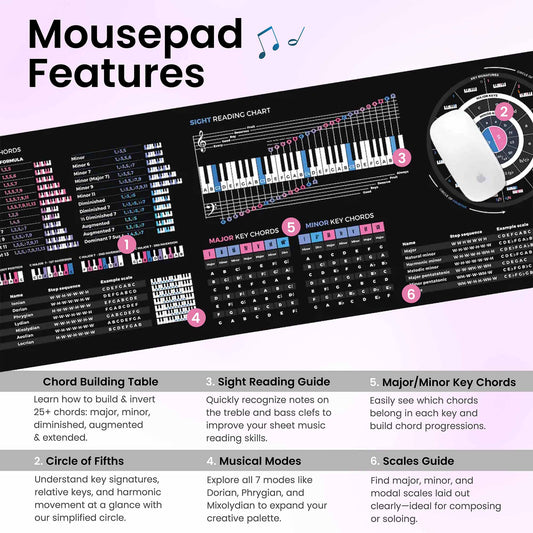
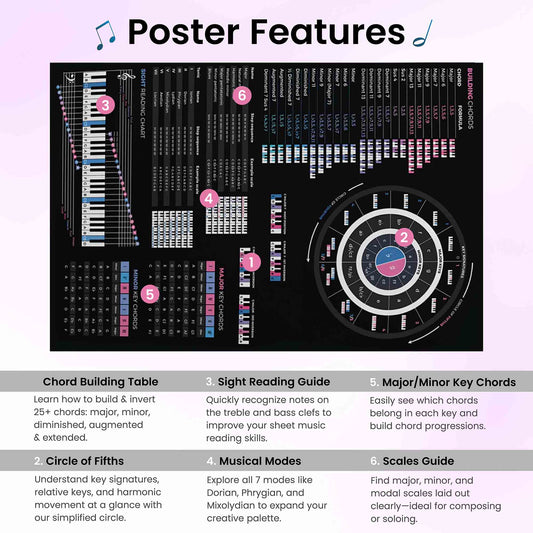
Start with the treble clef. Learn the note names for each line and space using the sight-reading chart, then do the same for the bass clef separately. Trying to memorize both at once is overwhelming — treat them as two alphabets to learn one after the other.
Step 3 — Match each hand to its clef
Sit at the piano and play simple notes, right hand reading treble, left hand reading bass. Connecting the symbol on the page to the physical key under your finger is what turns memorized note names into real reading.
Step 4 — Read real sheet music for songs you love
Once you've got the basics, find sheet music for a song you already know. Reading music you can hum makes it far easier to spot when you're reading correctly, and it lets you practice both clefs together in a real, musical context.
Common mistakes to avoid
- Trying to memorize both clefs at once. Learn the treble clef solid, then the bass clef. Splitting your focus slows both down.
- Forgetting that the same line means different notes. A note on the middle line of the treble staff is not the same pitch as a note on the middle line of the bass staff. The clef changes everything — always check which one you're reading.
- Ignoring middle C. Middle C is the anchor that connects the two clefs. If you can't find it quickly, everything else gets harder.
- Relying only on mnemonics. Line-and-space memory tricks help at first, but real fluency comes from reading the note's position directly, not reciting a phrase each time.
- Skipping the keyboard. Reading notes on paper without playing them means you never connect the symbol to the sound. Always tie your reading back to the keys.
Why the clefs matter
The treble and bass clefs are your entry point to becoming musically literate. Once you can read both, you can pick up sheet music for almost any song and play it — no need to wait for a tutorial or a chord chart. For pianists especially, the two clefs are essential, because piano music is written across both at the same time, one for each hand.
Learning the clefs is really learning to read the language of music. It opens up an enormous library of written music, lets you communicate precisely with other musicians, and deepens your understanding of everything you play. Master the two clefs and the rest of music notation falls into place. That's the treble and bass clef, simplified.
Take it further
The full guide to music notation — clefs, note values, connected notes, dotted notes, and how it all fits together — is laid out visually in Music Theory Simplified. Same clear, no-fluff style you're reading now.
Want a sight-reading reference next to your keyboard? The Music Theory Cheat Sheet Poster and Cheat Sheet Mousepad keep the notation basics in view while you practice.
Prefer a digital reference for any screen? Grab the Music Theory Cheat Sheet PDF, or get everything together in the Music Theory Bundle.

Reading music, made visual.
Music Theory Simplified turns clefs, notes and note values into diagrams you can actually play from.
FAQs about the treble and bass clef
What is the difference between the treble and bass clef?
The treble clef covers the higher notes above middle C (usually the right hand on piano), while the bass clef covers the lower notes below middle C (usually the left hand). They set different pitch ranges for the staff.
Why is the treble clef called the G clef?
Because its symbol resembles a stylized letter "G," and the curl of the clef wraps around the staff line that represents the note G (the second line from the bottom).
Why is the bass clef called the F clef?
Because its symbol resembles the letter "F," and its two dots sit on either side of the line that represents the note F (the fourth line from the bottom).
Which clef does each hand read on piano?
Generally, the right hand reads the treble clef (higher notes) and the left hand reads the bass clef (lower notes). Piano music is written on a grand staff that combines both.
Where is middle C on the clefs?
Middle C sits between the two clefs — on a short ledger line just below the treble staff or just above the bass staff. It's the note that connects them and a great anchor point for learning to read.
This post is part of Musiciangoods' Music Theory Simplified series — practical music theory, taught visually, for musicians who want to understand what they're playing. Explore more music learning tools here.







 Guitar Chords Chart Mousepad
 Guitar Theory Simplified (Paperback/PDF)
 Bass Guitar Theory Cheat Sheet Mousepad
 Bass Theory Simplified (Paperback/PDF)
 Music Theory Simplified - (Paperback/PDF)
 Music Theory Cheat Sheet Mousepad
 Ukulele Theory Simplified (Paperback/PDF)
 Ukulele Theory Cheat Sheet Mousepad
 Guitar Theory Cheat Sheet Mousepad
 Mixing Mastering Cheat Sheet Mousepad


