 4.8/5 on Trustpilot

You've learned that a whole note is four beats and a quarter note is one. Then you spot a note with a tiny dot next to it, and suddenly the math changes. That little dot is one of the most useful symbols in music notation — and the rule behind it is refreshingly simple.
In this guide we'll explain what dotted notes are, the one rule that governs every dot, how to count common dotted notes, and how to feel their rhythm so your playing sounds natural instead of mechanical.

What are dotted notes?
A dotted note is a regular note with a small dot placed to the right of its note head. That dot has one job: it extends the note's duration by half of its original value. So a dotted note always lasts the original note plus half of itself.
Before dotted notes make sense, it helps to have the standard note values in mind. In common (4/4) time: a whole note lasts 4 beats, a half note 2 beats, a quarter note 1 beat, an eighth note half a beat, and a sixteenth note a quarter of a beat. Dotted notes take those familiar values and stretch each one by 50%.
The one rule behind every dot
Here's the entire concept in a single sentence: a dot adds half the note's value to itself.
That's it. Take any note, figure out its normal length, add half of that length, and you have the dotted value. A couple of worked examples make it click:
- A dotted quarter note: a quarter note is 1 beat, half of that is another half beat, so the dotted quarter lasts 1½ beats. It's also equal to three eighth notes.
- A dotted half note: a half note is 2 beats, half of that is 1 more beat, so the dotted half lasts 3 beats. It's also equal to three quarter notes.
Notice the handy shortcut: a dotted note always equals three of the next smaller note value. A dotted half equals three quarters; a dotted quarter equals three eighths. That "rule of three" is often the fastest way to count them.
Common dotted note values
Applying the rule across the note family gives you this set of values in 4/4 time:
- Dotted whole note — 4 + 2 = 6 beats
- Dotted half note — 2 + 1 = 3 beats
- Dotted quarter note — 1 + ½ = 1½ beats
- Dotted eighth note — ½ + ¼ = ¾ beat
- Dotted sixteenth note — ¼ + ⅛ = 3/8 beat
The same logic applies to dotted rests, too — a dot after a rest extends the silence by half in exactly the same way.

How to count and feel dotted notes (4-step plan)
Step 1 — Learn the standard note values first
You can't extend a value you don't know. Make sure whole, half, quarter, eighth, and sixteenth notes are second nature in 4/4 time before you add dots. The dot only makes sense relative to the note it's attached to.
Step 2 — Apply the "add half" rule out loud
For each dotted note, say the math: "A half note is two beats, plus one is three." Speaking the rule turns it from an abstract idea into something you actually understand, and it stops you from guessing.
Step 3 — Count with subdivisions
Dotted rhythms are easiest to count when you break the beat into smaller pieces. A dotted quarter is simplest to feel as three eighth notes ("1-and-2"), held as one sound. Counting in eighths or sixteenths keeps you honest about exactly where the dotted note ends.
Step 4 — Clap it, then play it
Clap a simple rhythm using dotted notes against a steady beat before you try to play it on your instrument. Feeling the rhythm in your body first makes it far easier to reproduce cleanly on the keys — and it's how dotted notes start to sound musical rather than counted.
Common mistakes to avoid
- Thinking the dot doubles the note. It doesn't. The dot adds half the note's value, not the whole thing. A dotted half is 3 beats, not 4.
- Forgetting to count the dot at all. A dotted quarter is 1½ beats, not 1. Skipping the extra half beat throws off every note that follows in the measure.
- Confusing dotted notes with tied notes. They can sound similar, but a dot is a fixed 50% extension of one note, while a tie joins two separate written notes. Read the symbol carefully.
- Ignoring dotted rests. The rule applies to silence too. A dotted rest extends the pause by half, and missing it disrupts your timing just like missing a dotted note.
- Counting whole beats only. Dotted rhythms often land off the beat. Subdivide into eighths or sixteenths so you can place the note precisely instead of rounding.
Where you'll hear dotted rhythms
Dotted notes aren't just a notation detail — they shape the feel of music you already know. The gentle "long-short" sway of a waltz leans on dotted rhythms in 3/4 time. The dotted-quarter-plus-eighth pattern drives the pulse of countless pop and rock songs, giving a melody forward momentum instead of a flat, even march. Film and game scores use long dotted notes to let a theme breathe and hang in the air. Once you can spot the dot on the page, you start noticing that uneven, leaning rhythm everywhere — and you understand exactly why it feels the way it does.
Why dotted notes matter
Dotted notes add complexity, character, and flow to rhythm. Without them, music would be locked into rigid, even durations. The dotted rhythm — long, then short — is behind the lilt of a waltz, the swing of countless melodies, and the forward momentum of grooves across every genre. That uneven, "leaning" feel is one of the main things that makes rhythm expressive.
They're also a core part of reading music fluently. Once you understand that a dot simply adds half a note's value, an entire layer of notation opens up, and you can read and perform rhythms accurately instead of stumbling over them. Master the dot and you've mastered one of the most common and most musical symbols on the page. That's dotted notes, simplified.
Take it further
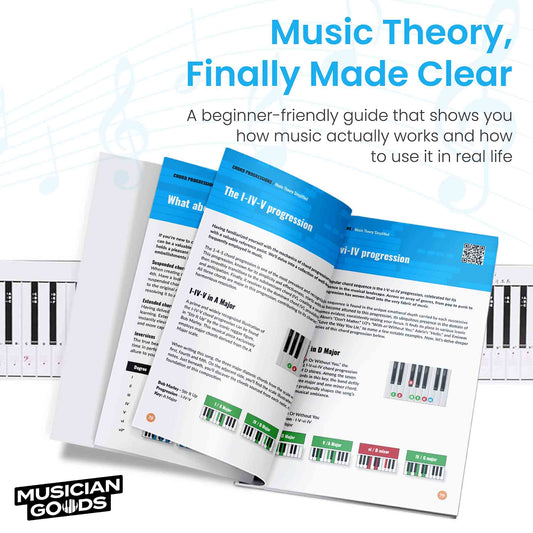
The full guide to music notation — note values, connected (beamed) notes, dotted notes, rests, and rhythm — is laid out visually in Music Theory Simplified. Same clear, no-fluff style you're reading now.
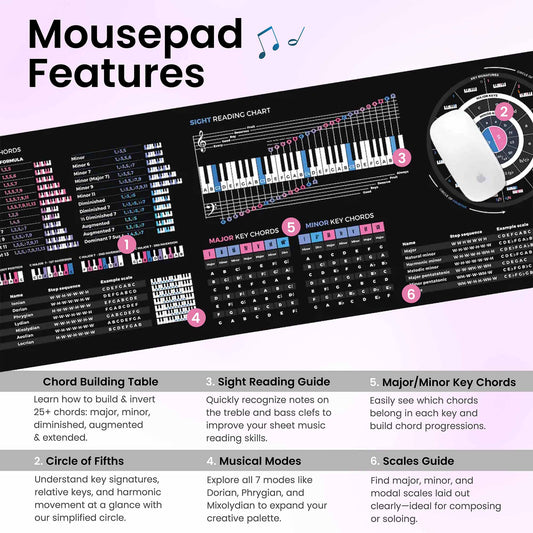
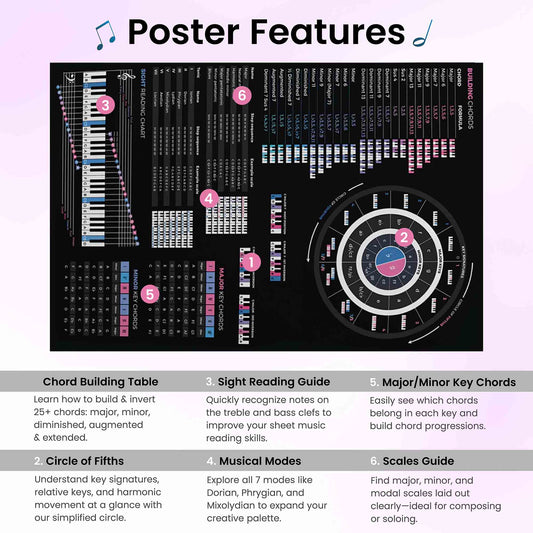
Want a note-value and rhythm reference next to your keyboard? The Music Theory Cheat Sheet Poster and Cheat Sheet Mousepad keep the notation basics in view while you practice.
Prefer a digital reference for any screen? Grab the Music Theory Cheat Sheet PDF, or get everything together in the Music Theory Bundle.

Rhythm, made visual.
Music Theory Simplified turns note values, dots and rests into diagrams you can actually play from.
FAQs about dotted notes
What does a dot after a note mean?
It extends the note's duration by half of its original value. So a dotted note lasts the original note plus half of itself — for example, a dotted half note lasts 3 beats instead of 2.
How many beats is a dotted quarter note?
1½ beats in 4/4 time. A quarter note is 1 beat, and the dot adds half a beat. A dotted quarter is also equal to three eighth notes.
How many beats is a dotted half note?
3 beats in 4/4 time. A half note is 2 beats, and the dot adds 1 more beat. It's equal to three quarter notes.
What's the difference between a dotted note and a tied note?
A dot extends a single note by exactly half its value. A tie connects two separate written notes so they're played as one continuous sound. They can produce similar lengths but are notated differently.
Do dots work on rests too?
Yes. A dot after a rest extends the silence by half, following the exact same rule as dotted notes.
This post is part of Musiciangoods' Music Theory Simplified series — practical music theory, taught visually, for musicians who want to understand what they're playing. Explore more music learning tools here.






 Guitar Chords Chart Mousepad
 Guitar Theory Simplified (Paperback/PDF)
 Bass Guitar Theory Cheat Sheet Mousepad
 Bass Theory Simplified (Paperback/PDF)
 Music Theory Simplified - (Paperback/PDF)
 Music Theory Cheat Sheet Mousepad
 Ukulele Theory Simplified (Paperback/PDF)
 Ukulele Theory Cheat Sheet Mousepad
 Guitar Theory Cheat Sheet Mousepad
 Mixing Mastering Cheat Sheet Mousepad


