 4.8/5 on Trustpilot

Editorial note: Musiciangoods does not sell studio furniture. We publish books, posters, and cheat sheets that teach the craft of making and mixing music. The retailer links below point to a product page where you can check current specs and price — we earn nothing from those clicks. The only product we earn from is our own book, Mixing & Mastering Simplified. This guide focuses on the desks a small-room producer actually chooses between, and notes the realistic trade-offs of each.
A studio desk is the one piece of gear you touch every time you sit down, and the wrong one quietly costs you hours. Monitors at the wrong height smear your stereo image, a cramped surface buries your interface under clutter, and a desk that is too deep pushes your speakers into the wall and muddies the low end. In a small room, those mistakes matter more, not less.
The good news is that a producer desk does not have to be expensive or enormous to fix all of that. What it needs is a stable surface at the right height, somewhere sensible for your monitors and interface, and ideally a keyboard tray and a little rack space so the room stays tidy. Beyond that you are paying for materials, adjustability, and looks.
The picks below span real budgets, from a compact steel workstation to premium modular furniture, and each is chosen for how well it suits a small home studio rather than a commercial control room. For every desk we note who it genuinely fits, because the best desk for a bedroom producer is rarely the biggest one on the page.
Quick comparison
| Desk | Best for | Rack space | Rough price |
|---|---|---|---|
| On-Stage WS7500 | Smallest footprint on a budget | None built in | around $300 |
| Gator Frameworks Content Creator | Best all-rounder under $400 | 3U | around $340 |
| Gator Frameworks Elite Main Desk | Most gear in a small room | 4U or 8U | around $630 |
| Dangerfox Genesis SplitBay | Angled racks and ergonomics | 16U angled | premium |
| Zaor Miza Z Flex | Best build and finish | Optional | premium |
| Zaor Miza 88 Flex | Producers who play an 88-key | 2 x 3U | premium |
The three things that matter in a small room
The first is footprint and depth. Measure your wall before anything else, and remember that desk depth sets how far your monitors sit from the wall behind them. A shallow desk that lets you pull speakers forward often sounds better in a small room than a deep one that traps them in a corner.
The second is monitor and ergonomic height. Your tweeters should sit roughly at ear height when you are seated, and your forearms should rest level when your hands are on a controller. A desk with a monitor shelf or a slide-out keyboard tray makes both far easier to get right than a flat slab.
The third is rack and cable management. Even a small studio accumulates an interface, headphone amp, and power conditioner, and a few rack spaces keep them mounted and tidy rather than sliding around. Built-in cable routing is the difference between a desk that stays clean and one that becomes a nest within a month.
1. On-Stage WS7500 — smallest footprint on a budget

If your room is tight and your budget tighter, the WS7500 is the sensible starting point. It is a compact steel workstation with a slim Z-frame, a raised shelf for monitors or a second screen, and a slide-out keyboard tray that tucks away when you are not using it.
There is no built-in rack, and the work surface is modest rather than generous, so this is a desk for a focused setup rather than a gear collection. What you get for the money is a stable, tidy footprint that fits where a larger desk cannot, which in a small bedroom studio is often exactly the point.
Best for: first studios, small rooms, and anyone who wants a keyboard tray and monitor shelf without spending much.
Check current price on Sweetwater →
2. Gator Frameworks Content Creator — best all-rounder under $400

The Content Creator main desk is the one most small studios should look at first, because it balances price, space, and features better than anything near it. You get a black work surface, a powder-coated steel frame, a pull-out keyboard tray, and an integrated three-space rack for your interface and headphone amp.
That built-in rack is the feature that sets it apart at this price, because it mounts your core gear instead of leaving it loose on the desk. The design is ambidextrous and can be expanded later with matching corner and rack sections, so a desk that fits a bedroom now can grow if you move to a bigger room.
Best for: the majority of home producers who want rack space, a keyboard tray, and room to expand without overspending.
Check current price on Sweetwater →
3. Gator Frameworks Elite Main Desk — most gear in a small room

When you have outgrown a basic workstation but do not have the room or budget for boutique furniture, the Elite main desk is the step up. Its double-platform design keeps monitors and screens on an upper shelf while your controller and hands sit lower, which is a real ergonomic gain over a single flat surface.
It also offers customisable dividers that switch between a four-space and eight-space rack, a slide-out tray sized for a 49-note keyboard, pre-bored holes for a mic boom arm, and levelling feet for uneven floors. It is heavier and pricier than the Content Creator, so it earns its place only if you genuinely have the gear to fill it.
Best for: producers with a growing rack and a controller who want a sturdier, more ergonomic desk that still fits a spare room.
Check current price on Sweetwater →
4. Dangerfox Genesis SplitBay — angled racks and ergonomics

The Genesis SplitBay is for the producer who wants a lot of outboard within arm's reach without a sprawling footprint. Its defining feature is angled rack bays on either side of the work surface, which tilt your gear toward you so the controls are easier to see and reach while keeping the desk compact.
Sixteen rack spaces is a serious amount for a home studio, and the walnut finish looks the part in a room where the studio is also a living space. It is a specialist choice rather than a first desk, so it makes sense once you know you want rack-mounted gear at the centre of your workflow.
Best for: outboard-heavy producers who want angled, accessible racks and a premium look in a compact footprint.
Check current price on Sweetwater →
5. Zaor Miza Z Flex — best build and finish

Zaor builds the desks people keep for a decade, and the Miza Z Flex is the one that fits a serious home studio rather than a commercial suite. The furniture-grade panels and finish feel a clear step above steel-framed workstations, and the design is clean enough to live in a shared room without looking like equipment.
It pairs that build with a slide-out keyboard tray rated for a heavy controller and stepped height adjustment so you can dial in ergonomics precisely. You are paying a premium for materials and refinement rather than raw rack space, so it suits the producer who wants the desk to be the last one they buy.
Best for: producers who want furniture-grade build, careful ergonomics, and a desk that looks at home in a living space.
Check current price on Sweetwater →
6. Zaor Miza 88 Flex — for producers who play an 88-key

If a full-size piano controller is central to how you work, most desks force an awkward compromise, and the Miza 88 Flex is built to solve exactly that. It has an adjustable tray sized for an 88-key keyboard, so your controller lives under the desk and slides out to play rather than eating your entire work surface.
Alongside the keyboard tray it offers two three-space racks, a top monitor shelf, a central storage section, and Zaor's usual cable management and finish. It is a large, premium piece, so it earns its footprint only if you genuinely track with a weighted keyboard, but for that producer nothing else on this list comes close.
Best for: composers and producers whose workflow centres on a full-size 88-key controller.
Check current price on Sweetwater →
How to choose the right desk for your room
Start with measurements, not features. Note the width of your wall and how far you can pull your monitors away from it, then rule out any desk that does not fit comfortably with room to sit and move. A desk that overwhelms a small room will make the room sound and feel worse regardless of how good the desk is.
Match the rack space to the gear you actually own. If your interface is your only piece of outboard, the built-in three-space rack on the Gator Content Creator is plenty, and paying for sixteen angled spaces would be wasted. If your rack is already full and growing, the Elite desk or the Dangerfox earns the extra outlay.
Decide how much a keyboard matters. Casual players are fine with the slim trays on the cheaper desks, but if a weighted 88-key is central to your writing, the Miza 88 Flex is built around that need and will save you daily frustration. Everyone else should prioritise footprint, monitor height, and cable management, and buy the least desk that covers those three things well.
Where the mixing knowledge fits in
A good desk gets your monitors and gear in the right place, but it cannot tell you whether your mix is translating. Understanding gain staging, EQ, compression, and how to reference your work is what turns a tidy studio into finished tracks. That is what our book is written to teach self-taught producers, in plain language.

View Mixing & Mastering Simplified →
Frequently asked
How wide should a studio desk be for a small room? Enough for your monitors to sit apart at ear width with your interface and controller between them, which for most small studios means a surface of roughly one to one-and-a-half metres. Prioritise a shallower depth so you can pull your monitors away from the wall behind them.
Do I need rack space in my desk? Only if you own rack gear. A single audio interface does not need it, but once you add a headphone amp, power conditioner, or outboard, a few rack spaces keep everything mounted and tidy. Buy the rack size that matches your gear now plus a little room to grow, not the largest on offer.
How high should my desk and monitors be? Aim for your monitor tweeters at roughly ear height when seated, and your forearms level when your hands are on a keyboard or controller. Desks with a separate monitor shelf and a slide-out keyboard tray make both easier to achieve than a single flat surface.
Is an expensive desk worth it for a home studio? For most beginners, no. A well-chosen sub-$400 desk covers footprint, monitor height, a keyboard tray, and basic rack space, which is everything a small studio needs. Premium desks are worth it for build quality, finish in a shared room, or specialist needs like a full 88-key tray.
Can I just use a regular office desk? Yes, and many producers do. A sturdy office desk at the right height works fine, especially with a set of desktop monitor stands to lift your speakers to ear height. A dedicated studio desk mainly adds a proper keyboard tray, integrated rack space, and cable management in one piece.
About the author
Melvin Tellier is the founder of Musiciangoods and the author of Mixing & Mastering Simplified. He writes practical, jargon-free guides that help self-taught producers set up a workspace and finish tracks that translate, from the room and the gear to the mix itself.







 Guitar Chords Chart Mousepad
 Guitar Theory Simplified (Paperback/PDF)
 Bass Guitar Theory Cheat Sheet Mousepad
 Bass Theory Simplified (Paperback/PDF)
 Music Theory Simplified - (Paperback/PDF)
 Music Theory Cheat Sheet Mousepad
 Ukulele Theory Simplified (Paperback/PDF)
 Ukulele Theory Cheat Sheet Mousepad
 Guitar Theory Cheat Sheet Mousepad
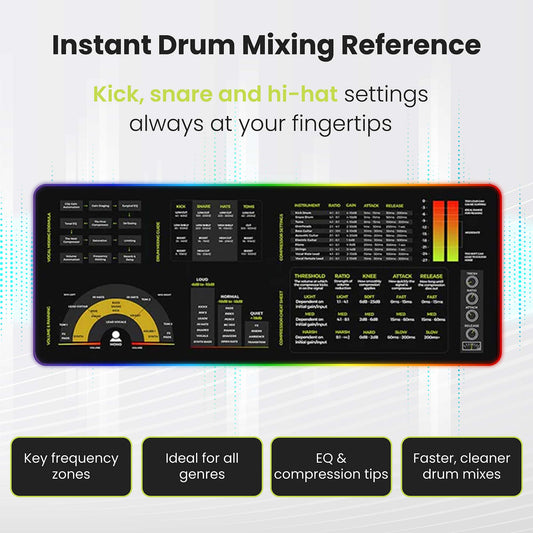
 Mixing Mastering Cheat Sheet Mousepad


