 4.8/5 on Trustpilot

Most people quit music theory in the first week. Not because it is hard, but because they start in the wrong place — with staff notation, key signatures and Italian words, none of which help you play anything. There is a much smaller core underneath all of it. Learn that core and you can read a chord chart, work out the key of a song, and understand why the chords in your favourite track go where they go.
This guide covers the 20% of music theory that explains roughly 80% of the songs you already listen to. Twelve notes, one scale formula, and three chord shapes. No sheet music required, and everything here works whether you play piano, guitar, ukulele or a MIDI controller.

What is music theory?
Music theory is the set of names and patterns musicians use to describe what they are already hearing. It is descriptive, not prescriptive — it did not come first and then produce the music. Songs came first; theory is the vocabulary that grew up around them so that players could talk to each other.
That distinction matters because it lowers the stakes. You are not learning rules that you are obliged to follow. You are learning labels for sounds you already recognise, which is why theory tends to click fastest for people who have been listening to music their whole lives.
Practically, beginner music theory answers four questions:
- What notes exist? Twelve of them, repeating.
- Which notes belong together? That is a scale, and a scale defines a key.
- What happens when you stack notes? That is a chord.
- Why do chords move the way they do? That is a chord progression.
Answer those four and you have a working knowledge of music theory. Everything more advanced — modes, secondary dominants, modal interchange — is an extension of the same four ideas.
How music theory works: the twelve notes
A full piano has 88 keys, but there are only twelve unique notes. That pattern of twelve repeats up and down the keyboard, getting higher or lower in pitch each time it restarts. Every song ever written, in every genre, is built from those twelve notes.
Seven of them are the white keys, named with the first seven letters of the alphabet: A, B, C, D, E, F, G. This sequence is called the musical alphabet, and after G it starts again at A. The remaining five are the black keys, and they are named relative to their neighbours — the key between C and D is either C♯ (a sharpened C) or D♭ (a flattened D). Two names, one sound. Musicians call those enharmonic equivalents.

Half steps and whole steps
The distance between any two adjacent keys — black or white — is a half step (also called a semitone). Two half steps make a whole step. That is the entire measuring system, and it is the reason the black keys are not evenly distributed.
Look at the keyboard and you will see two places where white keys sit side by side with no black key between them: E to F, and B to C. Those two pairs are already a half step apart. Every other pair of adjacent white keys is a whole step. This single quirk explains most of what beginners find confusing about key signatures later on.
Scales: which notes belong together
A scale is a selection of notes from those twelve, chosen using a formula of whole and half steps. The major scale formula is:
W – W – H – W – W – W – H
Start on C and follow it: C (whole) D (whole) E (half) F (whole) G (whole) A (whole) B (half) back to C. You never touch a black key, which is why C major is the scale every beginner starts on. Start the same formula on G and you will be forced onto one black key, F♯ — that is why the key of G major "has one sharp."
The natural minor scale uses a different formula (W–H–W–W–H–W–W) and produces the darker sound you hear in most sad or tense music. Play the notes of C major but start and end on A, and you get A natural minor — the same seven notes, a completely different mood. That relationship is called the relative minor, and you find it by counting down three half steps from the major root.
Chords: stacking the scale
A chord is three or more notes from a scale played at once. The standard beginner chord is a triad: take a note from the scale, skip one, take the next, skip one, take the next. Do that on C in the C major scale and you get C – E – G, a C major chord.
Do it starting on every note of the scale and you get the seven chords that belong to the key. In C major those are C, Dm, Em, F, G, Am, and B diminished. Three of them are major, three are minor, one is diminished — and that pattern is identical in every major key. Learn it once, use it everywhere.

How to learn music theory: a four-step plan
Step 1 — Learn the keyboard layout, even if you do not play piano
Spend one session finding every C on a keyboard. C is the white key immediately left of any group of two black keys — that is the only landmark you need. Then name the rest of the octave out loud: C, D, E, F, G, A, B.
Guitarists and ukulele players should do this too. Theory is easier to see on a keyboard because the layout is linear, and once you understand a concept there, translating it to a fretboard is straightforward. Almost every theory book, including ours, uses a keyboard as the reference diagram for exactly this reason.
Step 2 — Build the C major scale, then move it
Play C to C using only white keys and listen to it. Then apply the W-W-H-W-W-W-H formula starting from G, and from D, and from F. You will discover the sharps and flats yourself rather than memorising them from a chart, which makes them stick.
Give this a week. Do not move on until you can build a major scale from any starting note without looking anything up.
Step 3 — Harmonise one key
Take C major and build a triad on each of its seven notes. Play them in order: C, Dm, Em, F, G, Am, Bdim. Say the quality out loud as you play — "major, minor, minor, major, major, minor, diminished." That sequence is the single most reusable pattern in Western music.
Now pick any three of those chords and loop them. You are writing a chord progression, which is all most songs are doing.
Step 4 — Reverse-engineer songs you already know
Find the chords to a song you love. Work out which key it is in by looking at which chords appear — if you see C, F, G and Am, you are almost certainly in C major. Then number the chords by their position in the scale: C is 1, F is 4, G is 5, Am is 6.
Do this to ten songs and you will start noticing the same numbers recurring. 1-5-6-4 and 1-4-5 will show up constantly. That moment — recognising a pattern across songs that sound nothing alike — is when theory stops being homework and starts being useful.
Common mistakes to avoid
- Starting with sheet music. Reading notation is a separate skill from understanding harmony. Plenty of excellent musicians never learn to sight-read. Learn how music works first; learn to read it later, if you need to.
- Memorising key signatures as trivia. Do not learn that "E major has four sharps" as a fact. Derive it from the major scale formula. Derived knowledge survives; memorised knowledge evaporates.
- Learning theory away from an instrument. Theory learned only on paper stays on paper. Every concept in this article should be played, even badly, on something that makes noise.
- Trying to learn all twelve keys at once. Get genuinely fluent in C, G and D first. The patterns transfer, so the fourth key takes a fraction of the time the first one did.
- Believing theory will limit your creativity. This one is common and backwards. Knowing which notes belong together is what lets you choose to step outside them deliberately, rather than by accident.
Why music theory matters
The practical payoff is speed. A player without theory learns songs one at a time, as isolated sequences of shapes. A player with theory learns a pattern once and applies it to hundreds of songs, in any key.
It also unlocks three things that are genuinely hard without it:
- Transposing. A singer says the key is too high. With theory, you move the whole progression up or down in seconds because you know the numbers, not just the shapes.
- Collaborating. "Take the bridge to the relative minor" is a complete instruction to anyone with theory, and meaningless without it. Theory is the shared language in a rehearsal room or a studio.
- Writing on purpose. Without theory you write by trial and error until something sounds right. With it, you can hear a feeling you want and reach for the chord that produces it.
None of this requires years. The core described in this article is a few weeks of honest practice.

The whole core, in one book.
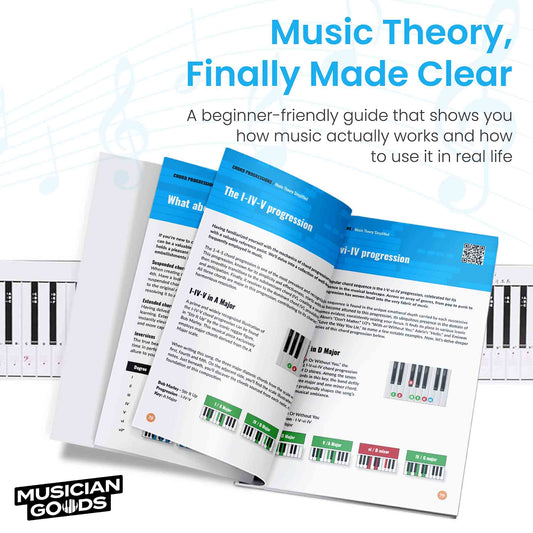
Music Theory Simplified turns the twelve notes, scale formulas and chord construction into keyboard diagrams you can read at a glance.
Take it further
The full path — the twelve-note pattern, keys and scales, intervals, every chord formula, chord progressions, notation, rhythm and the circle of fifths — is laid out chapter by chapter in Music Theory Simplified. It is built around diagrams rather than dense paragraphs, which is the format most self-taught musicians actually finish.
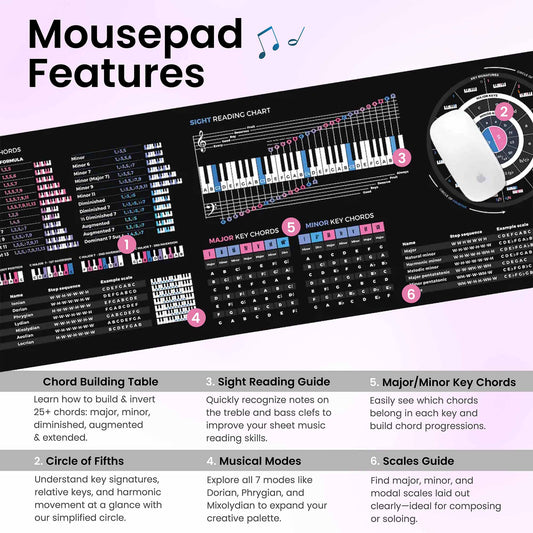
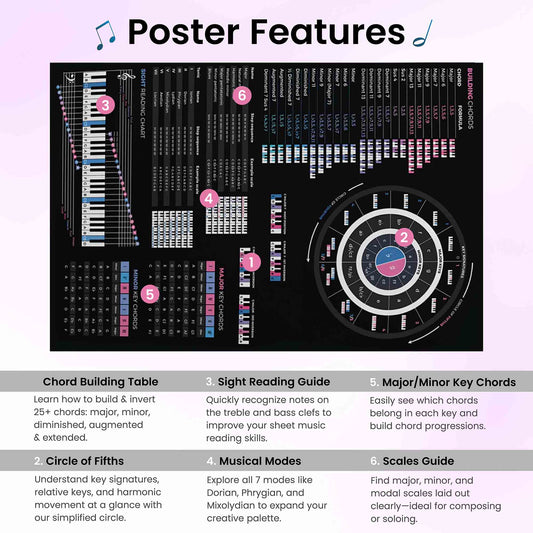
If you would rather have the essentials in front of you while you play, the Music Theory Cheat Sheet Poster and the Music Theory Cheat Sheet Mousepad keep the scale formulas, chord formulas and key signatures permanently in view — on the wall or under your hand at the desk.
Still hunting for note names on the keys? The Piano Removable Keyboard Note Stickers label the keyboard without damaging it, and peel off once you no longer need them. Or take the book and the cheat sheet together in the Music Theory Simplified Bundle.
Related reading: Do you need music theory to produce music?, the best music theory books for self-taught musicians, and is it too late to learn an instrument as an adult?
FAQs about music theory for beginners
How long does it take to learn basic music theory?
The core covered in this article — twelve notes, the major and minor scale formulas, and how triads are built — takes most people four to eight weeks at around twenty minutes a day. Reaching the point where you can hear a progression and name it takes longer, usually six months to a year of regular playing.
Can I learn music theory without an instrument?
You can read about it, but it will not stick. You need something that makes sound to test each concept against. A free piano app on a phone is enough to start; a cheap MIDI keyboard is better.
Do I need to read sheet music to understand music theory?
No. Notation and theory are separate skills. Notation is a writing system for recording music; theory explains how the music is put together. Many working musicians understand harmony thoroughly and read notation poorly, or not at all.
Should I learn theory on piano or guitar?
Learn the concepts on a keyboard even if guitar is your instrument. The piano's linear layout makes intervals, scales and chord construction visible in a way the fretboard does not. Once a concept makes sense on keys, mapping it to the fretboard is a small extra step.
Will learning music theory make my songs sound generic?
It has the opposite effect in practice. Writing without theory means falling back on the handful of chord shapes you happen to know. Theory widens the set of options and lets you break a pattern deliberately instead of avoiding it out of uncertainty.
This post is part of the Musiciangoods Simplified series — practical music theory, taught visually, for musicians who want to understand what they are playing. Explore more music learning tools here.







 Guitar Chords Chart Mousepad
 Guitar Theory Simplified (Paperback/PDF)
 Bass Guitar Theory Cheat Sheet Mousepad
 Bass Theory Simplified (Paperback/PDF)
 Music Theory Simplified - (Paperback/PDF)
 Music Theory Cheat Sheet Mousepad
 Ukulele Theory Simplified (Paperback/PDF)
 Ukulele Theory Cheat Sheet Mousepad
 Guitar Theory Cheat Sheet Mousepad
 Mixing Mastering Cheat Sheet Mousepad


