 4.8/5 on Trustpilot

The question is almost never really about age. It arrives dressed as a question about neurology, but underneath it is usually asking something closer to: will I embarrass myself, and is this a waste of the time I have left. Those deserve straight answers rather than encouragement.
So, straight answers. No, it is not too late. Yes, something real does change after childhood, and it is worth knowing exactly what. And no, that change is not the thing that will decide whether you succeed. The thing that decides it is far more boring, and entirely within your control.

Is it actually too late to learn an instrument as an adult?
No. Adults learn instruments to a genuinely satisfying standard all the time, and the ones who do not almost never fail because of their age. They stop because practice fell off, or because they set a target that had nothing to do with what they actually wanted.
The confusion comes from mixing up two different claims. The first is that becoming an elite concert soloist is realistically a childhood-start pursuit. That is broadly true. The second is that ordinary competence, playing songs you like, playing with other people, playing well enough to lose an hour without noticing, requires a childhood start. That is simply false, and the two claims get quietly swapped whenever someone says it is too late.
Ask yourself which one you are actually after. Almost nobody asking this question wants a solo career. They want to sit down in the evening and make something that sounds like music. That target is open at twenty-five, forty-five, and seventy, and the evidence for it is every community orchestra, open mic, and church band you have ever seen.
What genuinely does change after childhood?
Two things, and it is worth being precise rather than reassuring.
The first is fine motor patterning. Children lay down complex physical habits with less conscious effort than adults do, which is why the finest string and piano technique tends to be built early. An adult can absolutely acquire the same movements, but they will do it deliberately and slowly rather than by osmosis. In practice this shows up as the physical side, bow control, finger independence, clean fast passages, taking longer than the mental side.
The second is time, and this is the real one. A nine-year-old has a parent enforcing daily practice, no competing obligations, and a decade of low-stakes runway. You have a job, possibly children, and roughly twenty minutes of genuine attention on a Tuesday. This is not a brain difference. It is a schedule difference, and it is doing almost all of the work that people attribute to age.
Set against those, adults have advantages that children do not, and they are not consolation prizes. You can read. You can count. You understand an abstract instruction the first time instead of the fortieth. You can diagnose your own mistake and design a fix. You chose to be here, which means nobody has to make you. An adult who understands why a progression works can learn in an afternoon what a child absorbs over a year of unexplained repetition.
How long until I can actually play something?
Sooner than the fear suggests, with real numbers rather than encouragement. These assume twenty to thirty minutes most days.
On guitar or ukulele, a recognisable song with simple chords lands somewhere in the first month or two. The bottleneck is chord changes, not chords. On piano, a simple two-hand piece is realistic within two to three months. On violin, the honest answer is longer, because you are producing the pitch yourself with no frets to catch you, and the first months sound rough for everyone regardless of age.
Comfortable amateur playing, meaning you can pick up a song you like and work it out without help, is typically a one to three year horizon across most instruments. That range is wide because it is driven almost entirely by practice consistency, not by talent or starting age.
If those timelines feel long, it is worth noticing what they are being compared against. Most adults quit within the first eight weeks, during the stretch where the hands hurt and nothing sounds good. That window is the actual filter. Not age.
Which instrument should an adult beginner choose?
The one you want to hear yourself play. That sounds like a dodge and it is the most practical advice in this article, because motivation is the resource in shortest supply, and choosing a strategically easier instrument you feel nothing about is how people end up quitting an instrument that was supposedly easy.
That said, the practical differences are real. Ukulele is the gentlest start: four nylon strings, soft on the fingers, and a handful of chords covers an enormous amount of repertoire. Piano is the clearest to understand, since the layout is the theory made visible, and it rewards adults specifically because so much of the early difficulty is conceptual rather than physical. Guitar is the best value per hour for popular music and has the largest pool of people to play with, at the cost of a few weeks of sore fingertips. Violin is the steepest and the most rewarding for adults who care about it enough to take lessons, and it is the one instrument on this list where self-teaching is a genuinely poor plan.
One structural point that outranks the choice itself: pick the instrument that lets you play with other people soonest. Playing alone in a spare room relies entirely on willpower. Playing with anyone else replaces willpower with an appointment, and appointments survive bad weeks in a way that good intentions do not.
Do I need a teacher, or can I teach myself?
It depends on the instrument more than on you, and the split is sharper than most people expect.
Guitar, ukulele, and piano are all reasonably self-teachable to a decent amateur level. The instrument gives you the correct pitch whether or not your technique is good, so bad habits cost you speed and comfort rather than making you unlistenable. Plenty of adults get genuinely competent this way.
Violin and the other bowed strings are different. With no frets, intonation is your responsibility from the first note, and the bow arm builds habits within weeks that take years to undo. A few months of lessons early on is worth more than several years of enthusiastic solo effort, and this is the clearest case where paying for a teacher is not a luxury.
The middle path most adults land on, sensibly: a handful of lessons at the start to install the physical fundamentals, then self-directed learning with an occasional check-in when something stops improving. It is cheap, and it prevents the specific failure where you practise a mistake five hundred times.
Where does music theory fit for an adult beginner?
This is where being an adult is an outright advantage, and where most self-taught adults leave the most on the table.
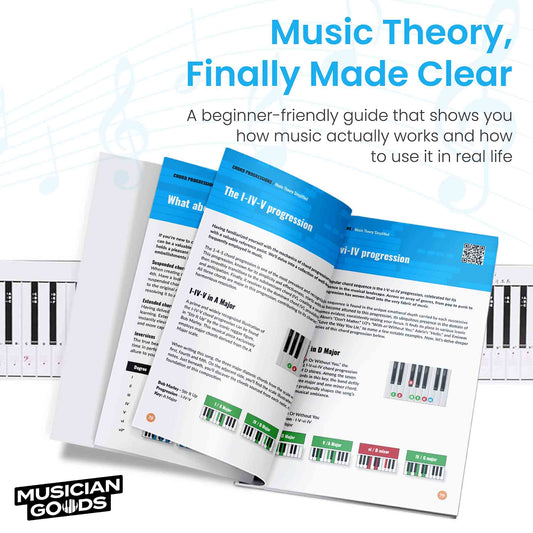
A child learns that these three shapes sound good together by playing them for a year. You can learn why they sound good together in a single sitting, and then apply it to every song you touch afterwards. The abstraction that a seven-year-old cannot use is the thing that makes your limited practice time efficient. Understanding why the I–IV–V progression turns up in thousands of songs means you stop learning songs one at a time and start recognising the same handful of patterns.
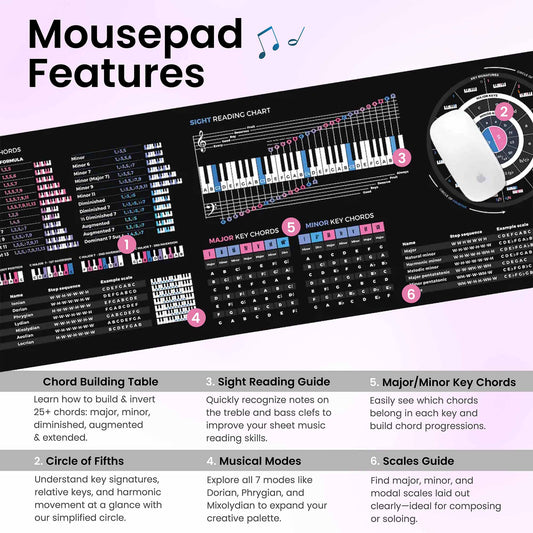
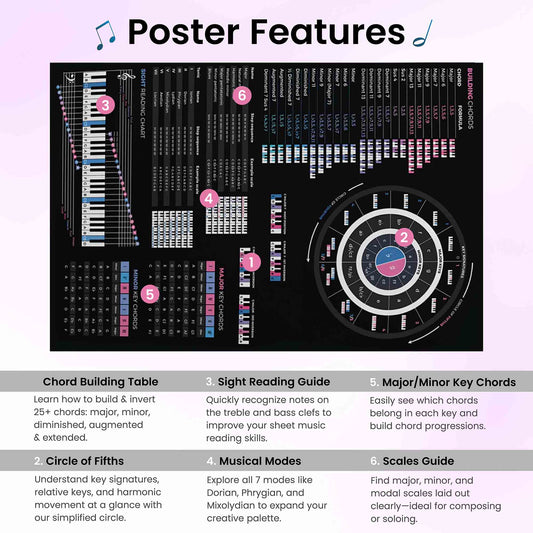
How much do you need? Less than people fear. Major and minor scales, how chords are built from them, what a key is, and the four or five progressions that underpin most popular music. That is a few weeks of casual reading, and it covers the vast majority of what you will meet. The circle of fifths alone answers more practical questions than most beginners realise.
The order matters though. Theory is a map, not a substitute for the territory. Play first, then let theory explain what your hands are already doing. Adults who read about music for six months without touching an instrument have learned a subject, not a skill.

View Music Theory Simplified →
The part that actually decides it
Not age. Not talent. Whether the instrument is out of its case, and whether twenty minutes lands on most days for long enough to get past the stretch where nothing sounds good.
That is an unglamorous answer, and it is also the good news, because every variable in it is one you control. The adults who fail at this are not failing a test they were born too late to pass. They are running out of consistency in month two, which is a scheduling problem wearing a neurology costume.
If you are asking whether it is too late, you have already done the hard part, which is wanting to. Buy or borrow the instrument, leave it somewhere you will trip over it, and give it twenty minutes today.
Frequently asked questions
Is 30, 40, or 60 too old to learn an instrument?
No. Adults across all of those ages reach a satisfying amateur standard regularly. The constraint is consistent practice time, not age. What a late start realistically rules out is the elite soloist track, which is not what almost anyone asking this question is after.
Do adults learn instruments more slowly than children?
Slower on the physical side, faster on the conceptual side. Adults acquire fine motor habits more deliberately than children do, but they read, count, understand instructions, and self-correct far better. In practice adults often progress faster in the first year and are simply outlasted by children's larger practice volume over a decade.
What is the easiest instrument to start as an adult?
Ukulele is the gentlest physically, with four soft nylon strings and a small chord vocabulary that covers a lot of songs. Piano is the easiest to understand conceptually. But the instrument you actually want to play beats the strategically easier one, because motivation is what runs out first.
How much should an adult beginner practise?
Twenty to thirty minutes on most days beats two hours at the weekend. Short frequent repetition is how motor learning consolidates, and a daily habit is far more likely to survive a busy week than a long session that has to be scheduled.
Can I learn an instrument without a teacher?
On guitar, ukulele, and piano, yes, to a decent amateur level. On violin and other bowed strings, self-teaching is a poor plan, because intonation and bow technique build habits within weeks that take years to correct. A few lessons up front is the efficient compromise on any instrument.
How long before I can play a song I recognise?
On guitar or ukulele, roughly one to two months of regular practice. On piano, two to three months for a simple two-hand piece. On violin, longer, because you produce the pitch yourself with no frets. Comfortable independent playing is typically a one to three year horizon.
Melvin Tellier is the founder of Musiciangoods, where he writes music theory books for people who want the shortest honest path from confused to competent. He is the author of Music Theory Simplified.






 Guitar Chords Chart Mousepad
 Guitar Theory Simplified (Paperback/PDF)
 Bass Guitar Theory Cheat Sheet Mousepad
 Bass Theory Simplified (Paperback/PDF)
 Music Theory Simplified - (Paperback/PDF)
 Music Theory Cheat Sheet Mousepad
 Ukulele Theory Simplified (Paperback/PDF)
 Ukulele Theory Cheat Sheet Mousepad
 Guitar Theory Cheat Sheet Mousepad
 Mixing Mastering Cheat Sheet Mousepad


