 4.8/5 on Trustpilot

Short answer: three to six months to play simple two-hand songs, about a year to play pieces people recognise, and three to five years to reach a confident intermediate level. Those numbers assume an adult practicing twenty to thirty minutes a day, four or five days a week, without a teacher. Lessons roughly halve the early timeline; sporadic practice roughly doubles it.
The reason "how long does it take to learn piano" has no single answer is that piano hides two skills inside one instrument. There is the physical skill of moving ten fingers independently, and the reading skill of turning two staves of notation into sound in real time. Most beginners underestimate the second one. Below are the real milestones, the practice patterns that reach them, and the factors that actually move the timeline.
What "learning piano" actually means
It helps to split the question into four stages, because the time to reach each one differs by an order of magnitude.
Beginner — first three months. You can find any note on the keyboard, play a five-finger position with each hand separately, read simple notes in both the treble and bass clef, and play short single-line melodies. You can play a few simplified songs hands-separate. Most self-taught adults reach this with twenty minutes a day, four times a week.
Hands-together player — three to twelve months. You can coordinate both hands at once on simple pieces, play basic chords in the left hand under a melody in the right, and read music slowly but without stopping every bar. You can play maybe ten pieces you actually like. This is where a lot of casual learners settle, and for playing songs at home it is a perfectly good destination.
Intermediate — one to five years. You can sight-read at a basic level, play pieces with independent rhythms in each hand, use the sustain pedal musically, and understand the key a piece is in rather than reading note by note. Early intermediate repertoire — easier Bach, Chopin preludes, pop arrangements with real voicings — becomes reachable. This is where most self-taught players stall, because the next decisions get murky without a curriculum.
Advanced — five years and up. You can read fluently, play complex independent lines in each hand, voice chords by ear, and learn new pieces quickly. Advanced playing is less a finish line than the depth of the toolkit. Very few self-taught adults arrive here without lessons, a structured program, or thousands of hours.
A realistic timeline for adults practicing 20 to 30 minutes a day
Assume you are an adult with no prior musical background, no teacher, and an honest twenty to thirty minutes a day, four or five days a week. Here is roughly what happens.
Week 1-3. You learn the layout of the keys, the names of the white notes, and a five-finger position in C for each hand separately. You play short melodies one hand at a time. Progress feels slow because both hands are still strangers to the keyboard, and this is where many beginners quietly stop.
Month 1-3. You start reading simple notation in both clefs, play your first easy pieces hands-separate, and attempt your first hands-together passages. The first time both hands cooperate on a short song is the moment the habit usually stabilises. Reading the bass clef lags behind the treble clef for almost everyone, and that is normal.
Month 3-9. Hands-together playing becomes the main work. You learn basic chords in the left hand, simple accompaniment patterns, and your first ten recognisable pieces. You discover the gap between "I can play the notes" and "this sounds musical," which is where the sustain pedal and dynamics enter.
Month 9-18. You start playing for other people. You read well enough to learn a new easy piece without someone showing you, you use the pedal without thinking, and you begin to notice you do not really understand why a piece is built the way it is. This is usually when learners start looking at theory, because the term "key" keeps appearing and they realise they cannot define it.
Year 2-3. If you keep going, this is where you become a real player. Sight-reading turns from decoding into reading. You can transpose a simple piece, harmonise a melody, and pick up early intermediate repertoire in a reasonable time. The keyboard stops feeling like a wall of identical keys and starts feeling like a map.
Year 4-5+. Most adults who keep going for five years become either a competent intermediate player or a specialist in the style they love. Reaching a generalist "advanced" level usually requires lessons or a deliberate program rather than drift.

What's actually slowing you down (and what isn't)
The factors that decide whether you make it through the first year are mundane, and they are rarely the ones beginners worry about.
Reading is the real bottleneck, not finger speed. Most adults can move their fingers faster than they can read what to play. The learners who stall almost always stalled on notation, not technique. Twenty minutes that includes five minutes of slow, deliberate sight-reading will move you faster than twenty minutes of replaying the one piece you already know.
Hands-together coordination feels impossible and then suddenly is not. Combining two independent hands is the single hardest beginner hurdle, and it is a wall almost everyone hits around month two or three. The fix is not effort, it is method: learn each hand alone until it is automatic, then combine at half speed. People who try to play hands-together at full speed from the start are the ones who conclude they "have no coordination."
The instrument matters less than the keys. A full-size keyboard with weighted, touch-sensitive keys is far better for building real technique than a small synth-action keyboard, but you do not need an acoustic grand. What hurts beginners is a keyboard with too few keys or unweighted keys that teach the fingers the wrong amount of force. Weighted keys and a sustain pedal cover the first several years.
What barely matters: talent. "Musical talent" predicts the first few weeks — people with a good ear pick up pitch and rhythm slightly faster — and very little after that. The difference between a year-five player and a year-five quitter is accumulated practice, not innate gift. For adult learners this is the most empowering and most evidenced fact about the instrument.
Does taking lessons actually cut the timeline?
Yes, by roughly half, and the gain concentrates in the first year. A competent teacher catches the habits that lock in fastest during self-teaching: collapsing finger joints, a tense wrist, ignoring the rhythm, and reading by finger pattern instead of by note. Those habits are the difference between a five-year player who sounds musical and a five-year player who sounds like a beginner with harder pieces.
Lessons matter less from year three onward, when the question stops being "how do I do this" and becomes "what should I learn next." At that stage a structured book or curriculum often substitutes for a teacher.
The cheapest middle path for most self-taught adults is a short burst of lessons early — three or four in the first six months, specifically for feedback on hand position, posture, and rhythm — then a return to self-study. Three lessons prevent most of the lock-in problems that quietly limit self-taught players for years.
Is it harder to learn piano as an adult?
Not in the way people assume. Adults learn to read notation, understand harmony, and grasp the structure of a piece faster than children, because those are intellectual skills and adults have more intellectual scaffolding. What children have is more practice time and far less self-criticism.
The biological factors — finger independence, motor learning, building the fine control the keyboard needs — barely differ between a thirty-year-old and a sixty-year-old. The real adult bottleneck is patience with sounding bad in the early weeks, plus a calendar that competes with practice. Neither is about age, and both are fixable.
What to do this week if you're starting
Get a full-size keyboard with weighted, touch-sensitive keys and a sustain pedal before you spend on anything else. Set a fixed twenty-minute slot three to five times this week, anchored to something you already do — morning coffee, after dinner, a lunch break — and protect it like an appointment.
Your first month should be only three things: learning the white-note names cold, playing a five-finger position cleanly with each hand separately, and reading simple single-line melodies in both clefs. Do not rush to hands-together playing or pedalling. The temptation to skip ahead is the main reason beginners stall — they end up six months in, playing one piece badly with both hands, instead of three months in, reading fluently with each hand alone.
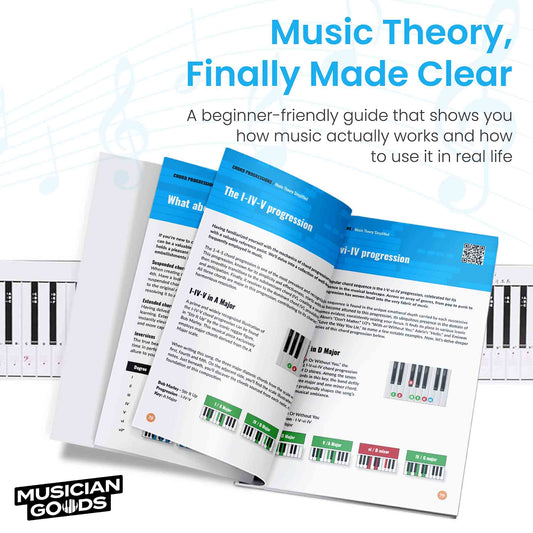
If you want to understand why the pieces you play are built the way they are — what a key is, why certain chords sit under a melody, how to read what you are seeing rather than decode it — our book Music Theory Simplified covers the full theory framework in plain language with full-color diagrams. It is built for self-taught adults who want the system, not more pieces to memorise.

View Music Theory Simplified →
Frequently asked questions
How long does it take to learn your first song on piano?
Two to four weeks for most adult beginners, using a simplified arrangement that keeps each hand to a single line and a slow tempo. The first piece always takes longer than expected, because hands-together coordination is new rather than because the piece is hard. By the third or fourth piece at the same level, the time drops sharply.
Can you learn piano by yourself without a teacher?
Yes. Many adults reach a comfortable hands-together level entirely self-taught using books, structured courses, and apps. The trade-off is that self-teaching lets bad habits lock in — tense wrist, collapsing fingers, ignoring rhythm — which a teacher would catch early. A common compromise is a handful of lessons in the first six months for feedback, then self-study from there.
How long does it take to learn piano professionally?
If "professionally" means earning a living teaching, accompanying, or performing, roughly eight to fifteen years of focused practice for most working pianists, usually including formal training. Professional playing demands fluent sight-reading, a large repertoire, improvisation or accompaniment skills, and reliable performance under pressure. Almost no one reaches it without sustained lessons or a music degree.
Is piano harder to learn than guitar?
They are hard in different places. Piano is easier at the very start because every note is laid out in front of you and pressing a key makes a clean sound, while guitar makes you fight sore fingertips and chord shapes for weeks. Piano gets harder sooner, though, because you read two staves at once and coordinate two independent hands. Most people find the first month easier on piano and the first year roughly even.
How much should I practice piano per day as a beginner?
Twenty to thirty minutes a day, four or five days a week, is the sweet spot for adult beginners. Short daily practice beats long weekly sessions because the fine motor patterns the keyboard needs consolidate through frequent repetition, not through occasional marathons. If you only have ten minutes, keep it daily and pick one specific thing to drill rather than playing through the piece you already know.






 Guitar Chords Chart Mousepad
 Guitar Theory Simplified (Paperback/PDF)
 Bass Guitar Theory Cheat Sheet Mousepad
 Bass Theory Simplified (Paperback/PDF)
 Music Theory Simplified - (Paperback/PDF)
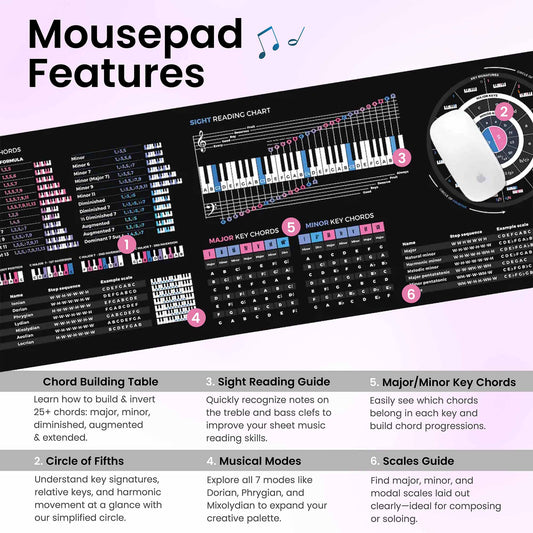
 Music Theory Cheat Sheet Mousepad
 Ukulele Theory Simplified (Paperback/PDF)
 Ukulele Theory Cheat Sheet Mousepad
 Guitar Theory Cheat Sheet Mousepad
 Mixing Mastering Cheat Sheet Mousepad


