 4.8/5 on Trustpilot

Everyone has had a song stuck in their head that they did not choose and could not evict. The phenomenon is common enough to have a name in the research literature: involuntary musical imagery, or more plainly, the earworm. What is less obvious is that catchiness is not luck. The songs that lodge themselves in memory tend to share a small set of musical features, and those features can be described, taught, and used on purpose.
This is a walkthrough of what actually makes a melody catchy — the theory behind the hook — and what a working songwriter can take from it.
What "catchy" actually means
Catchiness is a memory effect. A catchy passage is one the brain can encode quickly, replay accurately without the recording present, and predict as it unfolds. Every mechanism below serves one of those three functions: it makes the phrase easier to encode, easier to reproduce, or more satisfying to predict.
This is why catchy is not the same as good, and not the same as complex. A jingle can be catchier than a symphony. The features that produce catchiness are about how the ear grabs and holds a short musical idea, not about artistic depth. The two can coexist, but they are separate questions.
Repetition, and repetition with a difference
The single most reliable ingredient in a catchy phrase is repetition. A motif the ear hears once is an event. A motif it hears three or four times is a pattern, and patterns are what memory stores. Almost every hook you can name repeats a short cell of two to five notes several times in close succession.
Pure repetition alone becomes monotonous, so the strongest hooks use repetition with variation. The cell returns, but something small changes — the last note lands a step higher, the rhythm clips or extends, the phrase answers itself a degree lower. The ear gets the comfort of the familiar shape and the small reward of the change. This call-and-response within a single phrase is one of the oldest devices in melody, and it is doing the heavy lifting in most modern hooks.
Melodic contour: the shape you remember
People remember the shape of a melody more reliably than its exact pitches. Ask someone to hum a tune they half-know and they will usually get the contour right — the ups and downs — while missing specific intervals. This means the outline of a hook matters more than its precise notes.
Catchy melodies tend to have a clear, memorable contour: an arch that rises to a single high point and falls, a repeated stepwise climb, a distinctive leap followed by a stepwise return. The high note of a phrase — the melodic peak — is a natural anchor for memory, which is why so many hooks place their most important word or syllable at the top of the arch. A melody that wanders without a clear shape gives the ear nothing to hold.
The gap: expectation and its resolution
A large part of what feels satisfying in a hook is the setup and payoff of expectation. Tonal music trains the ear to expect certain notes. The leading tone, the seventh degree of the scale, pulls strongly upward to the tonic. When a melody climbs toward that resolution and then delivers it, the ear registers a small completion.
Skilled hooks play with the timing of that completion. They delay the expected note, land it on a strong beat, or approach it by a leap so the arrival feels earned. The pleasure of a catchy phrase is often the pleasure of a prediction confirmed slightly later than expected. Repeated listening does not dull this, because the brain still runs the prediction each time and still enjoys being right.
Rhythm and syncopation: the physical hook
Melody is only half of catchiness. The other half is rhythm, and specifically the placement of notes against the beat. A phrase whose accents fall exactly on the beats is stable but forgettable. A phrase that pushes a note slightly ahead of the beat, or lands it in the gap between beats, creates syncopation — a small rhythmic tension the body wants to resolve.
Syncopation is why some hooks make people move before they have consciously registered the tune. The displaced accent is a physical event. It engages the part of listening that is closer to dance than to analysis, and it makes a rhythmic figure as memorable as a melodic one. Many of the stickiest hooks in pop are rhythmic first and melodic second: a chant, a stutter, a repeated syllable placed just off the beat.
Singability: it has to fit a human voice
A hook that most people cannot sing does not spread. Catchy melodies tend to sit inside a comfortable vocal range — usually around an octave or less — and to move mostly by step and small leaps rather than by wide, difficult intervals. This is not an accident of taste. A phrase the average listener can reproduce with their own voice gets rehearsed every time they hum it, and rehearsal is what moves a melody from short-term to long-term memory.
The same logic applies to the lyric. Open vowels, hard consonants, and simple, repeated syllables are easier to sing and easier to recall. A hook built on a single repeated word, or on a nonsense syllable with a strong vowel, removes the lyric as an obstacle entirely. The listener does not have to remember words to replay the phrase, so the phrase spreads faster.
Placement: a hook has to arrive on time
The best hook in the world fails if it is buried. Catchy songs tend to state their central hook early and return to it often. The chorus arrives before the listener's attention has wandered, and the hook inside the chorus repeats enough times to be encoded but not so often that it exhausts itself. The structure serves the hook: everything before the chorus is a runway, and everything after is a reason to hear it again.
This is also why the first few seconds matter so much. A hook that appears in the opening bars — an instrumental figure, a vocal fragment, a rhythmic pattern — gives the ear something to hold immediately, and primes it to recognise the same figure when it returns in the chorus.
Why the mechanisms compound
No single feature makes a song catchy. What makes a hook stick is several of these working at once: a short melodic cell, repeated with small variation, shaped into a clear contour, landing on a strong beat with a touch of syncopation, sitting in a singable range, arriving early, and returning often. Each mechanism reinforces the others. Repetition makes the contour familiar; the contour makes the repetition tolerable; the singability turns every replay into rehearsal; the placement guarantees enough replays to matter.
This is why catchiness can be engineered but not faked. A writer who understands the mechanisms can build a phrase that uses all of them, but the phrase still has to be good on its own terms — the mechanisms amplify a strong idea, they do not manufacture one.
What this means if you want to write
If you are trying to write something memorable, the practical takeaways are concrete. Build your hook from a short cell you can repeat. Vary the repetition slightly rather than copying it exactly. Give the phrase a clear shape with one obvious high point, and put your most important word there. Keep it inside a range an untrained voice can sing. Let the rhythm push against the beat at least once. State it early, and come back to it.
None of this guarantees a hit, because catchiness is a floor, not a ceiling — it gets a song remembered, not necessarily loved. But the features are learnable, and hearing them in the songs already stuck in your head is the fastest way to start using them in your own writing.
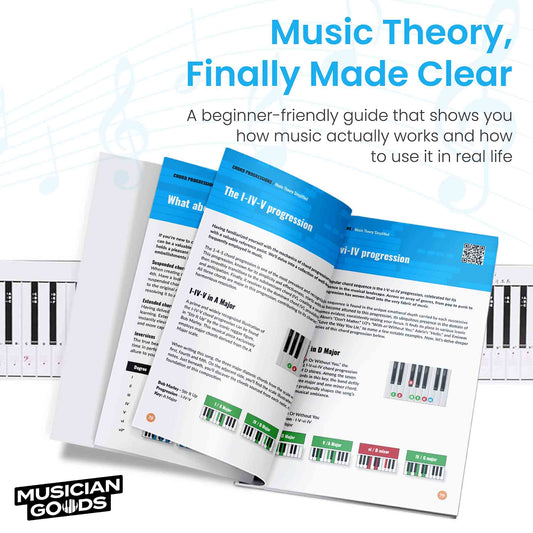
If you want to understand the harmonic and melodic machinery underneath these hooks — scale degrees, the pull of the leading tone, contour, consonance and tension — our book Music Theory Simplified covers the whole framework in plain language. It is written for self-taught musicians who want to understand why music works, not just memorise rules.

View Music Theory Simplified →
For more on the ideas behind these hooks, our guides to why most pop songs use the same four chords, music intervals explained, and the theory behind Canon in D are good next reads.






 Guitar Chords Chart Mousepad
 Guitar Theory Simplified (Paperback/PDF)
 Bass Guitar Theory Cheat Sheet Mousepad
 Bass Theory Simplified (Paperback/PDF)
 Music Theory Simplified - (Paperback/PDF)
 Music Theory Cheat Sheet Mousepad
 Ukulele Theory Simplified (Paperback/PDF)
 Ukulele Theory Cheat Sheet Mousepad
 Guitar Theory Cheat Sheet Mousepad
 Mixing Mastering Cheat Sheet Mousepad


