 4.8/5 on Trustpilot

Most songs stay in one key from start to finish. A minority do not — at some point the whole harmonic centre shifts, and the song relocates to a new home note. Sometimes the move is dramatic and obvious, a lift into a higher final chorus. Sometimes it is so smooth that a listener feels the change without being able to name it. Either way, the technique has a name: modulation, the act of changing key.
This is a walkthrough of why songwriters do it, what the main types of key change are, and how to train your ear to catch one as it happens.
What changing key actually means
A key is a home base. It is the note and the scale that a piece of music treats as its centre of gravity — the place the melody keeps returning to and the chord that feels like rest. To change key is to move that centre of gravity somewhere else, so that a different note now feels like home and a different set of chords feels like the natural family.
This is more than transposing a few notes up or down. A genuine key change reorganises the listener's sense of where the music is anchored. The old tonic stops feeling like rest, and a new one takes over. Done well, the ear accepts the relocation as natural. Done abruptly, it registers as a jolt — which is sometimes exactly the point.
The first reason: to raise the energy
The most familiar key change in popular music is the upward shift for a final chorus — the whole song jumps up a semitone or a whole tone and repeats the chorus higher. The effect is a sudden lift in energy and brightness. The melody sits higher in the singer's range, the chords feel newly urgent, and the listener registers an unmistakable gear change.
This works because the ear has settled into the original key over three or four minutes. Yanking everything up by a step breaks that settledness and forces renewed attention on a section the listener has already heard twice. It is a blunt instrument, and it has been used often enough to become a cliché — but the reason it became a cliché is that it reliably delivers the lift it promises.
The second reason: to mark a new section
Songs use key to structure attention. A bridge that modulates to a related key tells the ear, unmistakably, that the song has moved somewhere new before it returns home. The contrast makes the return to the original key feel like an arrival rather than a repetition.
This is a subtler use than the final-chorus lift. The song does not just get brighter; it visits a genuinely different harmonic region, spends a phrase or two there, and then finds its way back. The journey out and back gives the form a shape. The listener may not consciously notice the key has changed, but they feel the departure and the homecoming.
The third reason: to shift the emotional colour
Different key relationships carry different emotional weight. A move to the relative minor — the minor key that shares the same notes as the current major — darkens the mood without changing a single pitch in the scale, only the note that feels like home. A move to the parallel minor, keeping the same tonic but flattening the scale, is a more dramatic turn toward shadow. A move up a fourth or fifth to a closely related major key brightens and freshens without any sense of strain.
Songwriters use these relationships to make the harmony do emotional work the melody and lyric cannot do alone. A verse in a major key and a bridge in its relative minor can carry the same lyric into a different feeling. The key change is the mechanism; the shift in mood is the payoff.
The fourth reason: to follow the voice
Sometimes the reason is purely practical. A melody that sits perfectly in a singer's range for the verse may be too low or too high for the chorus, or a duet may need to accommodate two different voices. Shifting key between sections keeps every part of the song in a comfortable, expressive range for the person singing it. This is an unglamorous reason, but it is a real one, and it accounts for a fair number of the key changes listeners never consciously notice.
How the change is made: the pivot
The smoothest modulations rely on a shared resource between the two keys. Many chords belong to more than one key at once. A songwriter can approach such a chord as a member of the old key and then leave it as a member of the new key — a pivot chord. The ear crosses the boundary without feeling a seam, because for one chord it belonged to both places at once.
The alternative is a direct modulation, where the song simply arrives in the new key with no preparation, usually on a strong downbeat. The final-chorus lift is almost always a direct modulation: there is no pivot, just a decisive jump. The two approaches produce opposite effects — the pivot hides the change, the direct move advertises it — and songwriters choose between them based on whether they want the modulation felt or noticed.
How to hear a key change
Training your ear to catch modulation is mostly a matter of tracking where home is. Try to hum the tonic — the note that feels like rest — during a verse, and keep holding it in your head as the song moves into a bridge or a later chorus. If the note you were humming suddenly clashes with the music, or no longer feels like the resting point, the key has moved.
The upward final-chorus lift is the easiest to catch: it feels like everything has been physically hoisted, and the returning melody sits higher than before. Smoother modulations are harder, and the tell is usually a moment where a chord you did not expect appears and then, instead of resolving back, becomes the new normal. That chord is often the pivot, and the phrase after it is the new key settling in.
What this means if you want to write
If you want a key change to lift a final chorus, the direct move up a semitone or whole tone is the reliable tool, used sparingly so it keeps its impact. If you want a modulation the listener feels rather than notices, look for a chord shared between your current key and the key you want to reach, and pivot on it. If you want emotional contrast, move to the relative or parallel minor and let the same melody carry a different weight.
The point is that a key change is never decoration. It is a structural and emotional tool, and every one of its uses — the lift, the new section, the shift in colour, the accommodation of a voice — is a specific effect a writer can reach for on purpose. Once you can hear where home is, you can hear a song decide to move house.
If you want to understand the machinery behind modulation — keys, scale degrees, relative and parallel minors, pivot chords, and the circle of fifths that maps how keys relate — our book Music Theory Simplified covers the whole framework in plain language. It is written for self-taught musicians who want to understand why music works, not just memorise rules.

View Music Theory Simplified →
For more on how keys relate to one another, our guides to relative major and minor keys, the Camelot wheel for key mixing, and why pop songs share the same four chords are good next reads.




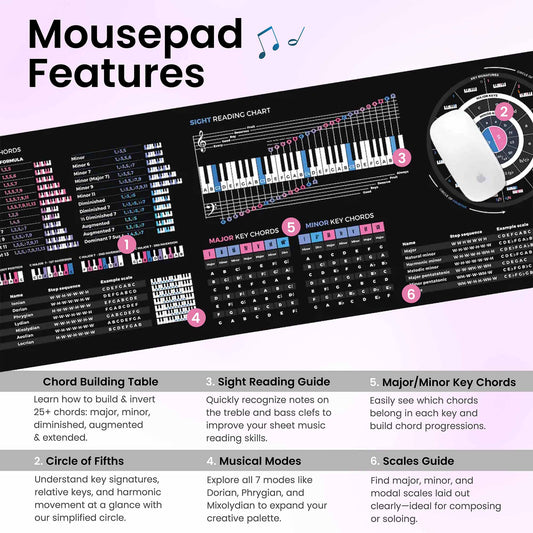





 Guitar Chords Chart Mousepad
 Guitar Theory Simplified (Paperback/PDF)
 Bass Guitar Theory Cheat Sheet Mousepad
 Bass Theory Simplified (Paperback/PDF)
 Music Theory Simplified - (Paperback/PDF)
 Music Theory Cheat Sheet Mousepad
 Ukulele Theory Simplified (Paperback/PDF)
 Ukulele Theory Cheat Sheet Mousepad
 Guitar Theory Cheat Sheet Mousepad
 Mixing Mastering Cheat Sheet Mousepad


