4.8/5 on Trustpilot

The major scale sounds bright and happy. But most of the music that gives you chills — the sad, the moody, the cinematic — leans on its darker twin: the natural minor scale. Learn one seven-step formula and you can play it in any key on the piano.
In this guide we'll break down what the natural minor scale is, the simple whole-and-half-step formula that builds it, how to play it in any key on the piano, and how it connects to the major scale you may already know.

What is the natural minor scale?
The natural minor scale is a seven-note scale that produces the darker, more melancholic sound at the heart of countless songs. There are actually three types of minor scale — natural, harmonic, and melodic — but the natural minor is by far the most common in music, so it's the one to master first.
Like every scale, it's defined by a specific pattern of whole steps and half steps. That pattern is what gives the scale its distinct, slightly sad character no matter which note you start on. A scale is like an alphabet: a source of notes you can rearrange, repeat, and shape into melodies. The natural minor scale simply gives you a darker set of letters to work with.
The natural minor scale formula
Here is the entire scale in one line:
Formula: Whole – Half – Whole – Whole – Half – Whole – Whole
Or, in shorthand: W – H – W – W – H – W – W
Say it out loud a few times — "W, H, W, W, H, W, W" — until it sticks. That spoken rhythm is the fastest way to lock the formula into memory, the same way you once memorized the alphabet.
A whole step is a distance of two keys on the piano (counting black and white keys together). A half step is the distance to the very next key. Start on any note, follow that pattern, and you've built a natural minor scale.
Starting on C, the formula gives you:
- C (start)
- Whole step up → D
- Half step up → E♭
- Whole step up → F
- Whole step up → G
- Half step up → A♭
- Whole step up → B♭
- Whole step up → C (octave)
So the C natural minor scale is: C – D – E♭ – F – G – A♭ – B♭ – C.
How to build the natural minor scale in any key
The magic of the formula is that it's portable. Once you know W-H-W-W-H-W-W, you can build the scale from any starting note — you're just copying the same pattern of whole and half steps to a new position on the keyboard.

Pick a root note. Apply the pattern. That's it. Start on A and you get A – B – C – D – E – F – G – A, the A natural minor scale, which uses only white keys. Start on E and you get E – F♯ – G – A – B – C – D – E. The root you choose sets the key; the formula does the rest.
Major and minor: the relative connection
Here's a shortcut that makes minor scales much easier. Every major scale has a relative minor — a natural minor scale that uses exactly the same notes, just starting on a different note.
To find a major key's relative minor, start on the root of the major scale and count down three half steps (a minor third). In C major, counting down three half steps lands you on A. So A natural minor is the relative minor of C major — both use only the white keys, with no sharps or flats. The difference is simply which note feels like "home." C major feels bright and resolved; A natural minor, built from the same notes, feels darker and more introspective.
This means every natural minor scale you learn doubles as a major scale you already knew — you're just entering it from a different door.
How to practice the natural minor scale on piano (4-step plan)
Step 1 — Learn C natural minor first
Start with C: C – D – E♭ – F – G – A♭ – B♭ – C. Play it slowly, ascending and descending, saying "whole, half, whole, whole, half, whole, whole" as you go. The two black keys (E♭ and A♭) are your landmarks.
Step 2 — Play A natural minor (all white keys)
Move to A minor: A – B – C – D – E – F – G – A. Because it's all white keys, it's the easiest natural minor scale to play and a great one to build finger memory on. Notice it sounds sad even though you're only touching white keys.
Step 3 — Transpose the formula to new keys
Now stretch yourself. Start the formula on D, then E, then G. Each time, count the whole and half steps carefully. This trains you to build the scale from scratch anywhere on the keyboard instead of memorizing note names one key at a time.
Step 4 — Use it to write a mood
Play a short melody using only the notes of a natural minor scale. Don't overthink it — wander up and down and let it sound moody. This is where the scale stops being an exercise and becomes a tool for creating emotion in your own music.
Common mistakes to avoid
- Mixing up the major and minor formulas. Major is W-W-H-W-W-W-H. Natural minor is W-H-W-W-H-W-W. The half steps land in different places — that's the whole difference in sound.
- Forgetting the flats. C natural minor has E♭, A♭, and B♭. Skip a flat and you'll accidentally play a different scale. Let the formula, not habit, decide the notes.
- Only memorizing note names. If you only memorize "C-D-E♭-F..." you're stuck when you change keys. Learn the step pattern so you can build the scale anywhere.
- Confusing natural minor with harmonic or melodic minor. Those raise certain notes and sound different. Master the natural minor first before exploring the others.
- Ignoring the relative-major shortcut. If you already know a major scale, its relative minor is the same notes. Not using that connection makes minor scales harder than they need to be.
Why the natural minor scale matters
The natural minor scale is one half of the foundation of Western music — the major scale is the other. Together they give you the two core emotional colors of nearly every song you've ever heard: bright and dark, happy and sad. Master both formulas and you can compose or improvise in any key, in either mood.
More practically, the natural minor scale unlocks the minor keys where so much memorable music lives — from film scores to pop ballads to rock and beyond. Learn the one formula, understand its link to the major scale, and you've added an entire emotional dimension to your playing. That's the natural minor scale, simplified.
Take it further
The complete guide to scales — major, natural minor, relative keys, and the full piano scales chart for every key — is laid out visually in Music Theory Simplified. It's the same clear, no-fluff style you're reading now.
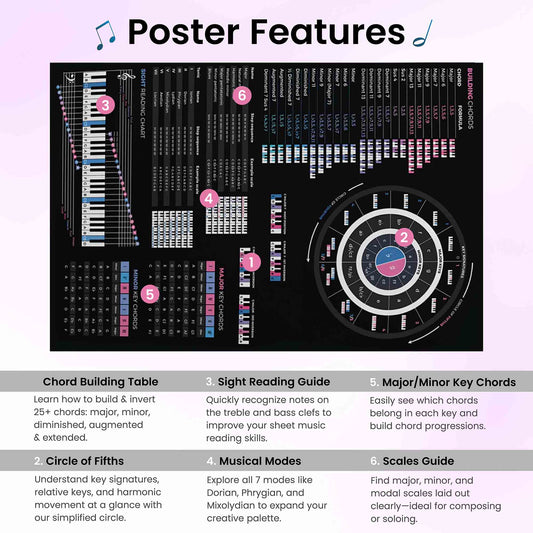
Want the scale formulas and note maps next to your keyboard while you practice? The Music Theory Cheat Sheet Poster and Cheat Sheet Mousepad keep major and minor scales in view whenever you sit down to play.
Prefer a digital reference for any screen? Grab the Music Theory Cheat Sheet PDF, or get everything together in the Music Theory Bundle.

Every scale, key and formula — mapped out visually.
Music Theory Simplified turns major and minor scales into diagrams you can actually play from.
FAQs about the natural minor scale
What is the natural minor scale formula?
Whole – Half – Whole – Whole – Half – Whole – Whole (W-H-W-W-H-W-W). Start on any note and follow that pattern of steps to build a natural minor scale in any key.
What are the notes of the C natural minor scale on piano?
C – D – E♭ – F – G – A♭ – B♭ – C. It has three flats: E♭, A♭, and B♭.
What is the easiest natural minor scale to play on piano?
A natural minor (A-B-C-D-E-F-G) is the easiest because it uses only white keys — no sharps or flats to worry about.
What's the difference between the major and natural minor scale?
They use different step patterns. Major is W-W-H-W-W-W-H and sounds bright; natural minor is W-H-W-W-H-W-W and sounds darker and more melancholic. The placement of the half steps is what changes the mood.
How is the natural minor scale related to the major scale?
Every major scale has a relative natural minor that uses the exact same notes, starting three half steps below the major root. For example, A natural minor is the relative minor of C major — both use only white keys.
This post is part of Musiciangoods' Music Theory Simplified series — practical music theory, taught visually, for musicians who want to understand what they're playing. Explore more music learning tools here.