4.8/5 on Trustpilot

The piano can look intimidating — 88 keys stretching left to right, black and white, seemingly endless. But there are only twelve note names on the entire instrument, and naming the white keys is almost as simple as reciting the alphabet. Learn the pattern once and the whole keyboard opens up.
In this guide, we'll break down piano note names the simple way — the seven letters that name the white keys, how they repeat across the keyboard, why the black keys have two names each, and how to practice until you can find any note by sight. No prior theory needed.

What are piano note names?
Every key on a piano has a name, and those names come from just the first seven letters of the alphabet: A, B, C, D, E, F, and G. These seven letters name the white keys and are called the "natural" notes. After G, the sequence simply starts over at A and repeats, all the way up and down the keyboard.
Because the physical pattern of keys repeats, the note names repeat with it. That's the single most important idea here: you're not memorizing 52 white keys, you're learning one seven-letter pattern that recurs across the whole instrument.
The black keys get their names from the white keys next to them, using sharps and flats — but we'll build the white keys first, because they're the foundation for everything else.
How piano note names work
The white keys run C-D-E-F-G-A-B, then back to C. Many teachers start on C because the first note of the standard reference layout is C and the last note before reaching the next C is B. Each note above C sits at a progressively higher pitch; each note below C sits lower. Same letters, different octaves.
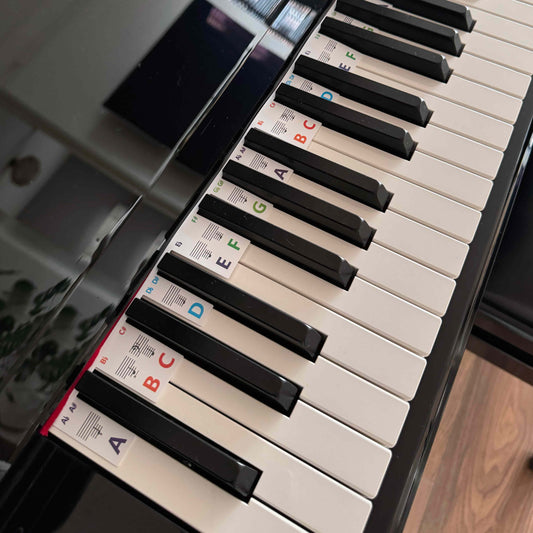
To find C reliably, look at the black keys. They're grouped in sets of two and three. C is always the white key immediately to the left of any group of two black keys. Once you can spot C, the rest of the alphabet falls into place moving right: D, E, F, G, A, B, and around again.

Now the black keys. Each black key sits between two white keys and takes its name from them, with a small twist. Moving right from a white key to a black key sharpens the note (raises its pitch) — so the black key just right of C is C♯. Moving left from a white key to a black key flattens the note (lowers its pitch) — so that same black key, seen from D, is D♭.
That means most black keys have two names for the same pitch: C♯/D♭, D♯/E♭, F♯/G♭, G♯/A♭, and A♯/B♭. These pairs are called enharmonic equivalents — two spellings, one sound.

One subtlety: sharps and flats can even apply to white keys. There's no black key between E and F, or between B and C, because those pairs are already a half step apart. So the note usually called F can also be written E♯, and F and E♯ are enharmonic equivalents too. A sharp or flat is just a notation for raising or lowering a pitch — it doesn't always mean a black key.
How to practice piano note names (4-step plan)
Naming notes is pure repetition. Here's an efficient way to lock it in.
Step 1 — Anchor on C, then say the whites
Find a group of two black keys, place your finger on the white key to its left (that's C), and say the letters out loud as you play up: C, D, E, F, G, A, B, C. Do it in a few different octaves so you're not memorizing one spot on the keyboard.
Step 2 — Play and say
Play random white keys and name them out loud before you look for confirmation. Speaking the name as you press the key ties the sound, the position, and the letter together.
Step 3 — Match written names to keys
Write out a few note names on paper (say, G, E, A, D) and find each one on the keyboard. This trains the reverse direction — going from a name to a key — which is what you'll need for reading music later.
Step 4 — Add the black keys
Once the white keys are automatic, name the black keys both ways: play the key right of C and say "C sharp," then "D flat." Work through all five black keys until both names come instantly. Finish with a timed drill — name as many notes as you can in thirty seconds.
Common mistakes to avoid
- Starting the alphabet at A. The musical alphabet uses A-G, but it's easiest to learn and reference the keyboard starting from C, because C sits just left of the two-black-key group and is simple to find.
- Ignoring the black-key groups. The two-and-three pattern of black keys is your map. Without it, you're guessing. Use the groups to locate C every time.
- Thinking a black key has only one name. Most black keys have two — a sharp and a flat — and which one you use depends on the musical context. Learn both from the start.
- Assuming E-F and B-C have a black key between them. They don't. Those pairs are already a half step apart, which trips up a lot of beginners counting up the keyboard.
- Only practicing in one octave. The names repeat everywhere. Practice across the whole keyboard so you can name a note no matter where your hands are.
Why piano note names matter
Note names are the vocabulary of music. Everything else is built on them.
- Scales, chords, and intervals are all described by note names — you can't build a C major chord if you can't find C, E, and G.
- Reading sheet music becomes possible, because the notes on the page map directly to named keys.
- Communicating with other musicians gets easy: "start on G" or "the D flat" means something concrete once the names are second nature.
Learn the twelve names and the whole language of music opens up. Piano, simplified, starts right here.
Take it further
The full walk-through of the piano keyboard — the 12-note pattern, note names, sharps and flats, and how they lead into intervals and scales — is laid out in Music Theory Simplified. It's the same clear, visual style you're reading now.
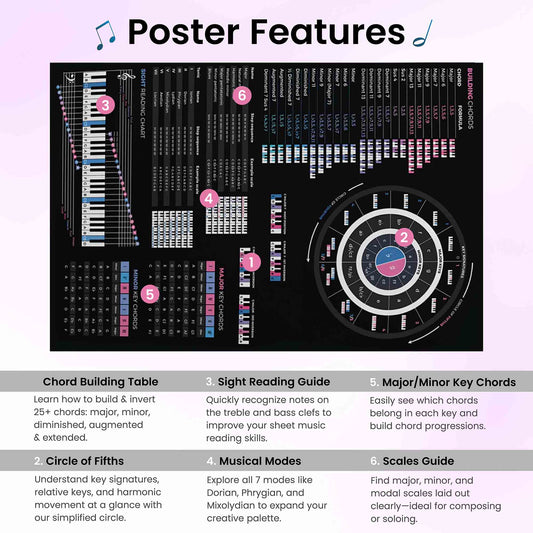
Want the note map and key concepts next to your keyboard while you practice? The Music Theory Cheat Sheet Poster and Cheat Sheet Mousepad keep note names, scales, and chord formulas in view whenever you sit down to play.
Prefer a digital reference for any screen? Grab the Music Theory Cheat Sheet PDF, or get everything together in the Music Theory Bundle.

The keyboard, made obvious.
Music Theory Simplified turns note names, sharps and flats, intervals and scales into diagrams you can play straight from.
FAQs about piano note names
What are the note names on a piano?
The white keys are named with the first seven letters of the alphabet — A, B, C, D, E, F, G — and the pattern repeats across the keyboard. The black keys are named as sharps (♯) or flats (♭) of the neighbouring white keys, giving twelve note names in total.
How do I find C on the piano?
Look for the groups of two black keys. C is always the white key immediately to the left of any group of two black keys. Once you find one C, every other C is directly above or below it in the same position.
Why do black keys have two names?
A black key can be reached by sharpening the white key below it (going up) or flattening the white key above it (going down). So the key between C and D is both C♯ and D♭. These two names describe the same pitch and are called enharmonic equivalents.
Why is there no black key between B and C or E and F?
Because B to C and E to F are already only a half step apart — the smallest distance between two notes. A black key sits between white keys that are a whole step apart, so those two pairs don't need one.
How long does it take to memorize piano note names?
Most beginners can name the white keys reliably within a few short practice sessions, since it's just a repeating seven-letter pattern. Adding the sharps and flats takes a little longer, but daily play-and-say drills make it automatic within a couple of weeks.
This post is part of Musiciangoods' Music Theory Simplified series — practical music theory, taught visually, for musicians who want to understand what they're playing. Explore more music learning tools here.