4.8/5 on Trustpilot

Tap your foot to almost any song and you'll feel it: some beats land harder than others. That push-and-pull between strong and weak beats is what turns a row of evenly spaced clicks into a groove you can move to. Once you can hear it, you'll never un-hear it.
In this guide, we'll break down strong and weak beats the simple way — what they are, where they fall in a bar, why the kick and snare line up with them, and how to train your ear to feel them in real songs. No notation background required.

What are strong and weak beats?
Every piece of music has a steady pulse, like a heartbeat. That pulse is measured in chunks of time called bars (or measures). Inside each bar, the beats aren't all equal — some feel emphasized and driving, and some feel softer and supportive. The emphasized ones are strong beats; the softer ones are weak beats.
Think of a bar as a mini rhythm cycle. It has strong beats that push the rhythm ahead and weaker beats that balance it out. That blend of strong and weak is exactly what makes a rhythm feel like a rhythm instead of a metronome ticking in a vacuum.
How many beats sit in each bar is set by the time signature — the two stacked numbers (like 4/4) at the start of a piece. The top number tells you how many beats are in a bar; the bottom number tells you which note value counts as one beat.
How strong and weak beats work
The most common time signature in Western music is 4/4 — four beats to a bar. In a 4/4 bar, the first and third beats are strong, like a little jump forward, while the second and fourth beats are weak, softer and more relaxed. Counted out loud, it's: one (strong) – two (weak) – three (strong) – four (weak).
You can hear this most clearly in a drum kit. As a general rule, the thumping kick drum lands on the strong beats — 1 and 3 — while the sharp snare drum cracks on the weak beats — 2 and 4. That interplay is the skeleton of nearly every pop, rock, and hip-hop groove you've ever tapped along to.

The pattern changes with the time signature. In 3/4 — waltz time — the strong beat lands on the first beat, and the next two beats are gentler and more subdued. That's the "ONE-two-three, ONE-two-three" sway you feel in a waltz. In 2/4, the first beat is strong and the second is lighter, giving music a quick, marching feel.
This grouping of strong and weak beats is what music theory calls meter. Meter is the recurring pattern of emphasis that a time signature sets up, and it's the reason a 4/4 pop song and a 3/4 waltz feel so different even at the same tempo.

How to hear strong and weak beats (4-step plan)
Feeling the pulse is a skill you build by listening, not memorizing. Here's a simple way to train it.
Step 1 — Count a 4/4 bar out loud
Put on any mainstream pop or rock song and count "1 – 2 – 3 – 4" in a loop, landing "1" on the most obvious downbeat. Say the odd numbers a little louder. You're literally speaking the strong-weak pattern before you try to feel it.
Step 2 — Clap the strong beats, tap the weak ones
Now split the job between your hands. Clap on 1 and 3 (strong), and lightly tap your knee on 2 and 4 (weak). This physically separates the two, so your body learns the difference instead of just your head.
Step 3 — Find the kick and snare
Listen for the deep thump and the sharp crack in the drums. The thump (kick) marks the strong beats; the crack (snare) marks the weak beats. Once you can pick those two sounds out, you've found the strong-weak grid of the whole song.
Step 4 — Switch to a waltz
Play a song in 3/4 time and count "1 – 2 – 3" instead. Notice how only the first beat feels strong now. Bouncing between 4/4 and 3/4 trains your ear to feel where the emphasis is, not just that emphasis exists.
Common mistakes to avoid
- Assuming every beat is equal. A bar isn't four identical ticks — it has a built-in shape of strong and weak. Playing everything at the same weight is what makes rhythm sound flat and robotic.
- Confusing tempo with meter. Tempo (BPM) is how fast the beats go. Strong and weak beats are about which beats are emphasized. A slow song and a fast song can share the same strong-weak pattern.
- Only counting, never feeling. Counting is a scaffold. The goal is to feel the pulse in your body so you can drop the counting and still stay locked in.
- Ignoring the backbeat. In most modern music the snare on beats 2 and 4 (the backbeat) is what makes people nod along. Don't treat the weak beats as unimportant — they carry the groove.
- Forgetting the time signature. Strong and weak beats fall differently in 4/4, 3/4, and 2/4. Always check how many beats are in the bar before you decide where the strong beat lands.
Why strong and weak beats matter
Strong and weak beats are the difference between a pulse and a groove. Once you understand them, three things click into place.
- You can lock in with a band or a backing track, because you know where the emphasis lands and can place your notes with it.
- Your own playing starts to breathe — accenting the strong beats and easing off the weak ones is what makes rhythm feel human instead of mechanical.
- You start hearing structure in every song: the meter, the backbeat, and the way the drums map onto strong and weak beats.
It's a small idea with an outsized payoff. Rhythm, simplified, starts here.
Take it further
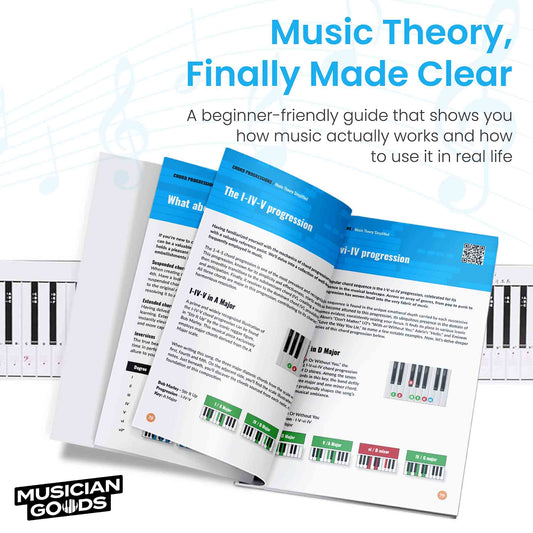
The full guide to rhythm and time — bars, beats, time signatures, meter, and how it all fits together visually — is laid out in Music Theory Simplified. It's the same clear, no-fluff style you're reading now.
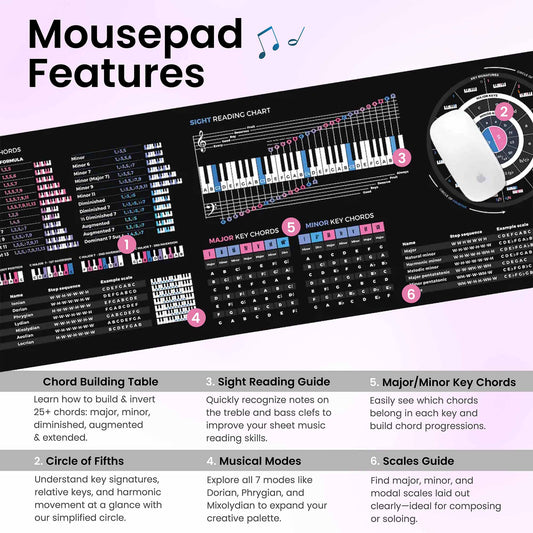
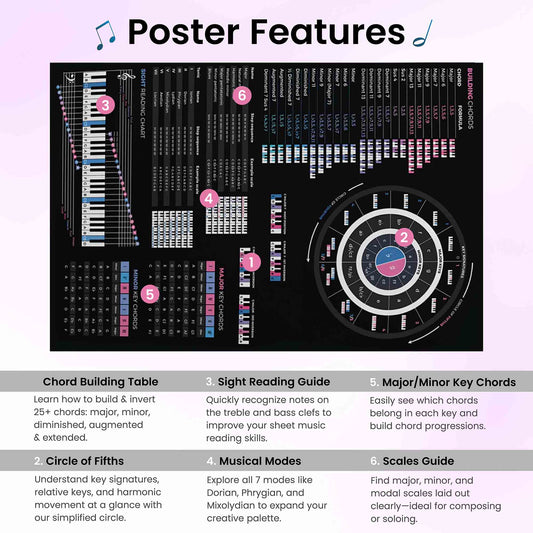
Want the essentials next to you while you play or produce? The Music Theory Cheat Sheet Poster and Cheat Sheet Mousepad keep time signatures, scales, and chord formulas in view whenever you sit down to work.
Prefer a digital reference for any screen? Grab the Music Theory Cheat Sheet PDF, or get everything together in the Music Theory Bundle.

Rhythm, made visual.
Music Theory Simplified turns bars, beats, meter and time signatures into diagrams you can actually play from.
FAQs about strong and weak beats
What are strong and weak beats in music?
Strong beats are the emphasized beats in a bar, often marked by the kick drum and usually falling on the downbeats. Weak beats are the softer, less emphasized beats that fall between them. Together they create the strong-weak pattern (the meter) that gives a rhythm its feel.
Which beats are strong in 4/4 time?
In a 4/4 bar, beats 1 and 3 are strong and beats 2 and 4 are weak. Counted out loud it's "ONE-two-THREE-four." The kick drum typically hits the strong beats and the snare hits the weak beats.
What is the difference between a strong beat and a downbeat?
The downbeat is the first beat of a bar and is always a strong beat. But not every strong beat is the downbeat — in 4/4, beat 3 is also strong even though it isn't the downbeat. "Downbeat" points to a position; "strong beat" points to emphasis.
Why do drummers put the snare on beats 2 and 4?
Placing the snare on the weak beats (2 and 4) creates the backbeat — the sharp accent that makes people nod and dance. It contrasts with the kick on the strong beats, and that contrast is what gives rock, pop, and funk their drive.
Do strong and weak beats change in 3/4 time?
Yes. In 3/4 (waltz time) only the first beat is strong; beats 2 and 3 are weak. That's why a waltz feels like "ONE-two-three, ONE-two-three." The strong-weak pattern always depends on the time signature.
This post is part of Musiciangoods' Music Theory Simplified series — practical music theory, taught visually, for musicians who want to understand what they're playing. Explore more music learning tools here.