4.8/5 on Trustpilot

Piano players get given songbooks. It is the safe default, and it is usually wrong: either the arrangement is too hard, or too easy, or it is music they would never choose, and it goes on the shelf next to the last three.
What pianists actually lack is rarely repertoire. It is the equipment around the instrument, a bench that does not wobble, a pedal that does not slide across the floor, headphones for practising at eleven at night, and a way of understanding the chords they keep playing without knowing why they work.
These ten picks cover that gap, from under €15 to a full weighted-key digital piano. Each one says who it suits and roughly what it costs, so you can choose without knowing whether they play Chopin or chord charts.

Quick comparison
| Gift | Best for | Approx. price |
|---|---|---|
| Keyboard note stickers | First-year players, smallest budget | €8–€15 |
| Adjustable padded bench | Anyone practising on a dining chair | €55–€70 |
| Piano-style sustain pedal | Digital piano owners with the plastic footswitch | €45–€55 |
| Closed-back headphones | Late-night practice in a flat | €90–€110 |
| Combined tuner and metronome | Students working on timing | €35–€45 |
| Z-style keyboard stand | Anyone whose keyboard sits on a table | €110–€130 |
| USB MIDI interface | Older digital pianos with MIDI ports only | €40–€50 |
| Scales and chords poster | Self-taught players with wall space | €20–€30 |
| 88-key weighted digital piano | The serious upgrade gift | €450–€550 |
| Music Theory Simplified | Players who read notes but not chords | €20–€30 |
1. Keyboard note stickers — the best gift under €15

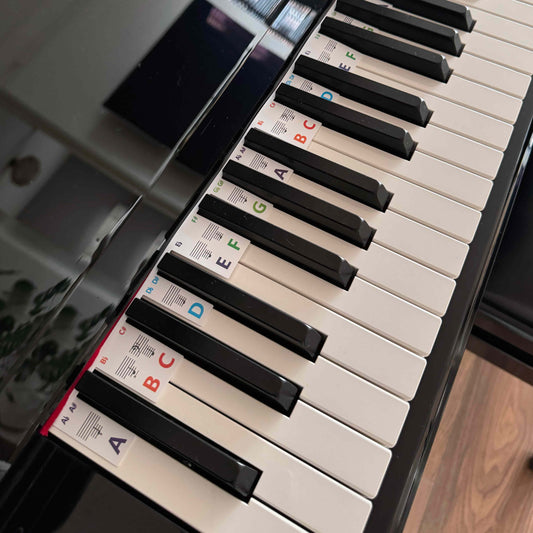
A piano keyboard is 88 keys of the same twelve names repeating, and for a beginner that pattern takes months to internalise. Note stickers put the names on the keys, so the player reads them constantly without setting aside time to memorise anything.
The important detail is that they are removable. These are training wheels: after a few months the player stops looking at them, peels them off, and nothing is left behind on the keys. Under €15, which makes them the natural small extra alongside a larger gift.
Best for: children and adult beginners in their first year, and anyone learning to link written notes to the keyboard.
2. An adjustable padded bench — the upgrade nobody buys themselves

A surprising number of people practise from a dining chair, which sits at the wrong height, tips the pelvis backwards, and puts the forearms at an angle that causes wrist strain within twenty minutes. Height is not a comfort preference at the piano, it determines whether the arm can stay level with the keys.
The On-Stage KT7800+ is the bench most shops sell because it does the job at around €60. Thick padded seat, three height positions, a locking mechanism that stops the X-frame folding under someone, and it collapses flat when the room is needed for something else.
Best for: anyone practising on a kitchen chair, and taller or shorter players who have never had the height right.
3. A piano-style sustain pedal — for digital piano owners

Almost every digital piano ships with a small plastic footswitch that skates across the floor the moment it is pressed. It is on and off with nothing in between, so the player cannot half-pedal, and chasing it under the piano is a running annoyance rather than a one-off one.
The Roland DP-10 has the shape and weight of a real damper pedal, a rubber plate that keeps it still on a wooden floor, and half-damper support on keyboards that read it. Around €50, and it plugs into essentially any digital piano or keyboard with a pedal jack.
Best for: anyone with a digital piano or stage piano, particularly students working on pedalling as a technique rather than a switch.
4. Closed-back headphones — for practising at eleven at night

The main practical advantage of a digital piano is that it can be silent, and most owners waste it because the only headphones in the house are earbuds that fall out or gaming headsets that make everything sound like it is underwater.
The Sony MDR-7506 has been the studio standard for decades at around €99: closed back so nothing leaks into the room, an honest midrange that does not flatter, and a coiled cable long enough to reach the jack without unplugging when someone stands up. It also folds into a bag for lessons.
Best for: flat dwellers, parents of practising children, and anyone whose best practice hour is after everyone else has gone to bed.
5. A combined tuner and metronome — for the timing problem

Nearly every pianist has a metronome app and nearly none of them use it, because reaching for the phone at the start of a practice session is how a practice session turns into twenty minutes of scrolling. A small unit that lives on the music desk removes that step entirely.
The Korg TM-60 is around €40 and does both jobs: a clear metronome with beat accents and subdivisions for practising rhythm, and a chromatic tuner that becomes useful the moment the household acquires a second instrument. There is a headphone output so the click can go into the same headphones as the piano.
Best for: students, exam candidates, and any self-taught player who speeds up whenever a passage gets easier. We compared the alternatives in our guide to metronomes for musicians.
6. A Z-style keyboard stand — for the keyboard living on a table

A keyboard on a desk is almost always too high, and a keyboard on a flimsy X stand shifts under anything played with force. Both problems quietly discourage practice, because the instrument feels temporary rather than like something set up and ready.
A Z stand is the fix: a wide rigid frame rated for far more weight than an 88-key piano, adjustable to a proper playing height, and stable enough to lean on. The On-Stage KS7365-EJ adds a second tier for a laptop or a small synth, and folds down without tools. Around €120.
Best for: anyone with a portable digital piano and no dedicated furniture for it, and gigging players who set up and break down often.
7. A USB MIDI interface — for connecting an older piano to a laptop

Plenty of good digital pianos predate USB and have only five-pin MIDI sockets on the back. Their owners assume the instrument cannot talk to a computer, so they never try the learning software, the notation programs, or the virtual piano sounds that would make the instrument feel new again.
The Roland UM-ONE mk2 is a cable with a small box in the middle that bridges that gap for around €45. Plug the MIDI out into the box, the USB into the laptop, and the piano becomes a controller for anything on the computer. No drivers on modern systems, no power supply.
Best for: owners of a pre-USB digital piano, and anyone curious about recording or notating what they play.
8. A scales and chords poster — for the self-taught player

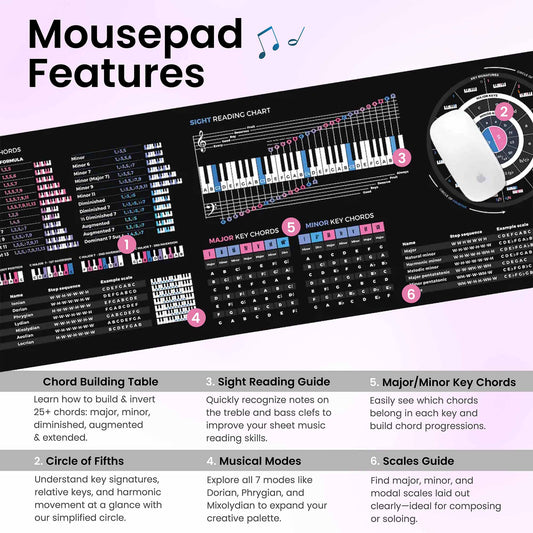
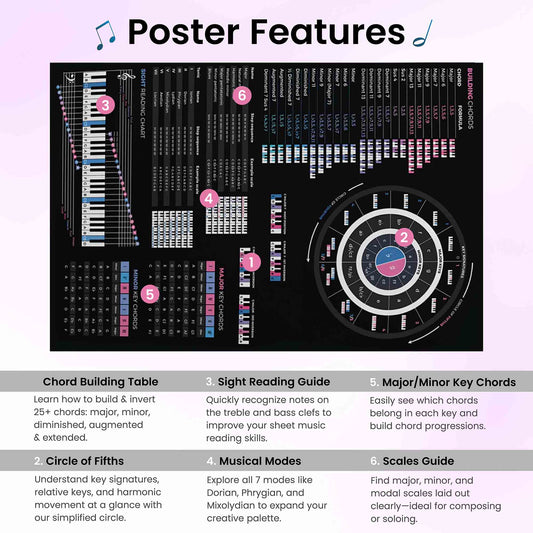
Reference material is only useful where the practising happens. A chart on the wall behind the piano gets read during the two seconds a player spends wondering what the notes of an F sharp minor seventh are, which is precisely when a book on a shelf helps nobody.
Our piano poster maps the scales and the chord shapes across the keyboard on a single sheet, so the player can find a shape by looking up rather than by searching. It also suits the person who insists they need nothing, because a poster does not compete with equipment they already own. Around €25.
Best for: self-taught players, home studios, and anyone who learned to read notes but never learned chord symbols.
9. An 88-key weighted digital piano — the serious upgrade

If the person you are buying for is learning on a 61-key unweighted keyboard, this is the ceiling they will hit within a year. Unweighted keys teach the fingers the wrong amount of effort, and 61 keys run out of range in a lot of standard repertoire, so the player eventually has to relearn things.
The Roland FP-10 at around €500 is the usual answer: 88 fully weighted hammer-action keys, a good piano sound, Bluetooth MIDI, and a footprint small enough for a flat. It is the gift for a serious student or a returning adult player, not for someone still deciding whether they like it.
If you want alternatives at this price and a few cheaper, we ranked six in our guide to beginner piano keyboards, and set expectations on progress in how long it takes to learn piano.
Best for: committed students who have outgrown a small keyboard, and adults returning to the instrument after years away.
10. Music Theory Simplified — for the player who reads notes but not chords

Classically taught pianists often read fluently and still cannot play from a chord chart, improvise a simple accompaniment, or transpose a song into a singer's key. Self-taught pianists usually have the opposite gap: they can play by ear but cannot explain what they are doing or repeat it deliberately.
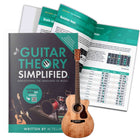
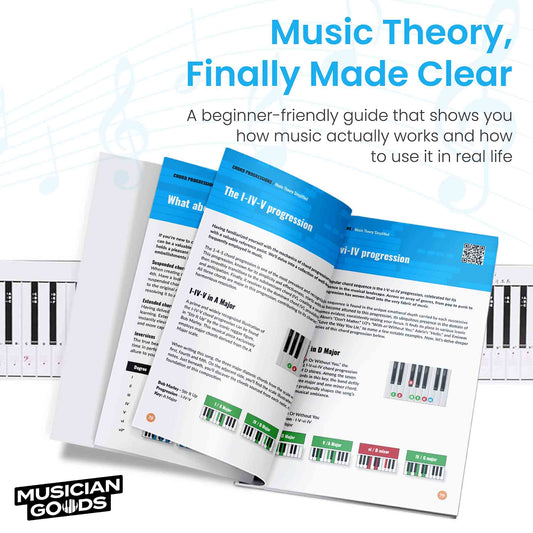
Music Theory Simplified is written for both. It covers intervals, scales, chord construction, inversions, keys, and progressions in plain language, using the keyboard as the reference throughout, because the piano is where theory is easiest to see.
It is the one gift here that keeps working after the novelty fades. A bench is useful for years; understanding why a progression resolves changes how the person plays every piece they touch afterwards. Pair it with the poster and you have a complete present under €55.

View Music Theory Simplified →
How to choose the right gift for a piano player
Work out first whether they play an acoustic piano or a digital one, because it changes half this list. The sustain pedal, the headphones, the MIDI interface and the stand only make sense for a digital instrument. The bench, the metronome, the poster, the stickers and the book suit either.
Then match the price to how settled they are. Under €30 the stickers and the poster are safe for anyone. Between €40 and €120 the bench, pedal, metronome, headphones and stand all fix a specific daily annoyance, which is where the best value in this list sits. Above €400 you are buying an instrument, and that is only right for someone who has already proved they will keep going.
Avoid buying repertoire unless they have named the piece. Sheet music is the most common gift for pianists and the least used, because difficulty level and taste both have to line up, and there is no way to check either from outside without spoiling the surprise.
If the person plays more than one instrument, our broader gifts for musicians guide covers twelve picks across instruments and budgets.
Frequently asked questions
What is a good gift for someone learning piano? Keyboard note stickers and an adjustable bench cover the two things beginners most often lack: a way to learn the key names quickly, and a correct seat height that prevents wrist strain. Together they cost under €75 and both get used from the first week.
What do you buy a pianist who has everything? Something that teaches rather than another object. Even pianists with a full room of equipment often have a specific gap, usually chord theory or improvisation, so a clear book on how harmony works gives them something new when gear cannot.
Is sheet music a good gift for a piano player? Usually not, unless they have named the piece. The arrangement has to match their level and their taste at the same time, and a book that is one grade too hard is more discouraging than no gift at all.
How much should you spend on a gift for a piano player? The picks here that get used every day sit between €15 and €120. Spending above €400 only makes sense for the digital piano, and only when the person has been practising consistently for at least a year on something smaller.
What is a good gift for a piano teacher? A combined tuner and metronome, or a scales and chords poster for the teaching room. Both are used across every lesson rather than for one student, which is what separates a good teacher gift from a good student gift.
What is the best last-minute gift for a pianist? A printable piano chords or scales chart PDF arrives instantly and still gives them something to use that evening. It is also the only item here with no size, colour, or model to get wrong.
Written by Melvin Tellier, founder of Musiciangoods. Musiciangoods publishes plain-language theory books, cheat sheets, and practice tools for self-taught musicians, including Music Theory Simplified. We do not sell pianos or accessories, and we earn nothing from the equipment recommended above.