4.8/5 on Trustpilot

The first month decides whether you keep playing. Most people who give up on piano do not give up because it is too difficult — they give up because they spent four weeks on exercises that never turned into a song. A first month built the other way round, around real music from day one, is far more likely to survive contact with a busy life.
This is a thirty-day plan for adult beginners starting from zero. It assumes twenty minutes a day, no teacher, and no previous experience. By the end of it you will know the keyboard layout, play four chords cleanly, and be able to accompany a genuine song.

What you actually need to start learning piano
Less than most people assume. The three things that matter:
- A keyboard with at least 61 keys. Weighted keys are nicer but not required to begin. Sixty-one keys is enough for everything in your first year; 88 becomes worthwhile once you play pieces that use both extremes of the range.
- Somewhere it can stay set up. This is the single biggest predictor of whether beginners keep going. An instrument that has to be unpacked gets played about a third as often as one that is always out.
- Twenty minutes, most days. Frequency beats duration by a wide margin. Twenty minutes six days a week will take you much further than two hours on a Sunday.
You do not need a teacher to start, though one accelerates things considerably around month three. You do not need to read sheet music. You do not need to buy a method book before you have touched the keys.
How the keyboard works
A full piano has 88 keys but only twelve unique notes. That group of twelve repeats along the whole keyboard, rising in pitch as you move right. Once you can see the repeat, the instrument stops looking like a wall of identical keys.
The black keys are the landmark. They come in alternating groups of two and three. Find any group of two black keys: the white key immediately to its left is C. That is the only piece of navigation you have to memorise. Every other white key follows the alphabet from there — C, D, E, F, G, A, B, and then back to C.

The black keys themselves take their names from the white keys beside them. The black key between C and D is C♯ if you are thinking of it as a raised C, or D♭ if you are thinking of it as a lowered D. Same key, two names, depending on context.
Two pairs of white keys have no black key between them: E and F, and B and C. This is not a mistake in the design — it is what gives the major scale its particular sound, and it is worth noticing early because it explains a lot later on.
Why chords come before scales
Traditional piano teaching starts with scales and finger exercises. For a self-taught adult who wants to play songs, that ordering is backwards. Chords produce recognisable music within days; scales take weeks before they sound like anything.
A chord is three or more notes played together. The basic one is a triad: play a note, skip the next white key, play the one after, skip again, play the next. Starting on C that gives you C – E – G, which is a C major chord. Your first real piano skill is placing those three fingers reliably.
Your first 30 days: a four-step plan
Step 1 — Days 1 to 5: learn the layout
Find every C on your keyboard. Then play the C major scale with your right hand, one white key at a time, saying each note name aloud: C, D, E, F, G, A, B, C. Use the standard fingering — thumb on C, index on D, middle on E, then tuck your thumb under to F and carry on with index, middle, ring.
Do this for five minutes, then spend the rest of the session just finding named notes at random. "Where is F? Where is A?" Speed comes later; accuracy first.
Step 2 — Days 6 to 14: four chords
Learn C major (C-E-G), G major (G-B-D), A minor (A-C-E) and F major (F-A-C). These four chords are the harmonic core of an enormous share of pop music.
Play each one until your hand finds it without you looking. Then practise moving between them, slowly, in this order: C – G – Am – F. Do not worry about rhythm or tempo yet. The only goal is landing all three notes at once, cleanly.
By day fourteen you should be able to loop those four chords continuously. That loop is already the accompaniment to hundreds of songs.
Step 3 — Days 15 to 22: add the left hand
Your left hand plays the root note — the note the chord is named after. On a C chord, play a low C. On G, a low G. On A minor, a low A. On F, a low F.
Right hand holds the chord, left hand plays the single low note underneath. This is how most modern pop piano is actually played, and it sounds substantially fuller than the right hand alone. Keep the same C – G – Am – F loop and add the bass note to each change.
Step 4 — Days 23 to 30: play a real song
Find a song that uses your four chords — there are thousands — and play along with the recording. Pick something at a slow tempo the first time. Playing in time with a record is a different skill from playing alone, and it is the one that makes everything feel worthwhile.
Finish the month by learning the numbering. In the key of C, the chord C is 1, F is 4, G is 5 and Am is 6. The loop you have been playing is 1-5-6-4. Once you think in numbers rather than letters, you can move that same progression into any key.

Common mistakes to avoid
- Starting with sheet music. Reading notation and playing piano are two skills. Trying to acquire both in week one usually means acquiring neither. Learn to play first.
- Practising only scales. Scales are worth doing, but a beginner who practises nothing else will quit before hearing any music. Aim for roughly a quarter of your session on technique and the rest on songs.
- Long, infrequent sessions. Ninety minutes on Saturday is worse than fifteen minutes daily. Motor learning consolidates between sessions, so the number of sessions is what counts.
- Buying an 88-key weighted piano before you know you will stick with it. A modest 61-key keyboard is entirely sufficient for the first year. Upgrade once playing is a habit rather than an intention.
- Comparing yourself to children who started at six. Adults learn differently — slower motor acquisition, much faster conceptual understanding. You will grasp why chords work far quicker than a child will. Use that advantage instead of fighting it.
Why the first month matters more than the next six
The dropout rate for self-taught adult beginners is concentrated almost entirely in the first eight weeks. After that point, most people who are still playing keep playing.
What gets people through those weeks is not talent or practice volume. It is hearing recognisable music early enough that the effort feels connected to a reward. This is why the plan above front-loads chords and delays scales, and why day thirty ends with a song rather than an exercise.
It also matters that you understand what you are doing rather than copying finger positions. A beginner who knows that C-E-G is a triad built by skipping scale notes can work out D minor without being taught it. A beginner who has only memorised hand shapes has to be taught every chord individually — and there are a lot of chords.

The next thirty days, and the thirty after that.
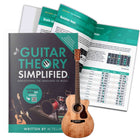
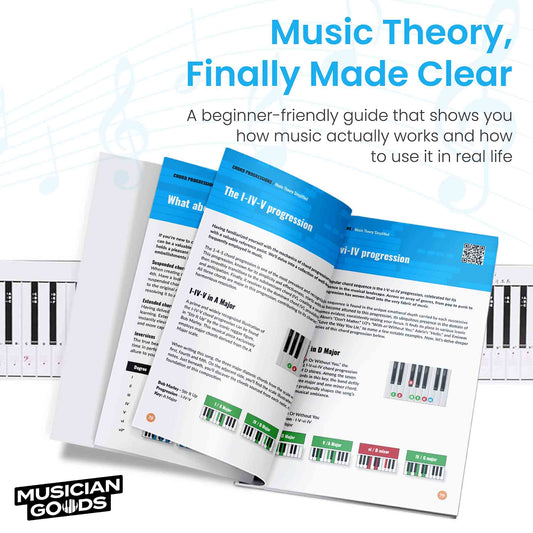
Music Theory Simplified takes the keyboard layout and the four chords you just learned and shows you where they came from — in diagrams, not dense text.
Take it further
Once the four chords are comfortable, the natural next step is understanding where they came from. Music Theory Simplified covers the keyboard fundamentals, keys and scales, every chord formula, chord progressions and the circle of fifths — written for self-taught players and built around diagrams rather than dense text.
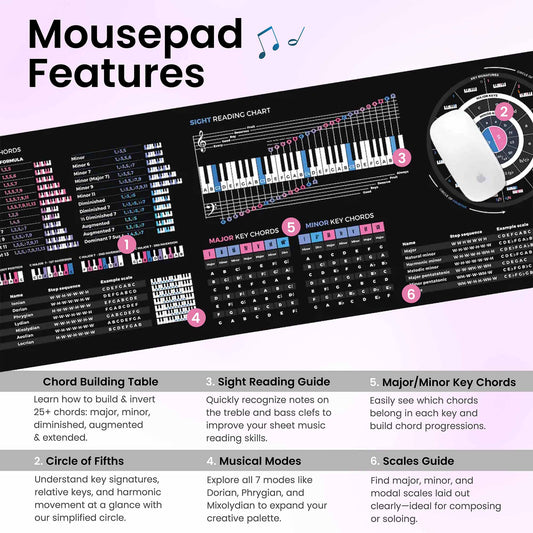
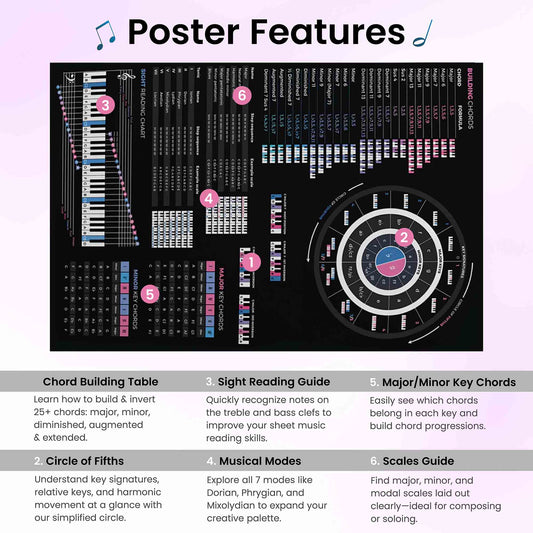
To keep the reference material in front of you while you play, the Music Theory Cheat Sheet Poster and the Music Theory Cheat Sheet Mousepad put the scales, chord formulas and key signatures where you can see them without opening a book.
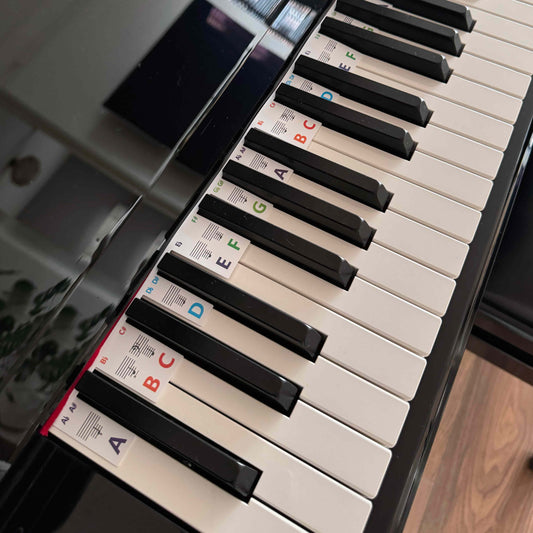
If you are still hunting for note names, the Piano Removable Keyboard Note Stickers label the keys and peel off cleanly once you no longer need them — usually somewhere around week three. Or take the book and cheat sheet together in the Music Theory Simplified Bundle.
Related reading: how long it takes to learn piano, the best beginner piano keyboards, and is it too late to learn an instrument as an adult?
FAQs about starting piano
Can I teach myself piano as an adult?
Yes, and a large share of adult players do. Self-teaching works well for the first six to twelve months, particularly for chord-based playing. A teacher becomes more valuable once you are working on technique, where an outside ear catches habits you cannot see.
How many keys do I need on my first keyboard?
Sixty-one is the practical minimum and is enough for everything in this article and well beyond. Seventy-six or eighty-eight keys matter once you play classical repertoire or pieces that use the full range. Weighted keys are worth having if the budget stretches, because they build finger strength that transfers to an acoustic piano.
Should I learn to read sheet music straight away?
Not in the first month. Notation is a separate skill and adding it to week one slows down the part that keeps you motivated — playing something recognisable. Most self-taught players pick up reading around month four to six, once playing itself is a habit.
How long until I can play a song?
With the plan above, roughly three to four weeks for a simple four-chord song at a slow tempo. Playing it smoothly and in time with a recording usually takes another two to three weeks on top.
Is piano harder to learn than guitar?
Piano is easier to start and harder to master. Producing a clean note is trivial on a keyboard and genuinely difficult on a guitar, so the first weeks are gentler. Later on, coordinating two hands playing different things is a bigger challenge than anything in beginner guitar.
This post is part of the Musiciangoods Simplified series — practical music theory, taught visually, for musicians who want to understand what they are playing. Explore more music learning tools here.