

Mixing vs Mastering, Simplified: What's the Difference?
Mixing and mastering are two different stages with two different jobs. Here's what each one does, how they differ, and...
Lire la suite Livraison suivie vers Norvège · Délais de livraison
 4,5/5 sur Trustpilot
Vous possédez un compte ?
Connectez-vous pour payer plus vite.
The MusicianGoods Journal
Practical lessons, gear guides and theory made simple.
Every great mix balances three dimensions: tone, dynamics, and space. Here's what each one is, which tools shape it, and how to balance all three for a clear, immersive mix.
Lire l’article


Mixing and mastering are two different stages with two different jobs. Here's what each one does, how they differ, and...
Lire la suite
Headroom is the space between your loudest peak and 0 dBFS. Here's what it is, why it decides whether your...
Lire la suite
A reference track is a pro song dropped into your session as an honest measuring stick. Here's why it beats...
Lire la suite
Track stacks group related instruments so you can control a whole drum kit or synth layer with one fader. Here's...
Lire la suite
Phase is a timing issue; polarity is an orientation issue. Here's the real difference, why multi-mic recordings turn thin, and...
Lire la suite
Gain staging is the simplest, most overlooked mixing step. Here's what it is, why it comes first, and a step-by-step...
Lire la suite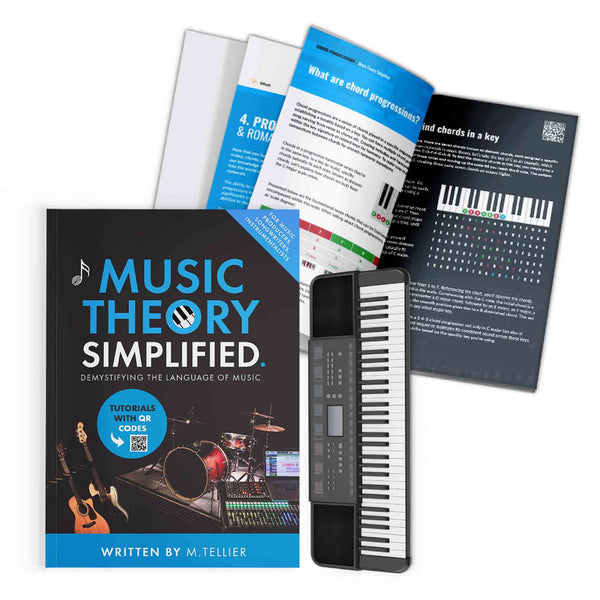

Reverb blends, delay defines. Here's the real difference between delay and reverb in mixing, the four delay types, the settings...
Lire la suite
A panning chart maps where every instrument belongs in the stereo field — center, mid, or wide. Here's how to...
Lire la suite
Reverb has only four controls that truly matter — pre-delay, decay, wet/dry, and diffusion. Here's what each one does, the...
Lire la suite
A compressor is an automatic volume control that evens out the loud and quiet parts of a track. Here's what...
Lire la suiteComplementary EQ gives each instrument its own frequency lane by boosting one where you cut the other. Here's how it...
Lire la suitePick your instrument — each has a complete learning system.
 Tableau des accords de guitare (fichier PDF)
 Théorie de la guitare simplifiée (Broché/PDF)
 Tapis de souris aide-mémoire théorie guitare basse
 Théorie de la Basse Simplifiée (Broché/PDF)
 Théorie de la musique simplifiée - (Broché/PDF)
 Tapis de souris "Cheat Sheet" de théorie musicale
 Théorie du ukulélé simplifiée (Broché/PDF)
 Tapis de souris avec fiche mémo de théorie pour ukulélé
 Tapis de souris aide-mémoire de théorie de la guitare
 Tapis de souris aide-mémoire mixage et mastering


