 4.8/5 on Trustpilot
You've cut the muddy frequencies and your vocal still isn't sitting right over the guitars. The missing technique is complementary EQ — instead of only cutting, you give each instrument its own frequency "lane" by boosting one where you cut the other. It's how professional mixes get two instruments to coexist without either one disappearing.
In this guide we'll explain what complementary EQ is, how it works using a real vocal-and-guitar example, when arrangement beats EQ entirely, and the core EQ guidelines that keep your mixes clean.

What is complementary EQ?
Complementary EQ is the technique of balancing two instruments so they don't compete in the same frequency space. Instead of only cutting or only boosting one track, you shape both together — cutting or boosting one instrument in one range while boosting the other in a different range. The result is that both instruments stay present without masking each other.
The key idea is that two sounds can share a mix peacefully if they each "own" a different part of the spectrum. Rather than fighting over the same frequencies, you assign each one its own lane. Where one instrument steps back, the other steps forward, and vice versa.
How complementary EQ works
The classic example is vocals and rhythm guitars, which both crowd the midrange. Here's how you give each its own space:
- The guitars get a boost in the low-mids (around 400 Hz–1 kHz) to add body and fullness.
- The vocals get a slight cut in that same lower range (around 300–400 Hz) and a boost in the upper-mids (around 2–3 kHz), where the words and presence of the voice live.
Shaped this way, the guitars provide warmth and weight while the vocals stay clear and intelligible on top. Each instrument gets its own spotlight in the mix without clashing — the boost in one is mirrored by a cut in the other, so they interlock rather than overlap.

When arrangement beats EQ
EQ isn't always the best solution. Sometimes the simplest way to fix a clash is to change the arrangement itself. If several instruments crowd the same frequency range, even perfect EQ won't stop the mix from sounding muddy.
Take a piano playing full chords that include low root notes. Those roots fill up the low end and clash with the bass and kick. Remove the root notes from the piano part and the chords still sound full, but the mix gets cleaner because the bass now has space to breathe. A few arrangement tweaks can clear up masking more effectively than any plugin. You can also:
- Simplify the rhythm by reducing how many notes are played.
- Move notes up or down an octave to avoid overlapping with other instruments.
- Use shorter note lengths so parts don't blur together.
The core EQ guidelines
Complementary EQ works best inside a set of sensible habits. These guidelines keep your moves clean and your mixes natural.
Step 1 — Cut before you boost
When something sounds muddy, harsh, or boxy, remove the problem before adding anything. Cutting the offending frequency is usually more transparent than boosting around it. A gentle dip around 200 Hz, for example, can clean up mud without touching the highs.
Step 2 — Make small moves
Subtle adjustments are almost always enough. A 1–3 dB cut or boost may not look like much, but it dramatically changes how an instrument sits. Big boosts of 5 dB or more often sound unnatural and create new problems elsewhere.
Step 3 — EQ in context
Never finalise EQ decisions while soloing a track. Something that sounds dull or thin alone may be perfect once blended. Always adjust while listening to the full mix — the goal is balance across the whole track, not making each instrument sound "perfect" in isolation.
Step 4 — Use high-pass and low-pass wisely
Roll off unnecessary sub-bass on most instruments (vocals, guitars, synths) to keep the low end clean, leaving the deepest frequencies for kick and bass. Likewise, trimming ultra-high "air" from bass and guitars clears clutter and makes room for vocals and cymbals to shine. And don't EQ everything — if a sound already sits well, leave it alone.
Common mistakes to avoid
- Only boosting, never cutting. Boosting both instruments where they clash just makes the clash louder. Complementary EQ relies on one track giving up space so the other can take it.
- Big, dramatic moves. Boosts of 5 dB or more sound unnatural and cause new problems. Keep adjustments in the 1–3 dB range.
- Reaching for EQ first. Sometimes an arrangement change — removing a root note or thinning a part — solves the clash better than any EQ curve.
- EQing in solo. Decisions made on a soloed track rarely translate to the mix. Always judge in context with everything playing.
- Over-processing. Not every track needs EQ. Over-shaping robs instruments of character and makes the mix sterile. Sometimes volume or panning is the better tool.
Why complementary EQ matters
Complementary EQ is what lets a busy arrangement still sound clear. Mastering it gives you:
- Two or more instruments coexisting in the same range without either disappearing.
- A more professional, intentional sound — every element has a defined place rather than competing for the same one.
- A mindset shift from "fix this one track" to "balance the whole mix," which is how experienced engineers think.
Take it further
Complementary EQ is one part of the full EQ and frequency chapter — masking and frequency clashes, subtractive vs additive EQ, filter types, EQ problem areas, and the frequency spectrum chart — all covered visually in Mixing & Mastering Simplified.
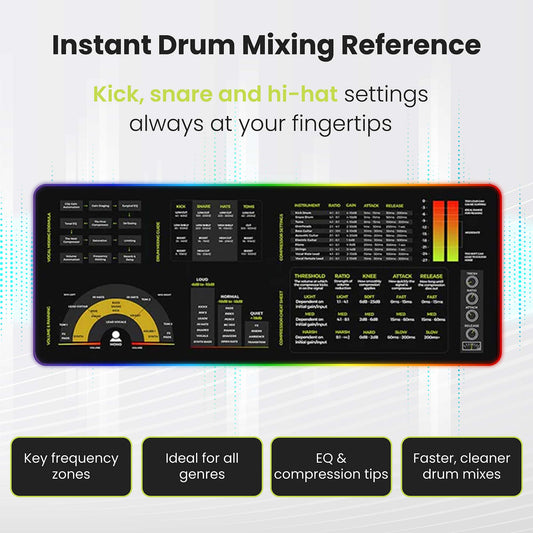
Want a printed reference for EQ targets while you mix? The Mixing & Mastering Cheat Sheet Poster and Cheat Sheet Mousepad keep frequency guidelines and effect settings at your desk.
To see exactly which range each instrument occupies, the Instrument Frequency Cheat Sheet Poster maps every instrument's frequency lane — or grab everything together in the Complete Mixing & Mastering Bundle.
FAQs about complementary EQ
What is complementary EQ?
Complementary EQ is a technique where you balance two instruments by boosting one in a frequency range while cutting the other in that same range, so each gets its own space. It stops instruments from masking each other and keeps both clear in the mix.
How is complementary EQ different from normal EQ?
Normal EQ shapes one track on its own. Complementary EQ shapes two tracks in relation to each other — where one is boosted, the other is cut — so they interlock instead of competing. It's about the relationship between sounds, not just one sound's tone.
What's a good example of complementary EQ?
Vocals and rhythm guitars. Boost the guitars in the low-mids (around 400 Hz–1 kHz) for body, and cut the vocals slightly there while boosting them in the upper-mids (around 2–3 kHz) for clarity. The guitars add warmth, the vocals stay intelligible on top.
Is complementary EQ always the best fix?
No. Sometimes changing the arrangement — removing overlapping root notes, simplifying a part, or shifting an octave — clears up a clash better than EQ. EQ is one tool; arrangement, volume, and panning are others.
How much should I boost or cut with complementary EQ?
Keep it subtle. Moves of 1–3 dB are usually enough to create separation. Large boosts of 5 dB or more tend to sound unnatural and create new problems, so favour small, intentional adjustments made while listening to the full mix.
This post is part of Musiciangoods' Mixing & Mastering Simplified series — practical production knowledge, taught visually, for producers who want to understand what they're hearing. Explore more mixing and mastering tools here.







 Mousepad con la tabella degli accordi di chitarra
 Mousepad Cheat Sheet della teoria della chitarra
 Foglio di riferimento rapido per missaggio e mastering Mousepad


