 4.8/5 on Trustpilot
Ear training is the skill that separates players who can only read music from players who can hear it. Learn to recognise intervals, chords and progressions by ear and you can transcribe a song, improvise with intent, and tune your own playing without a screen.
The good news is that ear training suits an app better than almost any other musical skill. Short daily drills, instant feedback and steady progress tracking are exactly what a phone does well. This guide ranks six ear training apps worth your time in 2026, with a clear pick for each kind of learner.
Quick comparison
| App | Platform | Best for | Free tier |
|---|---|---|---|
| Functional Ear Trainer | iOS, Android | Relative pitch from scratch | Yes |
| EarMaster | iOS, desktop | A full structured course | Trial |
| Tenuto | iOS, web | Theory plus ear training | Web free |
| Perfect Ear | iOS, Android | Best free all-rounder | Yes |
| Complete Ear Trainer | iOS, Android | Gamified daily progress | Yes |
| Teoria | Web | Free browser practice | Yes |
What ear training actually improves
It helps to know what you are buying before you pick an app. Ear training is not one skill but a cluster of related ones, and the apps below emphasise different parts of it.
The core is interval recognition, hearing the distance between two notes and naming it. Build on that and you reach chord quality recognition, telling a major chord from a minor or a dominant seventh by sound alone. Higher still sits progression and functional hearing, following how chords move and resolve within a key, which is what lets you play along with a song you have never seen written down.
Rhythm is the other half, often neglected. Being able to hear a rhythmic figure and clap or play it back is as much a part of a trained ear as pitch, and a couple of the apps here grade it directly.
Knowing which of these you most need points you straight to the right pick, so keep your own weak spot in mind as you read.
1. Functional Ear Trainer — best for relative pitch from scratch

Functional Ear Trainer teaches the single most useful ear skill first: hearing a note in relation to its key rather than in isolation. It plays a chord to establish a key, then asks you to identify a note by its function, which is how working musicians actually hear.
That approach builds relative pitch, the ability to recognise how notes relate to a tonal centre. It is more practical than chasing perfect pitch and it transfers directly to transcribing songs and improvising.
The app is free with a clean, no-nonsense interface, and it eases you in with early levels that use only a few scale degrees. For a complete beginner who wants the highest-value skill first, this is the place to start.
2. EarMaster — best for a full structured course

EarMaster is the closest thing to a formal ear training curriculum on a screen. It is used in music schools and conservatories, and its lessons progress through intervals, chords, scales, rhythm imitation and melodic dictation in a deliberate order.
A standout feature is rhythm training that listens to you clap or tap back a pattern through the microphone, closing the loop between hearing and performing. Few apps grade your output rather than just your recognition.
It runs on iOS and desktop and works from a free trial into a paid licence. For a serious student, a music major, or a teacher wanting a syllabus to assign, EarMaster offers more depth than anything else here.
3. Tenuto — best for theory and ear training together

Tenuto comes from musictheory.net, and it blends ear training with the written theory that underpins it. Alongside interval and chord ear exercises you get staff identification, keyboard and fretboard drills, and note-reading practice in one app.
That combination is its strength. Recognising a minor sixth by ear means more when you can also spot it on the staff and find it on your instrument, and Tenuto keeps those skills side by side rather than siloed.
The companion website is free to use in a browser, while the iOS app is a small one-off purchase. For a learner who wants ears and theory to grow together, Tenuto is the most joined-up option on this list.
4. Perfect Ear — best free all-rounder

Perfect Ear packs a remarkable amount into a free app. Interval, chord, scale and rhythm exercises sit alongside short theory lessons and a customisable practice mode, and it runs on both iOS and Android.
The flexibility is what wins users over. You can narrow drills to the exact intervals or chord types you struggle with, set your own difficulty, and track a daily streak that keeps the habit going.
A subscription removes ads and unlocks extras, but the free tier alone is enough to make real progress. For most players who just want a capable trainer without spending anything, Perfect Ear is the pragmatic choice.
5. Complete Ear Trainer — best for gamified daily progress

Complete Ear Trainer turns ear training into a game you want to return to. Its 300-plus levels unlock in sequence, each one a short, self-contained challenge, so progress feels like clearing stages rather than grinding drills.
The structure is genuinely motivating for learners who lose steam with open-ended practice. Because every level is bite-sized, it fits into a commute or a coffee break, and the difficulty ramps gently enough to keep you in the sweet spot between bored and overwhelmed.
It is free to begin, with a purchase to unlock the full ladder of levels, and it runs on iOS and Android. If motivation is your real obstacle, the game framing here does more than another feature list would.
6. Teoria — best free browser practice

Teoria is a long-running music education website with a deep set of free ear training exercises that run in any browser. There is nothing to install, which makes it ideal for practising at a desktop or on a school computer.
The exercises cover intervals, chords, scales and harmonic progressions, and they connect to a large library of written theory tutorials on the same site. It is plain in appearance but thorough in content.
Because it is browser-based it is less suited to quick phone sessions than the native apps above, but the price is zero and the coverage is wide. For a learner at a computer who wants free, no-signup practice, Teoria is hard to beat.
How to choose the right ear training app
Begin with the skill you most need. If you cannot yet name notes within a key, start with Functional Ear Trainer and its relative-pitch approach before anything else. That foundation makes every later exercise easier.
Then match the app to your motivation and setting. If you thrive on structure, EarMaster gives you a course; if you need a game to keep going, Complete Ear Trainer supplies one; if you practise at a computer, Teoria or the Tenuto website cost nothing.
Above all, favour short and daily over long and occasional. Ten focused minutes a day will train your ear faster than a rare hour-long session, and every app here is built to reward that rhythm.
One thing no app fully teaches is why the sounds work the way they do. Understanding intervals, chord construction and how progressions resolve gives your ear a framework to hang each sound on, which is why ear training and music theory reinforce each other so strongly.
How to build a daily ear training habit
The best app is the one you open every day, so the habit matters more than the feature list. A few small choices make it stick.
Anchor the practice to something you already do. Ten minutes with an interval drill during a morning coffee or a commute is easier to keep than a vague plan to train later, because the trigger is already in your routine. Most of these apps are built for exactly these short sessions.
Keep the difficulty honest. If you are scoring near perfect, the drills are too easy and you have stopped learning; if you are missing most of them, narrow the range until you are getting roughly three in four right. That band, challenging but achievable, is where an ear improves fastest.
Connect it to real music. After a drill, try to name an interval in a song you like or work out a simple melody by ear on your instrument. Transferring the skill out of the app is what turns quiz accuracy into genuine musicianship, and it keeps the practice feeling worthwhile.
Frequently asked questions
Can an app really train my ear, or do I need a teacher?
An app can take you a long way with interval, chord and progression recognition, which are well suited to drill-and-feedback practice. A teacher adds context, corrects habits and applies the skill to your instrument, so the two work best together rather than as substitutes.
How long does ear training take to show results?
With ten to fifteen focused minutes a day, most learners start recognising common intervals and basic chords within a few weeks. Deeper skills like transcribing full progressions take months of consistent practice, so treat it as a long habit, not a quick fix.
Should I train for perfect pitch or relative pitch?
Relative pitch, which is hearing how notes relate to each other and to a key. It is the skill working musicians use to transcribe, improvise and play by ear, and unlike perfect pitch it can be reliably developed at any age.
Are free ear training apps good enough?
For most players, yes. Functional Ear Trainer, Perfect Ear and Teoria are free and cover the core skills thoroughly. Paid apps mainly add structured courses, progress depth and ad-free practice, which matter more for serious students than for casual learners.
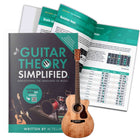
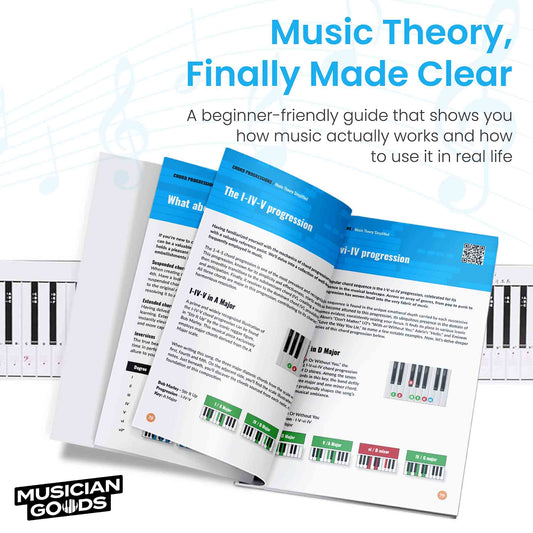
Ear training works fastest when you understand the theory behind the sounds. Music Theory Simplified explains intervals, chords and progressions in plain language, giving your ear a map to follow so recognition turns into real musical understanding.

View Music Theory Simplified →
Written by Melvin Tellier, founder of Musiciangoods. Melvin builds plain-language music education tools for self-taught players and has spent years turning the concepts behind ear training and theory into resources that make sense away from the classroom.


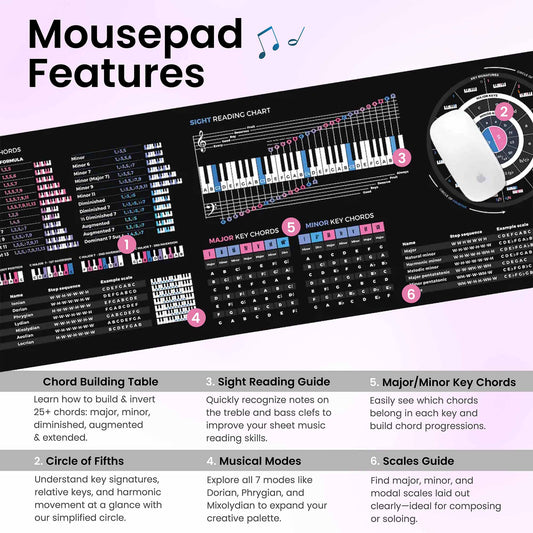

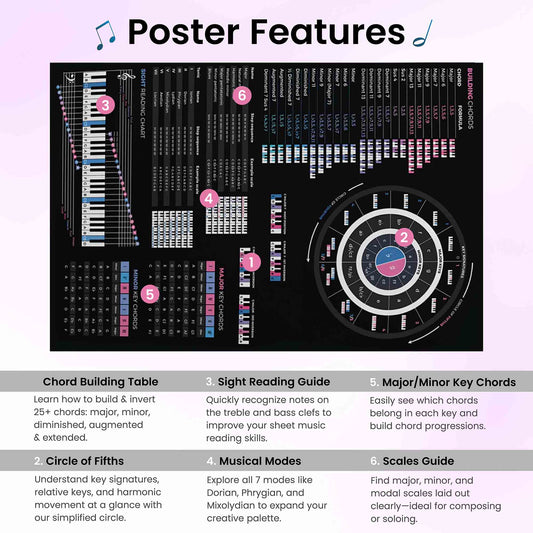



 Mousepad con la tabella degli accordi di chitarra
 Mousepad Cheat Sheet della teoria della chitarra
 Foglio di riferimento rapido per missaggio e mastering Mousepad


