4.8/5 on Trustpilot

Every chord, every melody, every harmony you've ever loved is built from one basic idea: the distance between two notes. That distance is an interval. Understand intervals and the rest of music theory stops feeling like a list of rules and starts making sense.
In this guide we'll explain what music intervals are, the difference between harmonic and melodic intervals, how intervals are named by number and quality, and how you can train your ear to recognize them using songs you already know.

What is a music interval?
A music interval is the distance between two notes or pitches, measured in semitones (half steps). Intervals are the essential building blocks of music — they define how notes relate to each other in scales, chords, and melodies, and the specific intervals between notes are what determine the quality and character of a chord.
When two pitches are identical, the interval is called a unison; played on the same correctly-tuned instrument, they can sound like a single note. As the distance grows, the intervals get names — second, third, fourth, and so on — each with its own sound and feel. Intervals also train your ear: they teach you to recognize the feeling of sounds, which is the foundation of everything from writing melodies to hearing chord changes.
Harmonic vs. melodic intervals
Every interval can be heard in one of two ways, and the distinction matters.
A harmonic interval is two notes played at the same time — like two voices singing different notes at once. Harmonic intervals are how we build chords and harmonies, giving music its rich, layered sound. Play C and E together and you're hearing a harmonic interval (a major third).
A melodic interval is two notes played one after the other, in sequence — like a melody moving from one note to the next. Melodic intervals are how we construct tunes, the catchy, memorable lines of a song. Play C, then E, and you've played the same interval melodically.
Here's the key idea: if you play C-E-G all together you get a C major chord (harmonic intervals stacked up). Play those same three notes one after another and you get a simple melody in the key of C. Same notes, same intervals — the only difference is whether they sound together or in sequence.
How intervals are named: number and quality
Every interval has two parts to its name: a number and a quality.
The number measures how many letter names the interval spans, counting both notes. C to E spans C, D, E — three letter names — so it's a "third." C to F spans four letter names, so it's a "fourth." The number tells you the interval's size on the staff.
The quality refines that size into an exact distance and gives the interval its character. Qualities fall into two families:
- Perfect intervals — unisons, fourths, fifths, and octaves. These have a stable, resolved sound and don't come in major or minor versions. They keep their natural, sharp, or flat form (with a few specific exceptions, like B to F).
- Major and minor intervals — seconds, thirds, sixths, and sevenths. These can be either major or minor, and that choice creates different moods. Major intervals tend to sound bright; minor ones sound darker or more emotional.

The two families play different roles. Perfect intervals provide stability and a sense of resolution. Major and minor intervals contribute the expressive, emotional side of melody and harmony. Knowing which is which lets you describe exactly what you're hearing.
Consonance and dissonance
Intervals also fall on a spectrum from consonant (stable, pleasant) to dissonant (tense, unresolved). Thirds, fifths, sixths, and the octave tend to sound consonant — restful and easy on the ear. Seconds, the tritone, and sevenths tend to sound dissonant — they create tension that wants to resolve. Neither is "good" or "bad": composers use dissonance to build tension and consonance to release it, and that push-and-pull is a big part of what makes music move.
How to train your ear to hear intervals (4-step plan)
Step 1 — Link each interval to a familiar song
The fastest way to recognize intervals is to anchor them to songs you already know. "Amazing Grace" opens with a perfect fourth. The Star Wars main theme also opens on a perfect fourth. The Simpsons theme starts with a tritone. Once an interval is tied to a tune, you'll recognize it instantly when you hear it again.
Step 2 — Play them on the piano, both ways
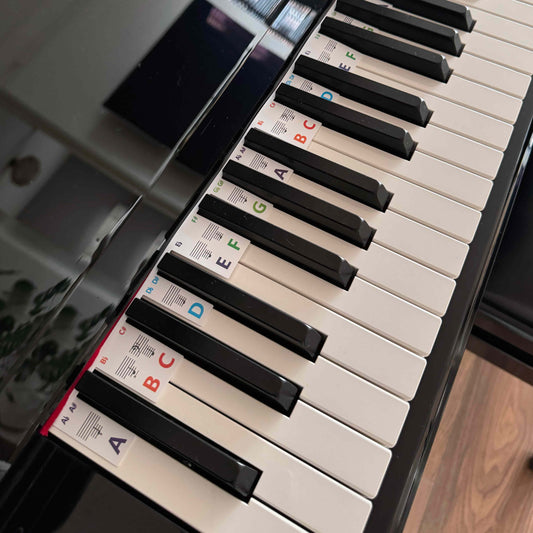
Sit at the keyboard and play each interval harmonically (together) and then melodically (one after the other). Hearing the same interval both ways deepens your understanding of how it functions in chords versus melodies.
Step 3 — Sort them by feeling
As you play, notice whether each interval sounds consonant and restful or dissonant and tense. Grouping intervals by their emotional feel — not just their names — is what makes them useful when you're actually writing music.
Step 4 — Use intervals to build melodies and harmonies
Put them to work. Harmonize a melody by adding a note a major or minor interval above or below it. Write a melody that leans on bright major intervals for a joyful feel, or minor intervals for something more melancholic. Experimenting is how intervals move from theory into your own sound.
Common mistakes to avoid
- Only counting notes, not steps. The number (third, fourth) tells you letter-name distance, but the quality (major, minor, perfect) tells you the exact sound. You need both to name an interval correctly.
- Trying to give perfect intervals a "major" or "minor" label. Fourths, fifths, unisons, and octaves are perfect — they don't come in major or minor versions.
- Memorizing names without listening. Intervals are an ear skill. If you can name a major third on paper but can't hear one, you've only done half the work.
- Ignoring melodic vs. harmonic context. The same interval behaves differently in a chord than in a melody. Practice hearing both.
- Treating dissonance as a mistake. Dissonant intervals aren't wrong — they create the tension that makes resolution satisfying. Learn to use them on purpose.
Why intervals matter
Intervals are the vocabulary underneath everything else in music. Chords are built from stacked intervals. Scales are defined by their interval patterns. Melodies move by intervals. Modulating to a new key relies on intervals to shift the tonal center. Once you can identify and hear them, you can describe exactly what's happening in any piece of music — and communicate it precisely to other musicians.
More than that, intervals are the tools you use to convey emotion. Bright major intervals lift a melody; minor intervals add depth and melancholy; consonance rests and dissonance drives. Master intervals and you're not just following music theory — you're using it to shape how your music feels. That's music intervals, simplified.
Take it further
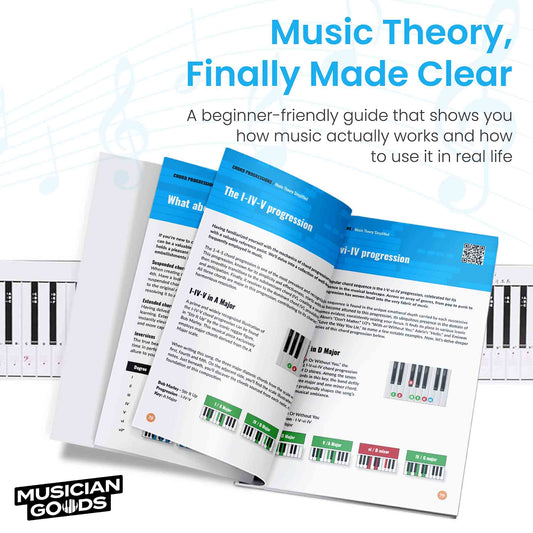
The full guide to intervals, chords, and how they connect — with the complete interval chart and song examples for training your ear — is in Music Theory Simplified. Same clear, no-fluff style you're reading now.
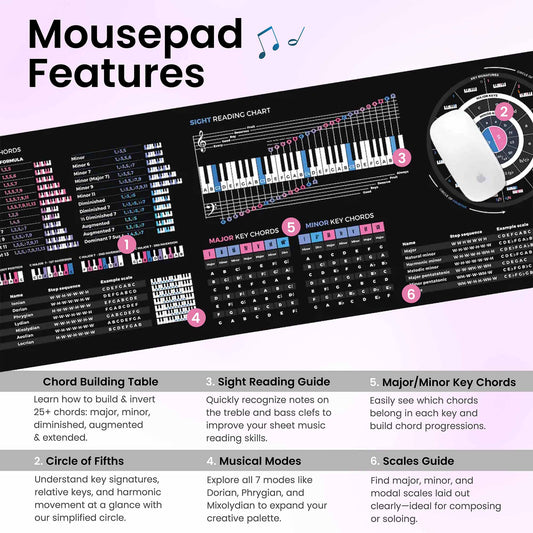
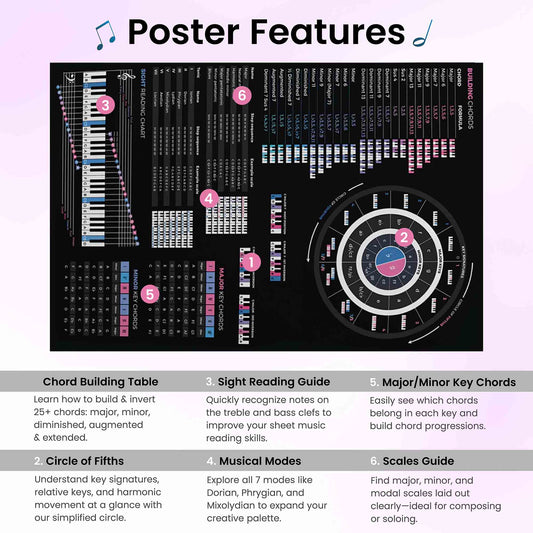
Want the interval chart and chord formulas next to your keyboard? The Music Theory Cheat Sheet Poster and Cheat Sheet Mousepad keep intervals, scales, and chords in view while you play.
Prefer a digital reference for any screen? Grab the Music Theory Cheat Sheet PDF, or get everything together in the Music Theory Bundle.

Every interval — mapped out visually.
Music Theory Simplified turns intervals, chords and harmony into diagrams you can actually play from.
FAQs about music intervals
What is an interval in music?
An interval is the distance between two notes, measured in semitones. It's described by a number (like third or fifth) and a quality (like major, minor, or perfect), which together define its exact sound.
What's the difference between a harmonic and a melodic interval?
A harmonic interval is two notes played at the same time (used to build chords). A melodic interval is two notes played one after the other (used to build melodies). The interval itself is the same — only the timing differs.
What are perfect intervals?
Unisons, fourths, fifths, and octaves. They have a stable, resolved sound and don't come in major or minor versions, unlike seconds, thirds, sixths, and sevenths.
How do I learn to recognize intervals by ear?
Link each interval to a song you know. For example, "Amazing Grace" and the Star Wars theme both open with a perfect fourth, and the Simpsons theme opens with a tritone. When you hear that interval again, the song helps you identify it.
What does consonant and dissonant mean?
Consonant intervals (like thirds, fifths, and octaves) sound stable and pleasant. Dissonant intervals (like seconds, sevenths, and the tritone) sound tense and want to resolve. Composers use both to create tension and release.
This post is part of Musiciangoods' Music Theory Simplified series — practical music theory, taught visually, for musicians who want to understand what they're playing. Explore more music learning tools here.