4.8/5 on Trustpilot
Most "best beginner keyboard" lists quietly ignore the one thing that decides whether you keep playing: the keys. A beginner who learns on 88 weighted, hammer-action keys can sit down at any acoustic piano and feel at home. A beginner who learns on light, springy synth keys has to relearn the instrument the day they touch a real one. So this list is deliberately narrow. It is six full-size, 88-key digital pianos with weighted keys, the kind you can grow into for years rather than out of in months.
Price still matters, and these range from a genuine budget pick to a step-up instrument that out-sounds its class. But within that range the question is not "which is cheapest" so much as "which weighted action and sound fits how you will actually practise." We will tell you which one suits a tight budget, a small flat, a heavy practiser, and the player who wants the most realistic feel for the money.
Quick comparison
| Keyboard | Best for | Key action | Approx. price |
|---|---|---|---|
| Yamaha P-145 | Best overall on a budget | Graded Hammer Compact | €480–€520 |
| Roland FP-10 | Most realistic key feel | PHA-4 Standard | €500–€560 |
| Alesis Recital Pro | Tightest budget, full hammer keys | Hammer-action | €280–€330 |
| Casio Privia PX-S1100 | Small flats and portability | Smart Scaled Hammer Action | €600–€650 |
| Yamaha P-225 | Best sound and feel as a step-up | Graded Hammer Compact | €650–€720 |
| Korg B2 | Simple, full-bodied all-in-one | Natural Weighted Hammer | €400–€450 |
Every keyboard here has 88 weighted keys, so the muscle memory you build transfers straight to an acoustic piano. Before you spend, budget a little extra for the parts that are not the instrument: a stable stand, a sustain pedal, and a pair of closed-back headphones for silent practice. If you are still deciding between a weighted digital piano and a lighter portable keyboard, read our breakdown of piano vs keyboard first, because it changes which of these you should even consider.
1. Yamaha P-145 — best overall on a budget

88 keys, Graded Hammer Compact action, 10 voices, USB-to-host, built-in speakers, headphone output
The P-145 is the keyboard most self-taught pianists actually start on, and it earns the position. It is the successor to the long-running P-45, slimmer and lighter, with Yamaha's Graded Hammer Compact action: heavier in the low keys, lighter up top, the way a real piano feels. For a beginner that graded weight is the whole point, because it trains the finger strength and control you will carry to any acoustic instrument.
The piano voice is sampled from a Yamaha concert grand and sounds convincing through both the built-in speakers and headphones. There is no clutter here. A handful of voices, a metronome, and a clean front panel mean you spend your time playing rather than scrolling menus, which is exactly what a beginner needs in the first year.
The honest limitation is the spartan feature set. The P-145 keeps only ten voices and a single physical button for most controls, so deeper functions hide behind key combinations. If you want recording, more sounds, or a richer speaker system, the P-225 below is the natural step up. For a first proper piano, though, the P-145 is the safe, low-risk choice.
Best for: first-time players who want a proven, no-fuss weighted piano and would rather spend the savings on a stand, pedal, and lessons.
2. Roland FP-10 — most realistic key feel

88 keys, PHA-4 Standard action with escapement, SuperNATURAL piano engine, Bluetooth MIDI, USB
If your priority is how the keys feel under your fingers, the FP-10 is the standout at this price. Roland fits it with the same PHA-4 Standard action found in pianos costing considerably more, including simulated escapement, the subtle notch you feel on a real grand when a key is pressed slowly. That detail is invisible on a spec sheet and obvious the moment you play.
The SuperNATURAL piano engine gives the FP-10 a lively, responsive tone that reacts well to how hard you play, so quiet passages stay delicate and loud ones bloom. Built-in Bluetooth MIDI is a quiet bonus for a beginner: it connects wirelessly to learning apps on a phone or tablet, which is how many self-taught players keep themselves accountable in the early months.
The trade-offs are size and speakers. The FP-10 is a dense little slab and its onboard speakers are modest, so you will reach for headphones or external speakers sooner than on the Yamaha. But for the feel of the keys alone, nothing else here matches it for the money.
Best for: players who care most about authentic key action and want the closest thing to an acoustic touch on a budget.
3. Alesis Recital Pro — tightest budget, full hammer keys

88 keys, hammer-action with adjustable touch response, 12 voices, built-in lesson mode, RCA outputs
The Recital Pro exists for one reason: it is the cheapest way to get 88 genuinely hammer-action keys under your hands. If your budget cannot stretch to the Yamaha or Roland, this is the keyboard that still lets you build correct technique rather than learning on light, unweighted keys you will have to abandon.
It also packs in more voices than its rivals at this level, twelve in total, plus a built-in lesson mode that splits the keyboard into two identical halves so a teacher and student can play side by side. For a household where a parent and child are both learning, that feature alone can justify the price.
You do pay for the savings elsewhere. The action is heavier and less refined than the Yamaha or Roland, the piano sound is serviceable rather than rich, and the build feels more plastic. None of that stops a beginner from learning to play properly. It simply means the Recital Pro is the instrument you outgrow fastest, which is a fair trade when the alternative is not starting at all.
Best for: the tightest budgets, second instruments, and households that want two players to practise side by side.
4. Casio Privia PX-S1100 — best for small flats and portability

88 keys, Smart Scaled Hammer Action, 18 voices, optional battery power, Bluetooth audio via adapter, touch-sensor controls
The PX-S1100 is the keyboard for anyone short on space. It is one of the slimmest 88-key weighted pianos made, shallow enough to stand against a wall or slide under a bed, with a clean glass-touch control panel instead of rows of buttons. In a small flat, that footprint is the difference between a piano you keep out and play and one that lives in a cupboard.
Despite the slim body, Casio's Smart Scaled Hammer Action feels surprisingly substantial, and the piano tone is bright and detailed. It can also run on batteries, so you can carry it to a friend's place, a rehearsal, or another room without hunting for a socket. Few pianos at this level are this genuinely portable.
The slim design does cost a little key-bed stability compared with the heavier Yamaha, and the deepest settings live in menus rather than on the surface. But if your constraint is space or you need to move the instrument, nothing here fits a small life as neatly.
Best for: small flats, shared rooms, and players who need to move or store the piano regularly.
5. Yamaha P-225 — best sound and feel as a step-up

88 keys, Graded Hammer Compact action, Yamaha CFX grand samples, Virtual Resonance Modeling, two-track recorder, USB audio
The P-225 is the answer to "what should I have bought once I knew what I was doing." It shares the P-145's reliable Graded Hammer Compact feel but adds the things that make daily practice more rewarding: richer CFX concert-grand samples, Virtual Resonance Modeling for a fuller, more resonant tone, a stronger speaker system, and onboard recording so you can hear yourself back.
That recorder is more useful than it sounds. Hearing your own playing is one of the fastest ways to improve, and having it built in removes the friction of setting up software. The improved speakers also mean you can practise out loud, with the instrument actually filling a room, rather than always reaching for headphones.
It costs meaningfully more than the P-145, and the underlying key action is the same, so the upgrade is about sound, speakers, and features rather than feel. For a committed beginner who knows they are in this for the long haul, that is money well spent. For someone still testing whether piano will stick, the P-145 remains the smarter first buy.
Best for: committed beginners who want the best sound and built-in recording, and anyone fairly sure they will keep playing for years.
6. Korg B2 — simple, full-bodied all-in-one

88 keys, Natural Weighted Hammer action, 12 sounds, larger onboard speaker system, USB MIDI and audio
The Korg B2 is the quiet alternative that does the basics very well. Its Natural Weighted Hammer action is firm and even across the keyboard, and Korg pairs it with one of the more generous onboard speaker systems in this group, so the piano sounds big and full straight out of the box without external speakers.
It keeps the interface simple, with a clean set of twelve sounds and minimal menu-diving, which suits a beginner who wants to play rather than configure. The USB connection carries both MIDI and audio, so it slots neatly into learning apps and basic home recording when you are ready for that step.
The B2's character sits between the budget Alesis and the refined Yamaha and Roland: better built and better sounding than the Recital Pro, slightly less nuanced in touch than the FP-10. If you want a straightforward, good-sounding piano and the Yamaha is sold out or over budget, the B2 is the easy second choice.
Best for: players who want a simple, full-sounding piano with strong built-in speakers and no fuss.

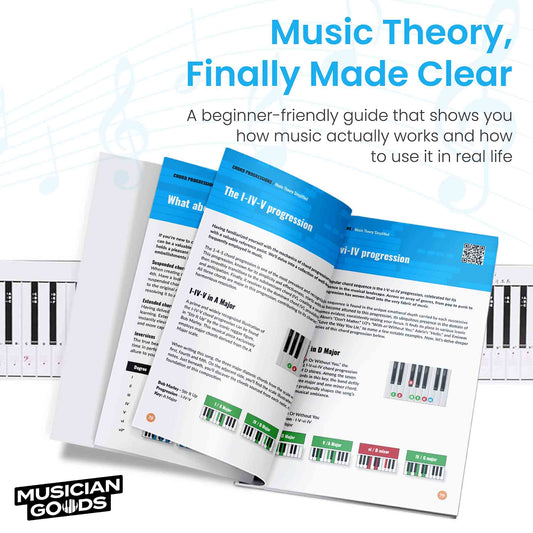
View Music Theory Simplified →
How to choose the right beginner piano
Start with the keys, not the sound. For learning piano, 88 weighted, hammer-action keys are the single feature worth protecting, because they build the technique that transfers to a real instrument. Everything on this list clears that bar, so you are choosing between honest options rather than avoiding a mistake. If a keyboard you are eyeing elsewhere has fewer than 88 keys or unweighted "synth" keys, treat it as a toy for testing interest, not a piano for learning.
Then match the instrument to your space and budget. If money is tight, the Alesis Recital Pro gets you real hammer keys for the least. If space is tight, the slim Casio PX-S1100 fits where nothing else will. If you want the best feel, the Roland FP-10 wins, and if you want the best all-round sound and recording, the Yamaha P-225 does. The Yamaha P-145 is the middle of the road that disappoints no one.
Finally, budget for the parts that are not the piano. A wobbly stand, no pedal, and no headphones will hold you back more than any difference between these six instruments. Spend the last of your budget on a stable stand, a sustain pedal, and closed-back headphones before you spend it on a fancier keyboard. And remember that the instrument only gets you so far. Knowing what the notes mean is what turns practice into playing, which is covered from the ground up in how long it takes to learn piano and in our own Music Theory Simplified.
Frequently asked questions
Do I really need 88 keys to start? For learning piano properly, yes. The full 88-key range and weighted, hammer-action keys are what let your technique transfer to an acoustic piano. Smaller 61-key keyboards are fine for testing whether you enjoy playing, but you will hit their limits quickly and have to relearn touch on weighted keys later.
What is the difference between a digital piano and a keyboard? A digital piano focuses on recreating the feel and sound of an acoustic piano with weighted keys, while a "keyboard" usually means a lighter, unweighted instrument with many sounds and built-in rhythms. For learning to play piano, a weighted digital piano like the ones here is the better foundation. We cover this in detail in our piano vs keyboard guide.
How much should a beginner spend? Plan for the instrument plus stand, pedal, and headphones. A capable weighted digital piano starts around €280 for the Alesis and sits around €480–€520 for the popular Yamaha P-145. Spending more buys better sound and features, not a different ability to learn, so do not feel you must reach the top of the range to start well.
Do these need anything extra to play? Most include a basic sustain pedal and a power supply, but a sturdy stand and a bench are usually separate, and a sustain pedal that stays put is worth upgrading early. Headphones let you practise silently, which matters more than beginners expect in a shared home.
Can I learn music theory on any of these? Yes. Music theory is independent of the instrument, and a piano keyboard is the clearest place to see how it works because the notes are laid out in a straight, visible line. Any of these six will do. The theory itself is what we teach in plain language in Music Theory Simplified.
Written by Melvin Tellier, founder of Musiciangoods. Musiciangoods publishes plain-language books and cheat sheets that help self-taught musicians learn the theory and craft behind the instrument, including Music Theory Simplified. We do not sell pianos or keyboards, and we earn nothing from the instruments reviewed above.