4.8/5 on Trustpilot

Most pop songs are built from a single key, a single tempo, and a verse-chorus-verse-chorus-bridge-chorus skeleton that almost every listener can predict by the second verse. Bohemian Rhapsody, released by Queen in 1975, breaks every one of those conventions and still became one of the most commercially successful songs ever recorded. The reasons it works are not magic. They are music theory, applied with unusual nerve.
This is a walkthrough of what is actually happening, harmonically and structurally, in the six-minute song. No tabloid trivia, no Freddie Mercury mythology. Just the choices a music-literate listener can hear in the recording and the theoretical names for those choices.
Why the song is structurally unusual
The first thing to notice about Bohemian Rhapsody is that it has no chorus. Nothing repeats. The song moves through six distinct sections in sequence and never returns to any of them. In classical terminology that structure has a name — through-composed — and it is almost unheard of in commercial pop, where repetition is the dominant building block.
The six sections, in order, are an a cappella introduction, a piano-led ballad, a guitar solo, a mock-operatic passage, a hard rock section, and a quiet outro. Each one has its own tempo, its own key centre, its own arrangement, and its own emotional register. They are stitched together by a few harmonic pivot points rather than by repeated material.
Most through-composed pieces sit in the classical or art-music tradition. Putting one on a hit single was a commercial gamble that, in 1975, looked indefensible right up until the song reached number one in the UK and stayed there for nine weeks.
The key plan
The song's tonal architecture moves roughly like this: B-flat major for the intro and ballad, modulating up to E-flat major for the guitar solo and the rock section, drifting through a sequence of rapidly shifting keys in the operatic middle, and returning to F major and then back to B-flat major at the close. The home key is B-flat. The whole long detour is built so that the return home at the end actually feels like a return.
That return matters because the listener has been pulled through unfamiliar harmonic territory for several minutes. When the song lands back on B-flat for the "nothing really matters" outro, the resolution carries weight that a verse-chorus structure could not produce.
The ballad's descending chromatic bass
The ballad section ("Mama, just killed a man") is built on one of the oldest and most reliable devices in Western music — a slowly descending chromatic bass line. The bass falls almost step by step from the tonic down to the fifth, and the chords on top are chosen to make each bass note sound like the natural root of a meaningful chord.
The pattern is the same one that underlies the second movement of Bach's Passacaglia and Fugue in C minor, the lament aria in Purcell's Dido and Aeneas, the verse of "Hit the Road Jack," and dozens of jazz standards. A descending bass under fresh upper-voice harmony is, in the Western ear, the sound of accumulating gravity. It works because each falling step adds tension that the next chord almost — but not quite — resolves.
The harmonic vocabulary in the ballad also leans heavily on secondary dominants. A secondary dominant is a chord that briefly turns toward a non-tonic chord as if it were a temporary tonic. In B-flat, the G7 that appears in the progression is acting as the V of Cm — it makes the listener expect Cm next, and gets it. This is how a small section of music can sound harmonically restless without ever genuinely leaving its key.
The pivot from ballad to opera
The transition from the ballad into the operatic section is a textbook example of a pivot modulation. The ballad ends on a chord that belongs to both the home key (B-flat) and the new key area the opera will move into. The listener experiences the chord first as the end of one section and then, retroactively, as the beginning of the next.
Pivot modulations make key changes feel inevitable rather than abrupt. They are one of the most useful tools in a songwriter's harmonic kit, because they let you shift the emotional centre of a song without breaking its surface continuity. Bohemian Rhapsody uses them between most of its sections, which is part of what allows the song to feel like one continuous arc despite being six separate pieces.
The operatic section
The mock-opera passage is harmonically the busiest part of the song. It moves through several keys in roughly ninety seconds, using sequences of secondary dominants and chromatic mediant relationships to keep the ear chasing the tonic without ever quite catching it.
A chromatic mediant is a chord whose root sits a third away from the previous chord but whose quality (major or minor) creates a colour shift the diatonic system would not normally permit. A move from C major to A-flat major, for example, is a chromatic mediant — both chords are major, but the second is not native to the key of the first. The effect is unstable and slightly cinematic. The operatic section is full of these movements, which is part of why it sounds like film music more than pop.
The vocal arrangement layers up to 180 overdubs of the band's three singing members. That is not a theoretical choice as such, but it has a harmonic consequence — the density of the vocal stack lets the arrangement put genuine four-, five-, and six-note chords in motion, rather than the two- and three-voice harmonies most rock vocals rely on. The "Galileo" volleys are call-and-response over chord changes that are themselves modulating, which gives the section its sense of compressed urgency.
The hard rock section
The hard rock section ("So you think you can stone me") sits in E-flat and uses a relatively straightforward rock progression — E-flat, B-flat, and F, with the occasional borrowed chord from E-flat minor for darker colour. After the harmonic complexity of the opera, the simplicity is the point. It functions the way a clearing functions after a dense passage of trees.
The section also reasserts a regular pulse. The previous two minutes have moved at multiple tempos and through several metric feels. Locking back into steady four-on-the-floor rock time is itself a kind of resolution, even before the song reaches its actual harmonic home.
The outro
The outro descends from F into B-flat, slowing and thinning until only a few sustained chords and a gong remain. The return to B-flat is the resolution the entire structure has been building toward. The song has spent five minutes departing from its home key and the final thirty seconds confirming that the home key was always where the music belonged.
The famous final line is sung over a B-flat major chord with the seventh — A natural — held in the upper voice. The seventh keeps the chord from feeling fully resolved. Rather than ending on certainty, the song ends on a chord that hints there might be more to say. The gong hit cuts that hint off.
What you can take from it as a writer
Bohemian Rhapsody is not a model anyone should literally copy. Through-composed six-minute pop singles are commercial suicide in any year that is not 1975 with the unique combination of FM radio promotion and a band already at the height of their popularity. What is useful is the underlying instinct.
The song treats harmony as a story-telling device rather than as a backdrop. Each key change carries emotional information. Each pivot chord is placed where the listener is most likely to be ready for movement. Each return to a familiar tonal centre is earned. These are choices any songwriter can make, even inside an ordinary verse-chorus form, once they know what the tools are called and what they do.
If there is a single takeaway, it is this: the harmonic vocabulary in this song is not exotic. Descending chromatic bass, secondary dominants, pivot modulations, and chromatic mediants are all standard items in any decent theory curriculum. What makes Bohemian Rhapsody remarkable is that someone with the confidence to use them all in one song actually did.
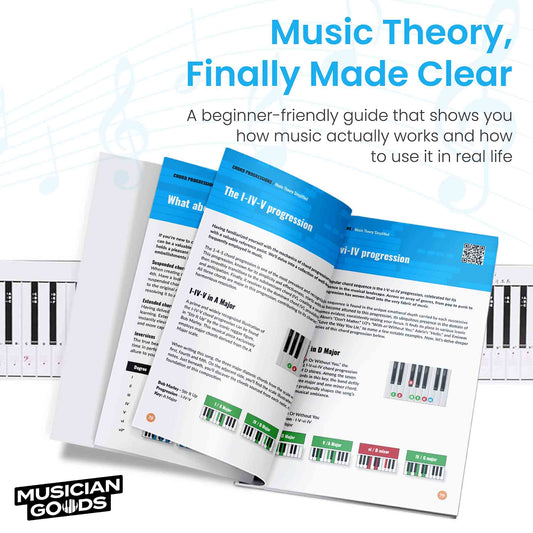
If you've read this far and want a working understanding of the theory the song is built on — descending bass lines, secondary dominants, modulation, chord function — our book Music Theory Simplified covers the entire framework in plain language. It is written for self-taught musicians who want to understand why songs work, not just memorise rules. For guitar-specific application of the same ideas — chord construction, the CAGED system, scale-to-chord relationships — see Guitar Theory Simplified.

View Music Theory Simplified →
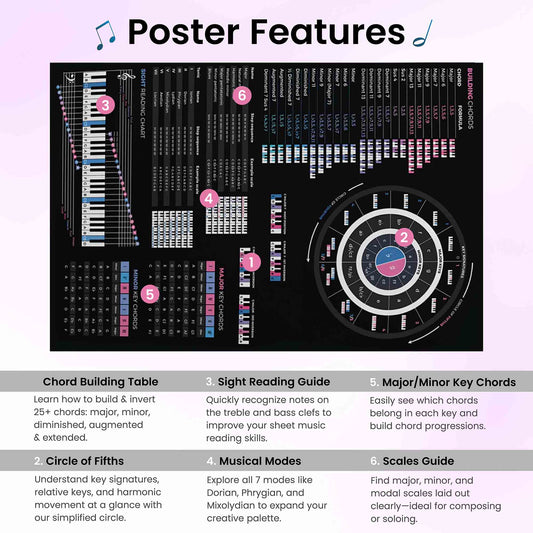
For more on the harmonic concepts mentioned above, our deep dives on the circle of fifths and the CAGED system are good next reads.