4.8/5 on Trustpilot

Modes have a reputation for being the scary, advanced end of music theory. They're not. A mode is just a familiar scale started from a different note — seven flavors made from the same set of ingredients. Once you see that, the mystery disappears.
In this guide we'll explain what musical modes actually are, walk through all seven — Ionian, Dorian, Phrygian, Lydian, Mixolydian, Aeolian, and Locrian — show you the formula for each, and explain how to use them to color the mood of your music.

What are musical modes?
A mode is a scale created by starting on a different degree of a parent scale rather than its root note. Take the notes of one major scale, begin on a different note, and play through to its octave — you've made a mode. It's the same set of notes, reorganized so a new note becomes "home," which gives the scale a completely different feeling.
Think of it like building different structures from the same set of blocks. The blocks don't change, but the shape and character do. All seven modes originate from the major scale, which serves as your fundamental building material. Each resulting mode has its own distinct mood — some bright, some dark, some dreamy, some unstable.
The seven modes explained
Here are all seven modes, in order, each described by its character and how it differs from the plain major scale.

Ionian — This is the modern major scale, the familiar "do-re-mi." Starting on C with all natural notes gives you C Ionian. Bright and resolved. Formula: 1-2-3-4-5-6-7.
Dorian — Resembles the natural minor scale but with one key difference: a raised (major) sixth. That single note gives Dorian a slightly brighter, jazzier feel than a plain minor scale. Formula: 1-2-♭3-4-5-6-♭7.
Phrygian — Also close to the natural minor scale, but defined by its minor second: the interval between the root and the second note is just a half step. That lowered second gives Phrygian a dark, exotic, Spanish-tinged sound. Formula: 1-♭2-♭3-4-5-♭6-♭7.
Lydian — Differs from the major scale by sharpening the fourth note. That raised fourth creates a subtly dreamy, magical, floating quality. Formula: 1-2-3-♯4-5-6-7.
Mixolydian — Set apart from the major scale by its flattened seventh. It's major and bright, but that lowered seventh gives it a bluesy, dominant, rock-and-roll edge. Formula: 1-2-3-4-5-6-♭7.
Aeolian — This is essentially the natural minor scale itself. Dark and melancholic, it appears in countless popular songs, including Bob Dylan's "All Along the Watchtower" and R.E.M.'s "Losing My Religion." Formula: 1-2-♭3-4-5-♭6-♭7.
Locrian — Considered the darkest and least stable of all the modes, thanks to a diminished fifth alongside a lowered second and seventh. It rarely feels settled, which makes it the rarest mode in practice. Formula: 1-♭2-♭3-4-♭5-♭6-♭7.
How modes work
The clearest way to understand modes is to build them all from one parent scale. Take C major — all white keys, no sharps or flats. Start on each successive note and play up to the octave, and you produce all seven modes without ever touching a black key:
- Start on C → C Ionian (major)
- Start on D → D Dorian
- Start on E → E Phrygian
- Start on F → F Lydian
- Start on G → G Mixolydian
- Start on A → A Aeolian (natural minor)
- Start on B → B Locrian
Same seven notes every time — only the starting point changes. That shift in "home base" is what rearranges the pattern of whole and half steps, and that new pattern is what gives each mode its own personality.
How to use modes in your music (4-step plan)
Step 1 — Pick a mode for the mood you want
Choosing a mode is like choosing the colors for a painting. Want dreamy and magical? Reach for Lydian. Want dark and moody? Aeolian or Phrygian. Want bluesy and driving? Mixolydian. Start from the feeling, then pick the mode that carries it.
Step 2 — Play it against a drone or root note
Hold the mode's root note (or a chord built on it) and play the scale over the top. Modes only reveal their character when the ear can hear them relative to their home note. Without that anchor, D Dorian just sounds like C major again.
Step 3 — Mix and match modes
You can combine modes to make music sound interesting and unique — a bit like mixing ice cream flavors. Shift from a bright Lydian section to a darker Aeolian one and you create contrast and movement between parts of a song.
Step 4 — Experiment with the unusual ones
Once the common modes feel comfortable, try the more unexpected ones like Phrygian or Locrian. These are the surprising flavors — used sparingly, they add tension and originality that set your music apart.
Common mistakes to avoid
- Overcomplicating them. A mode is just a scale started from a different note. If you're treating each one as an entirely new system to memorize, you're making it harder than it is.
- Playing modes without a tonal anchor. If you don't establish the mode's root with a drone or chord, every mode from C major's notes just sounds like C major. The home note is everything.
- Trying to use all seven all the time. Like ice cream flavors, you don't need every one every day. Most music leans on Ionian, Aeolian, Dorian, and Mixolydian. The rest are occasional spices.
- Ignoring the formulas. The scale-degree formulas (like Dorian's 1-2-♭3-4-5-6-♭7) tell you exactly what makes each mode unique. Skipping them means you never really learn why a mode sounds the way it does.
- Forgetting Aeolian and Ionian are old friends. Ionian is just the major scale and Aeolian is just the natural minor. You already know two modes — build the others from there.
Why modes matter
Modes give you a palette of moods that goes far beyond simple "happy major" and "sad minor." They're musical tools that help you create your own tunes with different feelings, surprises, and flavors — dreamy, bluesy, exotic, unstable — all from note sets you already understand.
You won't reach for all seven every day, and that's fine. But knowing they exist means that when a piece needs a specific color you can't get from a plain major or minor scale, you have the vocabulary to find it. That's musical modes, simplified.
Take it further
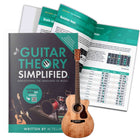
The full breakdown of scales and modes — with the complete interval and formula table, the piano scales chart, and a visual walkthrough of how modes come from the major scale — is in Music Theory Simplified. Same clear, no-fluff style you're reading here.
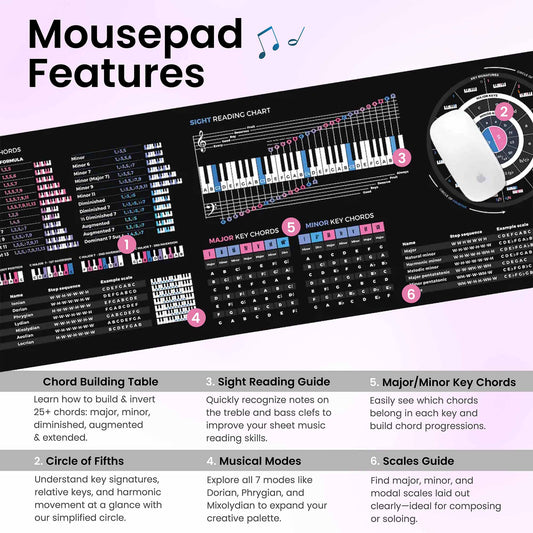
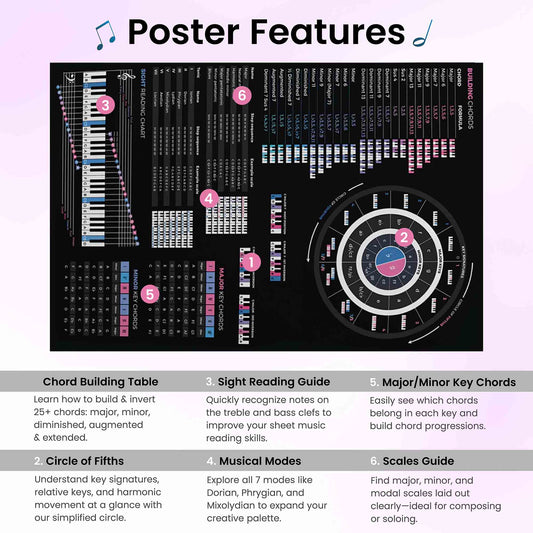
Want the mode formulas and scale maps next to your keyboard? The Music Theory Cheat Sheet Poster and Cheat Sheet Mousepad keep scales, modes, and intervals in view while you play.
Prefer a digital reference for any screen? Grab the Music Theory Cheat Sheet PDF, or get everything together in the Music Theory Bundle.

Every scale, mode and formula — mapped out visually.
Music Theory Simplified turns modes, keys and scales into diagrams you can actually play from.
FAQs about musical modes
What are the 7 musical modes in order?
Ionian, Dorian, Phrygian, Lydian, Mixolydian, Aeolian, and Locrian. They correspond to starting a major scale on its 1st through 7th notes, respectively.
What is the easiest way to understand modes?
Play only the white keys on a piano, but start on different notes. C to C is Ionian (major), D to D is Dorian, A to A is Aeolian (natural minor), and so on. Same notes, different starting point, different mood.
Which mode is the major scale?
Ionian is the modern major scale. Aeolian is the natural minor scale. So if you know major and minor, you already know two of the seven modes.
What makes each mode sound different?
The placement of whole and half steps, which changes because you start on a different note. That reshuffles the intervals — for example, Lydian's sharpened fourth or Mixolydian's flattened seventh — and each altered note gives the mode its character.
Do I need to learn all seven modes?
Not right away. Most music uses Ionian (major), Aeolian (minor), Dorian, and Mixolydian most often. Learn those first, then explore Phrygian, Lydian, and Locrian as you need new colors.
This post is part of Musiciangoods' Music Theory Simplified series — practical music theory, taught visually, for musicians who want to understand what they're playing. Explore more music learning tools here.