4.8/5 on Trustpilot
Most people practice scales the same way, running up and down as fast as they can, and then wonder why the scale falls apart the moment they try to use it in a song. Speed is not the problem. The problem is that repetition alone does not build the kind of memory you can reach for while you are playing.
This guide is about how to practice scales so they stick: so you can recall the notes without thinking, find them anywhere on your instrument, and actually use them to make music. The method works on guitar, bass, piano, ukulele, or any instrument, because it is about how you practice rather than which notes you play.
What "sticking" actually requires
A scale has stuck when two things are true. You can play it without conscious effort, and you can use it in a musical situation without hunting for the next note. Rote repetition builds the first one slowly and the second one barely at all, which is why so many players can rip through a scale as an exercise but freeze when asked to improvise with it.
The fix is to practice in a way that builds recall and application from the start. That means slower playing, naming what you play, connecting the scale to the fretboard or keyboard rather than to a shape, and using the scale musically long before it feels finished. The rest of this guide breaks that into concrete habits.
Start with one scale, not seven
The fastest way to learn no scales is to practice all of them at once. Pick one, almost always the major scale in a single key, and stay with it until it is genuinely automatic before adding another.
One well-drilled scale teaches you the pattern of whole steps and half steps that every other scale is measured against. Once the C major scale is effortless, a minor scale is a small change to something you already own, not a brand-new thing to memorize. Spreading your attention across seven keys on day one guarantees that none of them ever become automatic.
Practice slowly, with a metronome
This is the habit that separates players whose scales stick from players whose scales stay shaky. Practice slow enough that you never make a mistake, and let speed arrive on its own.
Set a metronome to a tempo where every note is clean and even, then only raise it once you can play the scale several times in a row with no errors. A useful structure is a tempo ladder:
1. Set the metronome slow enough to play perfectly (try 60 BPM).
2. Play the scale up and down, one note per click, four times clean.
3. Raise the tempo by 4 to 8 BPM.
4. Repeat. The moment you make a mistake, drop back down.
5. Stop while it still feels easy, not when it falls apart.
Playing fast and sloppy trains your hands to play fast and sloppy. Every clean, slow repetition is a rep that counts. Every rushed, error-filled one teaches your fingers a mistake you will later have to unlearn.
Say the note names as you play
Silent finger drills build a shape. Naming the notes builds knowledge you can use. As you play the scale, say or think the name of each note: C, D, E, F, G, A, B, C.
This is slower and more effortful, which is exactly why it works. It forces you to connect the physical motion to the actual note, so that when a song calls for the third of the scale you know it is an E, not just the second finger on a certain string. Players who name their notes learn the fretboard or keyboard as a byproduct of practicing scales. Players who only chase the shape have to learn it all over again later.
Learn the scale across the instrument, not as one shape
A scale you only know in one position is a scale you can barely use. On a piano that means playing it in more than one octave and with the correct fingering across the keyboard. On guitar or bass it means learning the scale in connected positions up the neck rather than memorizing a single box.
Practice moving the same scale to a new starting point and a new area of the instrument. This is where the note-naming pays off, because you are no longer moving a shape around, you are finding the same notes in a different place. It is the difference between knowing a scale and knowing where its notes live everywhere you might need them.
Use the scale musically before it feels finished
The final step in making a scale stick is to stop practicing it as a scale. Once you can play it slowly and cleanly, start using it to make sound that resembles music.
A few ways to do this from early on:
- Play the scale in sequences: groups of three or four notes,
  stepping forward one note each time (C D E, D E F, E F G ...).
- Skip notes: play every other note (C E G B D ...) to hear the
  intervals instead of a straight run.
- Improvise a short melody using only the scale's notes.
- Play the scale over a backing track or a single held chord in
  the same key and try to land on notes that sound resolved.
This is the point where a scale stops being homework and becomes a tool. Improvising with it, even badly, forces your ear and hands to connect, which is the whole reason to learn scales in the first place.
Space your practice instead of cramming
Fifteen focused minutes a day beats two hours once a week, and it is not close. Memory forms when you revisit material after a short gap, so short daily sessions build recall far better than a single long grind. A missed day is not a disaster, but a regular short habit is what makes a scale automatic.
A simple weekly structure keeps you moving without burning out:
Days 1-2   New scale, very slow, naming every note.
Days 3-4   Same scale, tempo ladder, add a second position.
Day 5      Sequences and note-skipping.
Day 6      Improvise over a backing track in the key.
Day 7      Light review, then start the cycle in a new key.
A 15-minute daily routine
If you do nothing else, this routine will make a scale stick in a couple of weeks:
Minutes 1-3    Slow run up and down, naming each note out loud.
Minutes 4-7    Tempo ladder with the metronome. Stop before mistakes.
Minutes 8-11   Sequences or a second position on the instrument.
Minutes 12-15  Improvise a short melody using only the scale.
Common mistakes that stop scales from sticking
The biggest one is practicing too fast, covered above. The next is practicing without a metronome, which lets your timing get uneven in ways you cannot hear until you play with others. Third is never naming the notes, which leaves you with a shape and no usable knowledge. Fourth is jumping between keys before any one of them is solid. And fifth is treating scales as a separate chore that never touches your actual playing, so the skill never transfers to music.
Fix those five and scales stop being the boring part of practice and start being the thing that makes everything else easier to learn.

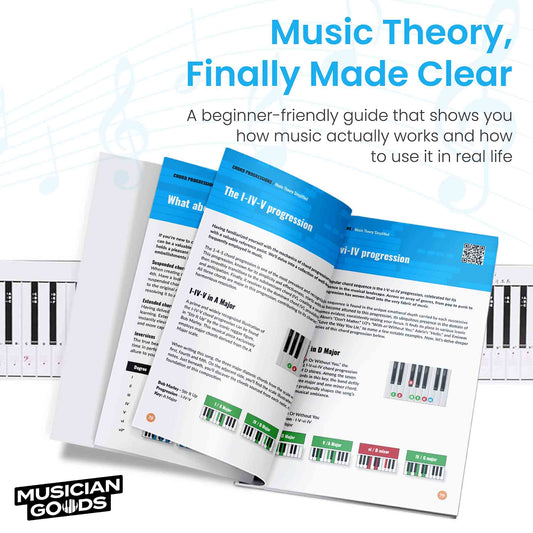
View Music Theory Simplified →
Understanding why a scale is built the way it is makes it far easier to remember. If you want the theory behind the patterns, see how the major scale is constructed and how to connect scale positions across the instrument.
Frequently asked questions
How long does it take for a scale to stick?
With 15 focused minutes a day using slow practice and note-naming, most beginners can play one scale automatically within about two weeks. Being able to improvise with it comfortably takes a little longer. Spreading the same total time across daily sessions works far better than a single long weekly practice.
How slow should I practice scales?
Slow enough that you never make a mistake. Set a metronome to a tempo where every note is clean and even, often around 60 BPM to start, and only raise it once you can play the scale several times in a row without an error. Speed built on clean repetitions is permanent, while speed built on sloppy ones has to be unlearned.
Should I practice scales with a metronome?
Yes. A metronome keeps your timing even and gives you an objective way to raise speed gradually. Without one, small timing errors creep in that you cannot hear on your own but that show up the moment you play with other musicians.
Do I need to say the note names out loud?
Saying or clearly thinking the note names is one of the most effective things you can do, because it connects the physical motion to real musical knowledge and teaches you the fretboard or keyboard at the same time. It is slower and more effortful, which is exactly why it builds usable recall rather than a memorized shape.
How many scales should I learn at once?
One. Pick a single scale, usually the major scale in one key, and drill it until it is automatic before adding another. One well-learned scale becomes the reference point that makes every later scale faster to learn, while splitting your attention across several at once means none of them become solid.
About the author
This guide was written by the team at Musiciangoods and reviewed by Melvin Tellier, founder of Musiciangoods and author of the Simplified series of music theory books. Musiciangoods builds clear, practical learning tools for self-taught musicians. If you want to understand the theory that makes scales click, Music Theory Simplified explains it one step at a time.