 4.8/5 on Trustpilot

Almost every chord you'll ever play on a piano starts life as a triad — three notes stacked in a simple, repeatable pattern. Learn how triads are built and you don't just memorize a handful of shapes; you get a formula that lets you construct any major, minor, diminished, or augmented chord, in any key, from scratch. That's the moment piano chords stop being mysterious.
In this guide we'll break down exactly what a piano triad is, the simple 1-3-5 formula behind it, and how to build the four main triad qualities yourself. This is piano triad chords, simplified.

What is a piano triad chord?
A chord is a group of notes that sound good played together at the same time, chosen from a musical scale. While a chord can be made with just two notes (a dyad), most chords have at least three — and a three-note chord is called a triad. Triads are the foundation of harmony on the piano.
Every chord is built around a main note called the root. If someone says "C chord," the root is C. From that root, we stack two more notes to complete the triad. What makes each triad sound different — happy, sad, tense — is its quality, which is determined by the exact intervals between those three notes.
There are four main triad qualities: major (bright and happy), minor (a bit sad or somber), diminished (tense), and augmented (mysterious or suspenseful). Change just one note of a triad and you can shift it from one quality to another — that's what gives triads their expressive range.
How triads are built: the 1-3-5 formula
Chords come from scales. Each note in a scale has a number, and we build chords by selecting specific numbers. For a triad, the formula is simple: take the 1st, 3rd, and 5th notes of the chord's scale — the root, the third, and the fifth.

Here's the process, step by step. First, choose your chord quality — major, minor, and so on — because that tells you which scale to use. Then write out that scale and number the notes, starting with the root as 1 and counting up to the octave. Finally, apply the formula: select note 1 (the root), the note two scale steps above it (3), and the note four scale steps above that (5).
An example: to build an A minor triad, use the A minor scale. Number it from A, then pick the 1st, 3rd, and 5th notes. That gives you A, C, and E — the A minor triad, with the characteristic mellow, slightly sad color of a minor chord. To build a C major triad, use the C major scale and pick 1-3-5: C, E, and G.
The four qualities come from small tweaks to which third and fifth you use: major is 1-3-5, minor lowers the third to 1-♭3-5, diminished lowers both the third and fifth to 1-♭3-♭5, and augmented raises the fifth to 1-3-♯5. Same root, different color.
How to practice piano triads (4-step plan)
Step 1 — Master the C major triad first
Start with the friendliest chord on the keyboard: C major. Play C, E, and G together with your thumb, middle finger, and pinky. Get comfortable seeing those three white keys as a single shape. This is your reference point for everything that follows.
Step 2 — Build triads with the formula, one key at a time
Pick a new root note and build its major triad using the 1-3-5 formula: write out the major scale, number it, and select 1, 3, and 5. Do G major (G-B-D), then F major (F-A-C), then D major (D-F♯-A). Building each one from the formula — rather than memorizing shapes — trains you to construct chords anywhere.
Step 3 — Change the quality of a triad
Take a major triad you know and turn it minor by lowering the third a half step (C-E-G becomes C-E♭-G). Then try diminished (lower the third and the fifth) and augmented (raise the fifth). Hearing how one moved note changes the entire mood is where triads really click.
Step 4 — Transpose a shape up and down
There's a second, more playful way to build chords: play a triad you know, then slide the whole shape up or down to a new key. Move a C major triad up a whole step and you've got D major. This transposing approach lets you explore new tonalities fast and reinforces the pattern in your hands.
Common mistakes to avoid
- Memorizing shapes without the formula. Learning chords as random finger patterns leaves you stuck. Learn the 1-3-5 formula and you can build any triad in any key.
- Forgetting which scale a chord comes from. The quality determines the scale. A minor triad uses the minor scale; skip that step and you'll pick the wrong notes.
- Confusing the third and the fifth. The third is what carries a triad's mood (major vs minor). Rushing past it means missing the note that matters most.
- Only practicing in C. C major has no sharps or flats, so it's easy — but chords live in every key. Practice triads in keys with black notes too.
- Ignoring diminished and augmented. Most beginners stop at major and minor. The other two qualities unlock tension and color you'll want for real progressions.
Why triads matter
Triads are the building blocks of almost all Western harmony. Once you can build them, everything more advanced becomes an extension of the same idea: add the 7th and you've got a seventh chord; add the 9th, 11th, or 13th and you've got extended chords. Rearrange the same three notes and you've got inversions. In other words, the 1-3-5 formula you learn here is the seed for the entire chord vocabulary of the piano. Understanding triads gives you three real powers — the ability to construct any chord from scratch, the ability to change a chord's emotional color at will, and a shortcut to reading and writing chord progressions confidently in any key.
Take it further
The full harmony chapter — triads, seventh chords, extended chords, all the chord formulas, inversions, and voicings — is laid out visually in Music Theory Simplified, in the same clear style as this post.
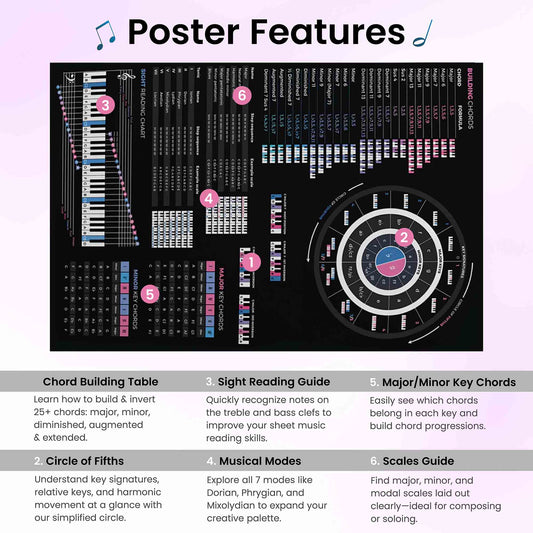
Want the chord formulas next to your keyboard while you practice? The Music Theory Cheat Sheet Poster and Cheat Sheet Mousepad put triad formulas, scales, and the circle of fifths right where you can see them.
Prefer a digital reference? The Music Theory Cheat Sheet PDF keeps every chord formula on your phone or tablet. Or grab everything together in the Music Theory Bundle.

FAQs about piano triad chords
What is a triad on the piano?
A triad is a three-note chord built from the 1st, 3rd, and 5th notes of a scale — the root, third, and fifth. It's the most basic and common chord type on the piano, and the foundation for larger chords.
What is the formula for a triad?
The basic triad formula is 1-3-5: the root, the third, and the fifth of the chord's scale. Major is 1-3-5, minor is 1-♭3-5, diminished is 1-♭3-♭5, and augmented is 1-3-♯5.
What are the four types of triads?
Major (bright and happy), minor (somber and sad), diminished (tense), and augmented (mysterious). Each has a distinct sound created by the exact intervals between its three notes.
How do I build a C major triad?
Take the C major scale, number the notes starting with C as 1, and select the 1st, 3rd, and 5th notes: C, E, and G. Play them together and you have a C major triad.
What's the difference between a major and minor triad?
The third. A major triad uses the 3rd note of the scale (1-3-5), while a minor triad lowers that third by a half step (1-♭3-5). That one note changes the chord from bright and happy to soft and sad.
This post is part of Musiciangoods' Music Theory Simplified series — practical music theory, taught visually, for musicians who want to understand what they're playing. Explore more music theory tools here.










 Χάρτης Ακκόρντων Κιθάρας Mousepad
 Σημειωματάριο Θεωρίας Μουσικής Mousepad
 Φύλλο Απάτης Μίξης και Μάστερινγκ Mousepad


