 4,8/5 su Trustpilot

Lo schema delle 12 note, i nomi delle note, toni e semitoni — insegnati prima sulla tastiera del pianoforte, perché è lì che la teoria musicale si vede meglio. Salta questo capitolo se suoni già il pianoforte. La maggior parte dei bassisti non lo suona — e questo capitolo sblocca tutto il resto del libro.
Bass Theory Simplified · Demystifying the language of music
Capisci finalmente il manico del basso.
Stop memorizing shapes.
La maggior parte dei bassisti memorizza le forme. Pochissimi capiscono perché funzionano.
Questo è il sistema visivo che trasforma il manico del basso da casuale a ovvio — così puoi scrivere brani, improvvisare con intenzione, suonare a orecchio e finalmente capire cosa stai suonando. Niente spartiti. Niente pianoforte. Nessuna base di teoria richiesta.
Sblocca la tastiera
PDF immediato · Inizia stasera
 Spedizione tracciata verso Andorra · Tempi di consegna
183
Pages
Anteprima · 60 sec
Dentro il libro
Spedizione rapida in tutto il mondo
USA, UE, UK, AU, CA · di solito 3–7 giorni
Spedizione tracciata
Tracciamento in tempo reale per ogni ordine
Assicurato & sicuro
Perso o danneggiato? Lo sostituiamo gratis
PDF consegnato subito
Leggilo stasera · senza attese
The uncomfortable truth
Most bassists memorize shapes.
Very few understand music.
You can play. You know your open chords. Maybe a pentatonic scale. But you can't explain why any of it works — and that's the wall that stops most bassists from ever becoming musical.
What you have now
Memorized shapes.
You can play songs. You remember chord grips. You know a few scale boxes. But if someone asks you to play in a different key, you freeze — because you don't know why the shapes work.
- Can't transpose to a new key
- Can't write your own progressions
- Can't follow what other musicians say
What you get
The language behind them.
Once you see why a chord is built the way it is, the shapes stop being random. They become a vocabulary you can speak fluently — in any key, anywhere on the bass neck, in any musical situation.
- Move freely between any key
- Write progressions intentionally
- Speak the language of music
Read this before you blame yourself
Music theory wasn't hard.
The explanations were.
Most theory books were written by classically-trained pianists for conservatory students. They assumed you read sheet music. They used Italian terms. They asked you to memorize forty modes before you'd written a single song.
That format wasn't built for self-taught bassists who learn by seeing, hearing, and playing. The information wasn't wrong — the delivery was.
"I started in 2008 with a MIDI keyboard and FL Studio, no theory. From 2010 to 2015 I taught music production on YouTube as MellaMayne — but I still couldn't really play the bass. Years later, after my first book (Music Theory Simplified, for piano) found readers, I wrote the bass version I wish I'd had at the start."
— Melvin Tellier · Founder, Musiciangoods · Self-taught since 2008
"Theory clicks when you stop trying to memorize it
and start seeing it on the bass neck."
and start seeing it on the bass neck."
Così lo insegna la maggior parte dei libri di teoria.
Trascina per scoprire un modo migliore.
Trascina il cursore e scopri perché oltre 200.000 musicisti preferiscono Basso: teoria semplificata.

←Trascina il cursore→
APPRENDIMENTO VISIVODiagrammi, colori & immagini della tastiera ti aiutano a imparare più in fretta.
TAGLIO PRATICOOgni concetto si collega direttamente al suonare musica vera.
PENSATO PER I BASSISTIScritto da un bassista, per bassisti. Non serve conoscere il pianoforte.
IMPARA CON SICUREZZACapisci finalmente perché la musica funziona ed esprimiti liberamente.
Codici QR inclusi
Bloccato su un concetto? Scansiona e guarda.
Ogni capitolo include codici QR stampati direttamente sulla pagina.
Niente app, niente login.
Oltre 50 video tutorial in tutti i 9 capitoli
Funziona su qualsiasi telefono — senza app
Gli stessi video valgono per PDF e cartaceo
Sfoglia il libro
Guarda esattamente come insegna il libro.
Explore real chapters and flip through actual pages from Bass Theory Simplified.

1 / 5
Built for clarity. Designed for results.
Every chapter tells you
exactly where you're going.
No fluff. No wasted time. Each chapter is structured to help you learn faster, stay focused, and actually understand.
01
Livello
Sai se un capitolo è per principianti, intermedio o avanzato prima di iniziare.
02
Tempo richiesto
La maggior parte dei capitoli richiede 1-3 ore, così impari con i tuoi tempi.
03
Obiettivo chiaro
Ogni capitolo inizia dicendoti cosa saprai fare alla fine.
 123456
04
Cosa imparerai
Vedi esattamente quali concetti e abilità tratta il capitolo.
05
Cosa ti servirà
Nessuna sorpresa: ogni capitolo ti dice esattamente quali strumenti userai.
06
Saltalo se lo sai già
Lo conosci già? Vai avanti e concentrati su ciò che non sai.
Un sistema di apprendimento completo.
Guide al gergo. Promemoria visivi. Videolezioni QR. Tutto ciò che ti serve per capire finalmente la teoria musicale.
GUIDE AL GERGO8 guide al gergo spiegano i termini musicali complessi — una alla fine di ogni capitolo.
PROMEMORIA VISIVIPagine di riferimento con codice colore, tra cui la tabella completa degli accordi, la mappa dei modi e il circolo delle quinte.
VIDEOLEZIONI QRScansiona i codici QR nelle pagine chiave per guardare spiegazioni video passo passo.
RIASSUNTI DEI CAPITOLIPunti chiave alla fine di tutti gli 8 capitoli per ripassare e fissare ciò che hai imparato.

What's inside the book
142 pages.
8 fundamental concepts. One connected system.
Every chapter builds on the last. Each one includes visual diagrams, a cheat sheet, a jargon guide, and a QR code linking to a video tutorial. Click any chapter to see what's inside.
01 Le basi del pianoforte
02 Le basi del basso
Pianoforte vs basso — finalmente tradotti. Come sono accordate le corde, perché il manico del basso è disposto così e come ogni concetto del Capitolo 1 si riporta sul manico. Il ponte tra la teoria musicale e il tuo strumento.
03 Tonalità e scale
Cos’è davvero una "tonalità". La scala maggiore, la minore naturale, la pentatonica maggiore e minore — tutte mappate visivamente su tutta la tastiera del basso. Posizioni e sistemi di scale, tonalità relative e un’introduzione ai modi musicali. Il capitolo che, secondo molti lettori, ha finalmente dato un senso al manico del basso.
04 Armonia — intervalli e accordi
Il capitolo più grande del libro. Intervalli musicali, intervalli tra le corde, tutti i tipi di accordi (maggiori, minori, sus, aumentati, diminuiti, di dominante), come si costruiscono gli accordi sul basso, tutte le formule e i rivolti. Il vocabolario completo dell’armonia — adattato alle frequenze basse.
05 La mappa dei modi
Gli accordi diatonici spiegati. Numeri romani. Gradi della scala. Movimenti di accordi in tonalità maggiori e minori. Le tre progressioni leggendarie: I-IV-V, I-V-vi-IV e IV-I-V-vi — gli schemi dietro gran parte delle linee di basso più famose, finalmente decifrati.
06 Progressioni di accordi
Una guida pratica alla notazione musicale, all’intavolatura per basso e alle tecniche delle tab (hammer-on, pull-off, slide, slap). Chiavi, note e valori — spiegati come li usano davvero i bassisti, non come li insegnano i libri di musica classica.
07 Notazione musicale
Il battito della musica. Il metro musicale. Indicazioni di tempo — 3/4, 4/4, 2/4 — e come il ritmo plasma tutto, da un groove funk a un riff metal. Perché molti bassisti si credono "ritmici per natura" e cosa si stanno davvero perdendo.
08 Ritmo e tempo
Il capitolo che unisce tutto. Armature di chiave, tonalità relative e la nostra versione semplificata del circolo delle quinte — il diagramma più utile della teoria musicale. Alla fine di questo capitolo parlerai la lingua della musica.
09 Il circolo delle quinte
Il momento in cui scatta la scintilla
Guarda il manico del basso passare da casuale a ovvio.
Toggle below to see the difference between how most bassists see the bass neck — and how you'll see it after the Harmony chapter.

La tastiera sembra casuale.
Impari una forma di accordo. Poi un’altra. Dimentichi quale sia quale.
132 note scollegate da memorizzare una alla volta.

La tastiera è uno schema.
Ogni accordo è fondamentale + terza + quinta in posizioni diverse.
132 note diventano un unico sistema da applicare ovunque.
Real readers · Real reviews
The book that finally made theory click
for thousands of self-taught bassists.

Marcus T.
After 12 years, the bass neck finally makes sense.
I've owned at least seven theory books. Every single one assumed I could already read sheet music or play piano. This one starts where I actually am — looking at a fretboard, wondering why anything works. By Chapter 4 I understood intervals for the first time in my life. The relief is hard to describe.
Jamal C.
Two weeks in and I'm writing my own progressions.
I used to write songs by stacking chords until something sounded okay. Now I actually choose chords on purpose because I understand what they'll do emotionally. The modes chapter alone unlocked five new positions on the bass neck I'd avoided for years.
Kenji T.
I can finally jam without freezing.
Someone calls a key in a jam, I used to panic and noodle around the same five frets. Now I actually know where to play and what notes work. Started picking up songs by ear last month — something I thought I'd never be able to do. This book is the cheat code I wish I'd had a decade ago.
From Shopify · Judge.me verified
Real photos from real readers.
Understood the bass neck in 2 days.
I'm not exaggerating. Chapter 4 broke down what every other book skipped.
10 years playing. Modes finally make sense.
The Keys & Scales chapter showed me modes as colors instead of seven random shapes. Mind blown.
Wrote a full song in one weekend.
The Chord Progressions chapter and the Roman numerals system is pure gold. Bought the mousepad too.
Bridged piano theory and bass in a weekend.
As a producer who only knew theory on piano roll, this book finally got me playing it on bass.
The QR videos made the modes chapter click.
Was stuck on modes for 20 minutes, scanned the code, watched the 2-min video, instant clarity. Best theory book I've bought.
I'm 56 and finally feel like I understand bass.
Wish I had this 30 years ago. The Harmony chapter alone was worth twice the price.
Finally a theory book that doesn't feel like school.
I'd given up on theory three times before this. The 'why' explanations finally clicked. Now I'm writing songs again.
I keep it on my amp every practice session.
Lives on top of my amp. Open it, scan a QR, learn one concept, jam. Repeat. Best $25 I've spent on bass.
Real customers · Real reactions
Hear it from bassists
who've been through it.
Unedited videos from readers about their experience with the book. The good, the honest, and the "I wish I'd found this sooner" moments.
"@leylasmusic dà il suo parere sincero"
@leylasmusicVedi il sistema
"@daynabeemusic spiega perché questo libro funziona"
@dangallaghermusicVedi il sistema
"@martin.dalesio decifra il manico del basso"
@martin.dalesioVedi il sistema
"@maxveresmusic scrive la sua prima canzone"
@maxveresmusicVedi il sistema
"@beccasmelodies finalmente capisce la teoria"
@beccasmelodiesVedi il sistema
"@sjplaysmusic lo consiglia"
@sjplaysmusicVedi il sistema
A complete learning system
One transformation.
Four tools.
The book teaches the framework. The companions make it stick.
Il libro
La struttura
183 pagine da "cos’è un accordo?" a "so scrivere qualsiasi progressione."
€21,99
Add to cart
Il tappetino
Ripasso quotidiano
Il promemoria è sotto le tue mani ogni giorno. La teoria diventa memoria muscolare.
€24,99
Add to cart
Adesivi per la tastiera
Allenamento visivo
Mappa il sistema delle note sul manico. Allena gli occhi mentre suoni.
€9,99
Add to cart
Il poster da parete
Apprendimento passivo
Scale, intervalli e la mappa dei modi — sempre nel tuo campo visivo.
€29,99
Add to cart
Choose your starting point
Pick your edition.
Start understanding tonight.
Sconto pacchetto attivo — risparmia fino al 20% aggiungendo gli extra qui sotto.
Scegli la lingua
PDF immediato
Digital
Il libro — PDF
€21,99
Consegna immediata
- 183-page PDF · all 9 chapters
- QR video tutorials included
- Searchable, any device
- 30-day refund
1
Prendi il PDF
Physical
Il libro — cartaceo
Spedizione tracciata in tutto il mondo
- Full-color paperback (142pp)
- QR video tutorials included
- Worldwide tracked shipping
- 30-day refund
1
Prendi il cartaceo
Il più scelto
Cartaceo + PDF
Miglior rapporto qualità-prezzo
Edizione completa
€56.98
Risparmi €16.99 · Cartaceo + digitale
- Full-color paperback (142pp)
- Instant PDF (read tonight)
- QR video tutorials
- Worldwide tracked shipping
- 30-day refund
1
Prendi la completa
Risparmia di più acquistando più libri
Set di più libri già pronti
Bass + Bass
Save €9.99
Da €32,99
Bass + Ukulele
Save €9.99
Da €32,99
Miglior rapporto qualità-prezzo
3-book bundle
Bass + Bass + Piano
Da €47,99
All 4 books
Bass + Bass + Piano + Ukulele
Da €64,99
I pacchetti includono lo stesso contenuto dei singoli libri.
30-day refund
Worldwide tracked shipping
Garanzia soddisfatti o rimborsati di 30 giorni.
Se il libro non ti aiuta a capire finalmente la teoria, scrivici entro 30 giorni. Ti rimborsiamo fino all’ultimo centesimo, senza domande.
Regali gratuiti da €35 & €55
In pacchetto risparmi fino al 25%
Accessories for your Bass Theory book.
64% of readers added at least one. Bundle & save up to 25% — plus unlock free gifts at €35 and €55.
The transformation
From confusion
to fluency.
This isn't about adding more information. It's about how you experience the bass from this point forward.
Before
- Memorizing chord shapes
- Stuck in two positions on the bass neck
- Noodling without direction
- Confused when musicians talk theory
- Writing progressions that "sort of work"
- Freezing when someone calls a key
After
- Writing songs that actually sound the way you want
- Playing songs by ear instead of hunting for tabs
- Improvising with intention, not luck
- Learning new songs faster by recognizing patterns
- Jamming confidently in any key, anywhere on the bass neck
- Finally understanding what you're playing — and why
What makes this different from free YouTube tutorials?
YouTube teaches isolated tricks. This teaches a connected system.
I'm a complete beginner. Is this too advanced for me?
No. The book starts with zero assumptions.
I've tried theory before and it always felt overwhelming. Why will this be different?
Because most theory is taught as abstract concepts on paper.
Do I need to read sheet music or know piano?
No. Everything is taught visually on the bass fretboard.
Does it work for acoustic and electric?
Yes. The fretboard layout is identical.
What if it doesn't help me?
30-day full refund.
What's the difference between the PDF and the paperback?
Content is identical. The PDF is instant; the paperback ships.
How long does shipping take?
Most orders ship within 1–2 business days.
How do the QR codes work? Do I need internet?
Open your phone's camera, point at the code, watch.
I play left-handed / 7-string / drop tunings — does it still work?
Yes. Music theory is the same regardless.
How long does it take to finish the book?
No rush. Most readers take 8–15 hours cover-to-cover.
Can I get this if I'm in the EU? VAT & customs?
Yes — we ship worldwide. VAT included at checkout.
Part of the Theory Simplified series
The same method, refined across five instruments.
Built on the same visual, plain-English approach that made Music Theory Simplified (the piano edition) a hit. Each book is independent — pick the one for your instrument.
Smetti di memorizzare forme. Inizia a capire la musica.
Un sistema visivo pensato per bassisti autodidatti.

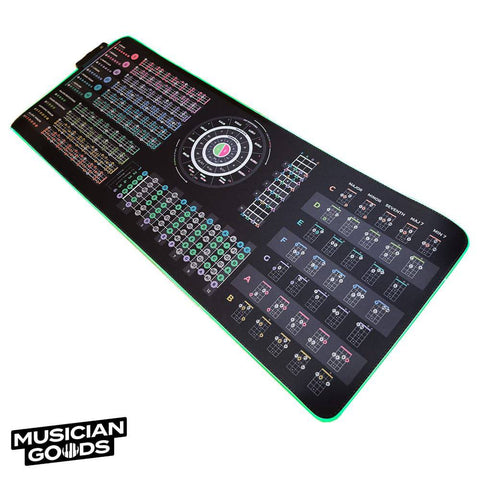
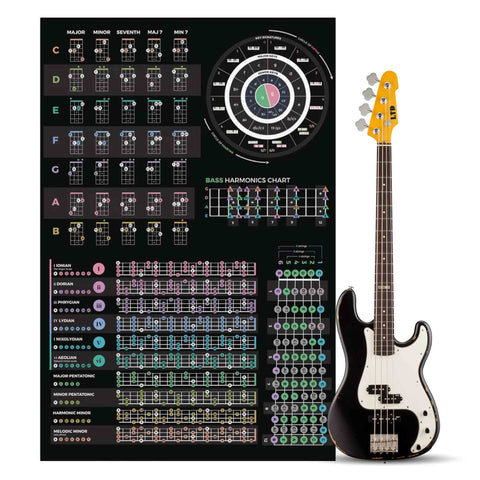
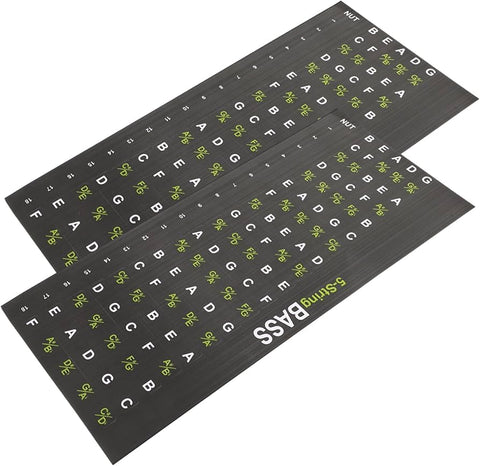
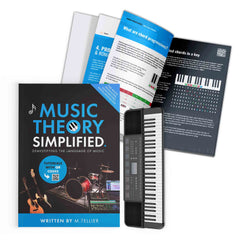
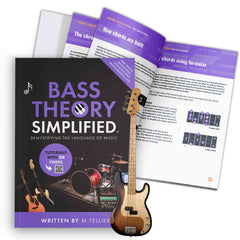
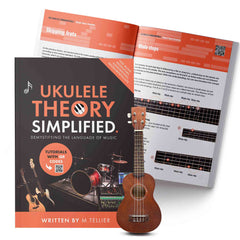
 Tabella degli accordi per chitarra (file PDF)
 Teoria della chitarra semplificata (Brossura/PDF)
 Tappetino per mouse con schema riassuntivo di teoria della chitarra basso
 Teoria del basso semplificata (Copertina flessibile/PDF)
 Teoria Musicale Semplificata - (Brossura/PDF)
 Tappetino per mouse con schema di teoria musicale
 Teoria dell'Ukulele Semplificata (Brossura/PDF)
 Tappetino per Mouse con Foglio di Riferimento della Teoria dell'Ukulele
 Mousepad Cheat Sheet della teoria della chitarra
 Foglio di riferimento rapido per missaggio e mastering Mousepad


