 4.8/5 on Trustpilot
The 12-note pattern, note names, whole & half steps — taught on the piano keyboard first because that's where music theory is easiest to see. Skip this chapter if you already play piano. Most bassists don't — and this single chapter unlocks everything else in the book.
Bass Theory Simplified · Demystifying the language of music
Finally understand the bass neck.
Stop memorizing shapes.
Most bassists memorize shapes. Very few understand why they work.
This is the visual system that turns the bass neck from random into obvious — so you can write songs, improvise intentionally, play by ear, and finally understand what you're playing. No sheet music. No piano. No prior theory required.
Unlock the Fretboard
Instant PDF · Start tonight
🇨🇿
Tracked shipping to Czechia · Delivery times
183
Pages
Preview · 60 sec
Inside the book
Fast worldwide shipping
US, EU, UK, AU, CA · usually 3–7 days
Tracked delivery
Real-time tracking on every order
Insured & secure
Lost or damaged? We replace it free
Instant PDF delivery
Read tonight · no waiting
The uncomfortable truth
Most bassists memorize shapes.
Very few understand music.
You can play. You know your open chords. Maybe a pentatonic scale. But you can't explain why any of it works — and that's the wall that stops most bassists from ever becoming musical.
What you have now
Memorized shapes.
You can play songs. You remember chord grips. You know a few scale boxes. But if someone asks you to play in a different key, you freeze — because you don't know why the shapes work.
- Can't transpose to a new key
- Can't write your own progressions
- Can't follow what other musicians say
What you get
The language behind them.
Once you see why a chord is built the way it is, the shapes stop being random. They become a vocabulary you can speak fluently — in any key, anywhere on the bass neck, in any musical situation.
- Move freely between any key
- Write progressions intentionally
- Speak the language of music
Read this before you blame yourself
Music theory wasn't hard.
The explanations were.
Most theory books were written by classically-trained pianists for conservatory students. They assumed you read sheet music. They used Italian terms. They asked you to memorize forty modes before you'd written a single song.
That format wasn't built for self-taught bassists who learn by seeing, hearing, and playing. The information wasn't wrong — the delivery was.
"I started in 2008 with a MIDI keyboard and FL Studio, no theory. From 2010 to 2015 I taught music production on YouTube as MellaMayne — but I still couldn't really play the bass. Years later, after my first book (Music Theory Simplified, for piano) found readers, I wrote the bass version I wish I'd had at the start."
— Melvin Tellier · Founder, Musiciangoods · Self-taught since 2008
"Theory clicks when you stop trying to memorize it
and start seeing it on the bass neck."
and start seeing it on the bass neck."
Most theory books teach this.
Drag to reveal a better way.
Drag the slider to see why 100,000+ musicians prefer Bass Theory Simplified.

←Drag the slider→
VISUAL LEARNINGDiagrams, colors & fretboard visuals help you learn faster.
PRACTICAL FOCUSEvery concept connects directly to playing real music.
BUILT FOR BASSISTSWritten by a bassist, for bassists. No piano knowledge required.
LEARN WITH CONFIDENCEFinally understand why music works and express yourself freely.
QR codes included
Stuck on a concept? Just scan and watch.
Every chapter includes QR codes printed right on the page.
No app, no login.
50+ video tutorials across all 9 chapters
Works on any phone — no app needed
Same videos work for PDF and paperback
Flip through the book
See exactly how the book teaches.
Explore real chapters and flip through actual pages from Bass Theory Simplified.

1 / 5
Built for clarity. Designed for results.
Every chapter tells you
exactly where you're going.
No fluff. No wasted time. Each chapter is structured to help you learn faster, stay focused, and actually understand.
01
Skill Level
Know whether a chapter is beginner, intermediate, or advanced before you start.
02
Time Required
Most chapters take 1-3 hours, so you can learn at your own pace.
03
Clear Outcome
Every chapter starts by telling you what you’ll be able to do when finished.
 123456
04
What You’ll Learn
See exactly which concepts and skills the chapter will cover.
05
What You’ll Need
No surprises. Each chapter tells you exactly which tools you’ll use.
06
Skip If You Know This
Already familiar? Jump ahead and focus on what you don’t know.
A Complete Learning System.
Jargon guides. Visual cheat sheets. QR video lessons. Everything you need to finally understand music theory.
JARGON GUIDES8 jargon guides break down complex music terms — one at the end of every chapter.
VISUAL CHEAT SHEETSColor-coded reference pages including the full chord chart, modes map, and circle of fifths.
QR VIDEO LESSONSScan QR codes on key pages to watch step-by-step video explanations.
CHAPTER SUMMARIESKey takeaways at the end of all 8 chapters to review and lock in what you’ve learned.

What's inside the book
142 pages.
8 fundamental concepts. One connected system.
Every chapter builds on the last. Each one includes visual diagrams, a cheat sheet, a jargon guide, and a QR code linking to a video tutorial. Click any chapter to see what's inside.
01 The Piano Fundamentals
02 The Bass's Fundamentals
Piano vs bass — finally translated. How the strings are tuned, why the bass neck is laid out the way it is, and how every concept from Chapter 1 maps onto the bass neck. The bridge between music theory and your instrument.
03 Keys & Scales
What a "key" actually is. The major scale, natural minor, major & minor pentatonic — all visually mapped across the full bass fretboard. Scale positions, scale systems, relative keys, and an intro to the musical modes. This is the chapter most readers say made the bass neck finally make sense.
04 Harmony — Intervals & Chords
The biggest chapter in the book. Music intervals, string intervals, all chord types (major, minor, sus, augmented, diminished, dominant), how chords are built on bass, all chord formulas, and chord inversions. The complete vocabulary of harmony — adapted for the low end.
05 The Modes Map
Diatonic chords explained. Roman numerals. Scale degrees. Chord motions for major and minor keys. The three legendary progressions: I-IV-V, I-V-vi-IV, and IV-I-V-vi — the patterns behind most popular bass lines, finally decoded.
06 Chord Progressions
A practical guide to musical notation, bass tablature, and bass tab techniques (hammer-ons, pull-offs, slides, slaps). The clefs, notes and values — explained the way bassists actually use them, not the way classical books teach them.
07 Music Notation
The musical heartbeat. Music meter. Time signatures — 3/4, 4/4, 2/4 — and how rhythm shapes everything from a funk groove to a metal riff. Why most bassists assume they're "naturally rhythmic" and what they're actually missing.
08 Rhythm & Time
The chapter that ties everything together. Key signatures, relative keys, and our simplified version of the circle of fifths — the single most useful diagram in music theory. By the end of this chapter you're a literate musician.
09 The Circle of Fifths
The moment it clicks
Watch the bass neck go from random to obvious.
Toggle below to see the difference between how most bassists see the bass neck — and how you'll see it after the Harmony chapter.

The fretboard feels random.
You learn a chord shape. Then a different shape. You forget which is which.
132 unrelated notes to memorize one by one.

The fretboard is a pattern.
Every chord is a Root + 3rd + 5th in different positions.
132 notes become one system you apply everywhere.
Real readers · Real reviews
The book that finally made theory click
for thousands of self-taught bassists.

Marcus T.
After 12 years, the bass neck finally makes sense.
I've owned at least seven theory books. Every single one assumed I could already read sheet music or play piano. This one starts where I actually am — looking at a fretboard, wondering why anything works. By Chapter 4 I understood intervals for the first time in my life. The relief is hard to describe.
Jamal C.
Two weeks in and I'm writing my own progressions.
I used to write songs by stacking chords until something sounded okay. Now I actually choose chords on purpose because I understand what they'll do emotionally. The modes chapter alone unlocked five new positions on the bass neck I'd avoided for years.
Kenji T.
I can finally jam without freezing.
Someone calls a key in a jam, I used to panic and noodle around the same five frets. Now I actually know where to play and what notes work. Started picking up songs by ear last month — something I thought I'd never be able to do. This book is the cheat code I wish I'd had a decade ago.
From Shopify · Judge.me verified
Real photos from real readers.
Understood the bass neck in 2 days.
I'm not exaggerating. Chapter 4 broke down what every other book skipped.
10 years playing. Modes finally make sense.
The Keys & Scales chapter showed me modes as colors instead of seven random shapes. Mind blown.
Wrote a full song in one weekend.
The Chord Progressions chapter and the Roman numerals system is pure gold. Bought the mousepad too.
Bridged piano theory and bass in a weekend.
As a producer who only knew theory on piano roll, this book finally got me playing it on bass.
The QR videos made the modes chapter click.
Was stuck on modes for 20 minutes, scanned the code, watched the 2-min video, instant clarity. Best theory book I've bought.
I'm 56 and finally feel like I understand bass.
Wish I had this 30 years ago. The Harmony chapter alone was worth twice the price.
Finally a theory book that doesn't feel like school.
I'd given up on theory three times before this. The 'why' explanations finally clicked. Now I'm writing songs again.
I keep it on my amp every practice session.
Lives on top of my amp. Open it, scan a QR, learn one concept, jam. Repeat. Best $25 I've spent on bass.
Real customers · Real reactions
Hear it from bassists
who've been through it.
Unedited videos from readers about their experience with the book. The good, the honest, and the "I wish I'd found this sooner" moments.
"@leylasmusic shares her honest take"
@leylasmusicView
"@daynabeemusic on why this book works"
@dangallaghermusicView
"@martin.dalesio cracks the bass neck"
@martin.dalesioView
"@maxveresmusic writes his first song"
@maxveresmusicView
"@beccasmelodies finally gets theory"
@beccasmelodiesView
"@sjplaysmusic recommends it"
@sjplaysmusicView
A complete learning system
One transformation.
Four tools.
The book teaches the framework. The companions make it stick.
The Book
The framework
183 pages from "what's a chord?" to "I can write any progression."
664,00 Kč
Add to cart
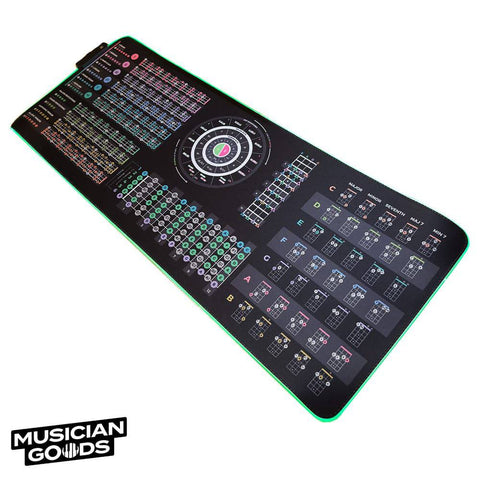
The Mousepad
Daily reinforcement
The cheat sheet sits under your hands every day. Theory becomes muscle memory.
754,00 Kč
Add to cart
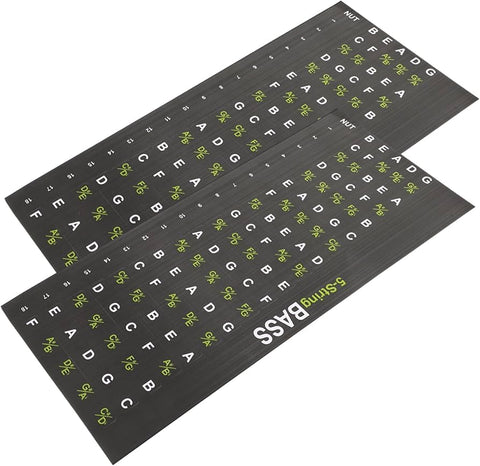
Fretboard Stickers
Visual training
Map the note system onto your neck. Train your eyes while you play.
302,00 Kč
Add to cart
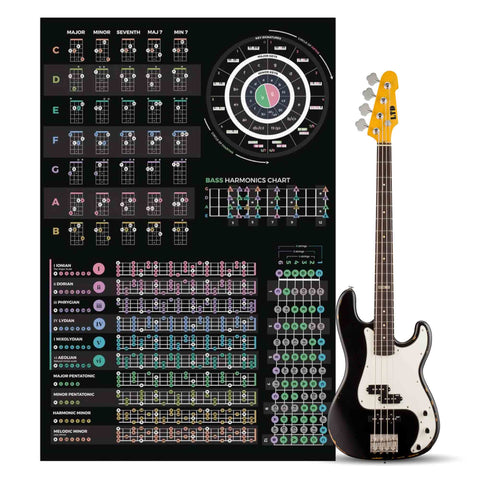
The Wall Poster
Passive learning
Scales, intervals, and the modes map — always in your peripheral vision.
905,00 Kč
Add to cart
Choose your starting point
Pick your edition.
Start understanding tonight.
Bundle savings active — save up to 20% when you add extras below.
Choose language
Instant PDF
Digital
The Book — PDF
664,00 Kč
Instant delivery
- 183-page PDF · all 9 chapters
- QR video tutorials included
- Searchable, any device
- 30-day refund
1
Get the PDF
Physical
The Book — Paperback
1.056,00 Kč
Tracked worldwide shipping
- Full-color paperback (142pp)
- QR video tutorials included
- Worldwide tracked shipping
- 30-day refund
1
Get the Paperback
Most popular
Print + PDF
Best value
Complete Edition
1.207,00 Kč
€56.98
Save €16.99 · Print + Digital
- Full-color paperback (142pp)
- Instant PDF (read tonight)
- QR video tutorials
- Worldwide tracked shipping
- 30-day refund
1
Get Complete
Save more when you buy multiple books
Pre-bundled multi-book sets
Bass + Bass
Save €9.99
From 996,00 Kč
Bass + Ukulele
Save €9.99
From 996,00 Kč
Best value
3-book bundle
Bass + Bass + Piano
From 1.448,00 Kč
All 4 books
Bass + Bass + Piano + Ukulele
From 1.961,00 Kč
Bundles include the same content as individual books.
30-day refund
Worldwide tracked shipping
30-day money-back guarantee.
If the book doesn't help theory finally make sense, email us within 30 days. We'll refund every cent — no questions asked.
Free gifts unlock at €35 & €55
Bundle & save up to 25%
Accessories for your Bass Theory book.
64% of readers added at least one. Bundle & save up to 25% — plus unlock free gifts at €35 and €55.
The transformation
From confusion
to fluency.
This isn't about adding more information. It's about how you experience the bass from this point forward.
Before
- Memorizing chord shapes
- Stuck in two positions on the bass neck
- Noodling without direction
- Confused when musicians talk theory
- Writing progressions that "sort of work"
- Freezing when someone calls a key
After
- Writing songs that actually sound the way you want
- Playing songs by ear instead of hunting for tabs
- Improvising with intention, not luck
- Learning new songs faster by recognizing patterns
- Jamming confidently in any key, anywhere on the bass neck
- Finally understanding what you're playing — and why
Questions
Frequently asked questions
Still wondering something? Contact us and we’ll get back to you fast.
What makes this different from free YouTube tutorials?
YouTube teaches isolated tricks. This teaches a connected system.
I'm a complete beginner. Is this too advanced for me?
No. The book starts with zero assumptions.
I've tried theory before and it always felt overwhelming. Why will this be different?
Because most theory is taught as abstract concepts on paper.
Do I need to read sheet music or know piano?
No. Everything is taught visually on the bass fretboard.
Does it work for acoustic and electric?
Yes. The fretboard layout is identical.
What if it doesn't help me?
30-day full refund.
What's the difference between the PDF and the paperback?
Content is identical. The PDF is instant; the paperback ships.
How long does shipping take?
Most orders ship within 1–2 business days.
How do the QR codes work? Do I need internet?
Open your phone's camera, point at the code, watch.
I play left-handed / 7-string / drop tunings — does it still work?
Yes. Music theory is the same regardless.
How long does it take to finish the book?
No rush. Most readers take 8–15 hours cover-to-cover.
Can I get this if I'm in the EU? VAT & customs?
Yes — we ship worldwide. VAT included at checkout.
Part of the Theory Simplified series
The same method, refined across five instruments.
Built on the same visual, plain-English approach that made Music Theory Simplified (the piano edition) a hit. Each book is independent — pick the one for your instrument.
Stop memorizing shapes. Start understanding music.
A visual system built for self-taught bassists.

 Guitar Chords Chart Mousepad
 Guitar Theory Simplified (Paperback/PDF)
 Bass Guitar Theory Cheat Sheet Mousepad
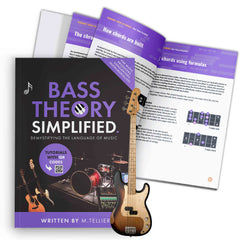
 Bass Theory Simplified (Paperback/PDF)
 Music Theory Simplified - (Paperback/PDF)
 Music Theory Cheat Sheet Mousepad
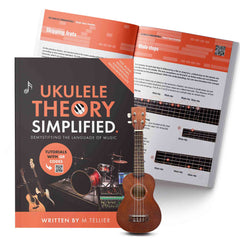
 Ukulele Theory Simplified (Paperback/PDF)
 Ukulele Theory Cheat Sheet Mousepad
 Guitar Theory Cheat Sheet Mousepad
 Mixing Mastering Cheat Sheet Mousepad


